 뒤로
뒤로BIOL-1110 Biology I for Majors: Course Syllabus and Success Guide
스터디 가이드 - 스마트 노트
 자료에 맞춘 맞춤형 노트, 핵심 정의, 예시, 맥락을 확장해 제공합니다.
Course Introduction
BIOL-1110 – Biology I for Majors is an introductory course designed to provide students with foundational knowledge in biology, focusing on cellular and molecular processes. The course emphasizes critical thinking, scientific reasoning, and the application of biological concepts to real-world societal and environmental issues.

Course Structure and Logistics
Instructor and Contact Information
Instructor: Dr. Cerrone Foster
Email: fosterc@etsu.edu
Office: Nicks Hall 359
Student Drop-In Hours: Scheduled via online link
Class Meetings
Location: Bud Frank Theatre, RM 118-Gilbreath Hall A010
Schedule: Tuesdays and Thursdays, 8:35–9:55am and 10:10–11:30am
Course Materials
Required Textbook and Tools
Textbook: "Campbell Biology in Focus, 4th edition" (eText or Print + Mastering Biology access)
Student Response System: TopHat (phone or tablet required; laptops not allowed)
Study Guide: Provided for each chapter on D2L (not submitted, but essential for exam preparation)
Major Course Topics
The course covers the following key topics, aligning with the core chapters of a General Biology curriculum:
The Process of Science and Scientific Reasoning
Evolution and Natural Selection
Cell Structure and Function
Biological Membranes and Transport
Biological Molecules and Enzymes
Energy Transformation in Living Systems
DNA Structure, Replication, and Inheritance
Gene Expression and Regulation
Cell Division and Cancer
Meiosis, Genetic Variation, and Patterns of Inheritance
Biology in Societal and Environmental Contexts
Learning Outcomes
By the end of the course, students should be able to:
Evolution: Explain how the diversity of life evolved through genetic change, diversification, and extinction.
Information Flow: Describe how genetic information regulates growth and behavior, and how phenotype is influenced by genotype and environment.
Energy and Matter: Explain how biological systems grow and change through chemical transformation pathways governed by thermodynamics.
Science and Society: Apply biological knowledge in societal contexts and understand the relationship between science and society.
Scientific Process: Demonstrate evidence-based reasoning through observation, experimentation, and hypothesis testing.
Quantitative Reasoning: Use quantitative analysis and mathematical reasoning in biological contexts.
Course Policies
Attendance
Attendance is required; up to 4 absences allowed before grade penalty.
Excused absences require documentation but still count toward the 4-day limit.
Late Work and Make-Up Policy
Exams and in-class quizzes must be completed as scheduled; no late submissions.
Mastering Biology assignments are open for multiple weeks; two lowest scores are dropped.
Make-up exams are at instructor discretion and require prior communication.
Classroom Expectations
Laptops are not allowed; tablets and smaller devices are permitted for note-taking.
Respectful behavior is required; disruptions may result in removal from class and loss of participation points.
Assessment and Grading
Grade Components
Exams (4): 45%
Midterm Exam: 10%
Final Exam: 10%
Mastering Biology Assignments: 20%
In-Class Quizzes (TopHat): 15%
Grading Scale
Grade | Percentage Range |
|---|---|
A | 92–100% |
A- | 90–91% |
B+ | 88–89% |
B | 82–87% |
B- | 80–81% |
C+ | 78–79% |
C | 72–77% |
C- | 70–71% |
D+ | 68–69% |
D | 60–67% |
F | 0–59% |
Learning Cycle and Study Strategies
The course employs an active learning cycle to maximize student engagement and retention. The cycle includes preparation before class, interactive participation during class, and review and assessment after class.
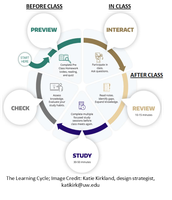
Preview: Complete pre-class work such as study guide questions or reading quizzes.
Interact: Attend class and participate in TopHat questions for credit.
Review: Spend at least 60 minutes after class reviewing notes and filling gaps.
Study: Engage in focused study sessions to reinforce concepts and vocabulary.
Check: Assess learning using Mastering Biology and study area resources.
Academic Integrity and AI Policy
Students must adhere to ETSU’s Academic Integrity policy; plagiarism and cheating are prohibited.
Generative AI tools may be used for study purposes only, specifically those associated with the textbook. AI is not allowed for in-class or exam responses.
Additional Resources and Support
Access to Pearson Biology’s Study Area for videos, practice questions, and learning tools.
Supplemental instructor support available.
University policies and accessibility information provided via syllabus attachment link.
Summary Table: Course Success Essentials
Component | Details |
|---|---|
Textbook | Campbell Biology in Focus, 4th edition + Mastering Biology |
Response System | TopHat (phone/tablet required) |
Study Guide | Provided on D2L for each chapter |
Attendance | Required; up to 4 absences allowed |
Grading | Exams, quizzes, assignments, and participation |
AI Policy | Permitted for study only, not for graded assessments |
Conclusion
This syllabus provides a comprehensive overview of BIOL-1110, outlining expectations, resources, and strategies for success. Students are encouraged to actively engage with the material, utilize available resources, and uphold academic integrity throughout the course.
