 뒤로
뒤로Biological Importance of Water: Properties, Structure, and Function
스터디 가이드 - 스마트 노트
 자료에 맞춘 맞춤형 노트, 핵심 정의, 예시, 맥락을 확장해 제공합니다.
Biological Importance of Water
Subcomponents of Biological Molecules
The sequence and arrangement of subcomponents in biological molecules determine their properties and functions. Water, as a fundamental molecule, plays a critical role in shaping the behavior of biological systems due to its unique chemical structure.
Water's Polarity and Hydrogen Bonding
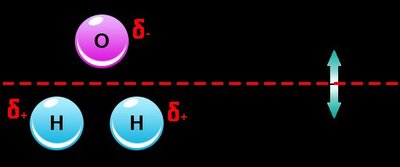
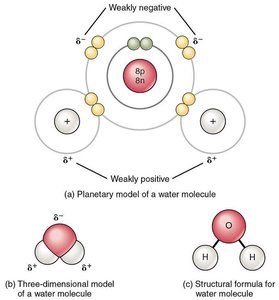
Water is a polar molecule, meaning it has an uneven distribution of charge. This polarity allows water molecules to form hydrogen bonds, which are weak interactions between the partial positive charge of hydrogen and the partial negative charge of oxygen in adjacent molecules. These bonds are essential for many of water's properties.
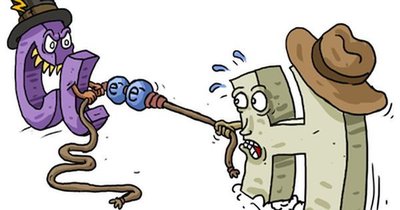
Polarity: Oxygen is more electronegative than hydrogen, resulting in a partial negative charge on oxygen and partial positive charges on hydrogen.
Hydrogen Bonds: Weak individually, but collectively strong and responsible for water's unique characteristics.
Example: Water's polarity enables it to dissolve many substances, making it a universal solvent.
Emergent Properties of Water
Water's polarity and hydrogen bonding give rise to several emergent properties that are vital for life. These include cohesion, adhesion, surface tension, capillary action, high specific heat, evaporative cooling, and density differences between liquid and solid states.
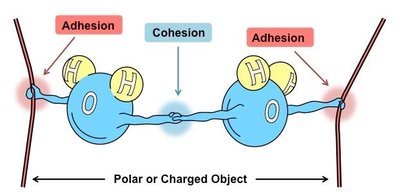
Cohesion: Water molecules stick to each other due to hydrogen bonding.
Adhesion: Water molecules stick to other polar substances.
Surface Tension: The measure of how difficult it is to break the surface of a liquid; water has high surface tension.
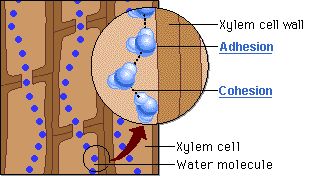
Capillary Action: The movement of water up narrow tubes against gravity, important in plant transport.
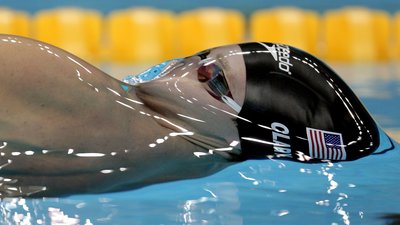
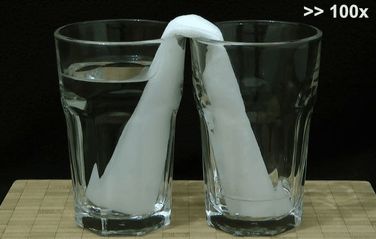
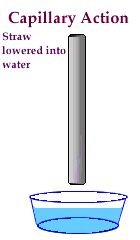
Cohesion, Adhesion, and Surface Tension
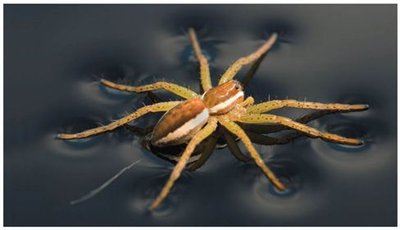
Cohesion and adhesion are responsible for water's ability to move through plant vessels and for phenomena such as surface tension, which allows small organisms to walk on water.
Cohesion: Attraction between water molecules.
Adhesion: Attraction between water and other substances.
Surface Tension: Caused by cohesive forces at the surface; allows objects to rest on water without sinking.
Example: Water striders walking on water.
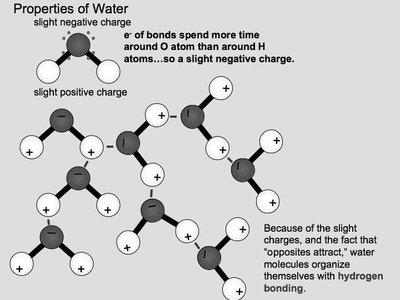
Capillary Action and Transpiration in Plants
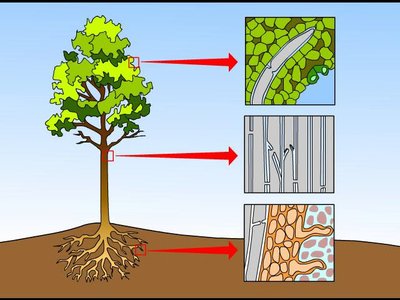
Capillary action, resulting from cohesion and adhesion, enables water to move up plant xylem tubes. Transpiration pull, combined with capillary action, is essential for water transport from roots to leaves.
Transpiration: Evaporation of water from plant leaves creates a pull that moves water upward.
Factors Affecting Transpiration: Temperature, humidity, wind, and light.
Specific Heat and Heat of Vaporization
Water has a high specific heat, meaning it can absorb or release large amounts of heat with minimal temperature change. This property stabilizes temperatures in organisms and environments.
Specific Heat:
Heat of Vaporization: The energy required to convert 1 g of liquid water to gas.
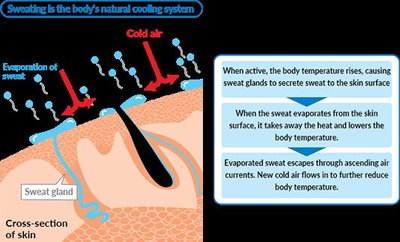
Evaporative Cooling: As water evaporates, it cools the surface, helping regulate temperature.

Density of Water: Liquid vs. Solid
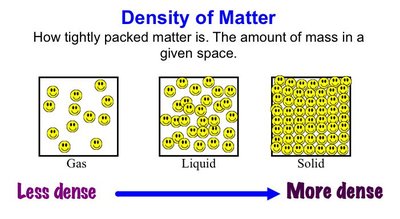
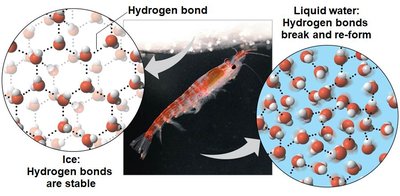
Unlike most substances, water is less dense as a solid (ice) than as a liquid. This is due to the stable hydrogen bonds in ice, which create an open lattice structure.
Greatest Density: Water is most dense at 4°C.
Biological Importance: Ice floats, insulating aquatic life in winter.
Water as a Universal Solvent
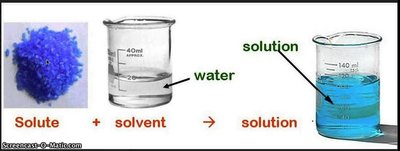
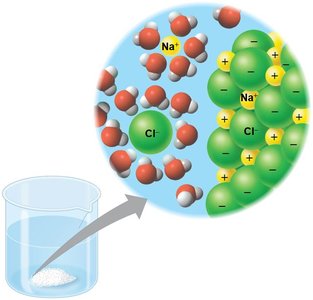
Water's polarity allows it to dissolve a wide range of substances, making it the universal solvent. It forms hydration shells around ions and polar molecules, facilitating chemical reactions in cells.
Hydrophilic: Substances with affinity for water (polar or ionic).
Hydrophobic: Substances without affinity for water (nonpolar).
Example: Salt (NaCl) dissolving in water.
Acids, Bases, and pH
Water can dissociate into ions, affecting the pH of solutions. The pH scale measures the concentration of hydrogen ions, with lower values indicating acidity and higher values indicating basicity.
pH Formula:
Neutral Solution: , pH = 7
Acidic Solution: , pH < 7
Basic Solution: , pH > 7
Buffers and pH Regulation
Buffers are substances that minimize changes in pH by accepting or donating hydrogen ions. In biological systems, carbonic acid and bicarbonate act as a buffer system, maintaining pH homeostasis.
Buffer Reaction:
Importance: Buffers are crucial for maintaining stable internal environments in organisms.
Ocean Acidification
Excess carbon dioxide dissolves in ocean water, forming carbonic acid and lowering pH. This process, known as ocean acidification, reduces carbonate ion availability, affecting marine organisms that rely on carbonate for shell formation.
Normal: Carbonate ions help form shells of marine animals.
Acidification: Increased hydrogen ions convert carbonate to bicarbonate, reducing shell formation.
Summary Table: Properties of Water
Property | Description | Biological Importance |
|---|---|---|
Polarity | Unequal sharing of electrons | Enables hydrogen bonding, solvent abilities |
Hydrogen Bonding | Weak bonds between water molecules | Cohesion, adhesion, high specific heat |
Surface Tension | Difficulty breaking water's surface | Allows small organisms to walk on water |
Capillary Action | Movement in narrow tubes | Water transport in plants |
High Specific Heat | Resists temperature change | Stabilizes organism/environment temperature |
Heat of Vaporization | Energy to convert liquid to gas | Evaporative cooling |
Density | Ice less dense than liquid | Ice floats, insulates aquatic life |
Solvent Ability | Dissolves polar/ionic substances | Facilitates biochemical reactions |
Additional info: Academic context was added to clarify the mechanisms and importance of water's properties in biological systems, including formulas and examples relevant to General Biology.
