 뒤로
뒤로Carbon and the Molecular Diversity of Life
스터디 가이드 - 스마트 노트
 자료에 맞춘 맞춤형 노트, 핵심 정의, 예시, 맥락을 확장해 제공합니다.
Carbon and the Molecular Diversity of Life
Introduction to Carbon Chemistry
Carbon is a fundamental element in biological molecules, forming the backbone of organic compounds. Its unique bonding properties allow for the formation of a wide variety of complex molecules essential for life.
Major elements of life: Carbon (C), Hydrogen (H), Oxygen (O), Nitrogen (N), Sulfur (S), and Phosphorus (P) are consistently found in living organisms.
Valence and bonding: Carbon typically forms four covalent bonds, resulting in a tetrahedral geometry. This versatility enables the construction of large, complex molecules.
Electronegativity: Carbon's electronegativity is similar to many other elements, allowing it to form both polar (0.4–1.7 difference) and nonpolar (<0.4 difference) covalent bonds.
The Urey-Miller Experiment
The Urey-Miller experiment (1953) demonstrated that organic molecules could be synthesized abiotically under conditions thought to resemble those of early Earth, supporting the idea that life's building blocks can form naturally.
Formation of Bonds with Carbon
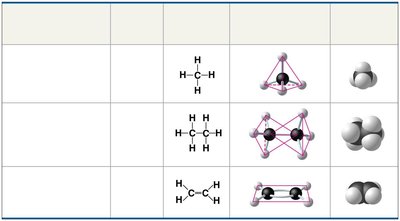
Carbon's ability to form four covalent bonds with various atoms allows for the diversity of organic molecules. In molecules with multiple carbons, each carbon bonded to four other atoms has a tetrahedral shape. Double bonds between carbons result in planar structures.
Tetrahedral geometry: Seen in methane (CH4), ethane (C2H6).
Planar geometry: Seen in ethene (C2H4), where double bonds restrict rotation.
Carbon Bonding with Other Elements
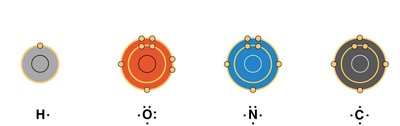
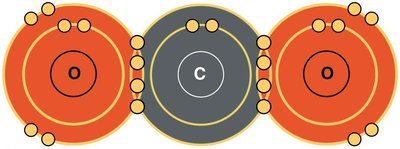
Carbon can bond with elements other than hydrogen, such as oxygen and nitrogen, forming important biological molecules like carbon dioxide (CO2) and urea (CO(NH2)2).
Carbon Skeletons
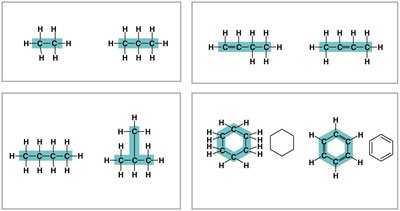
Carbon chains form the skeletons of most organic molecules. These chains vary in length, branching, double bond position, and the presence of rings, contributing to molecular diversity.
Length: Chains can be short or long.
Branching: Chains may be unbranched or branched.
Double bond position: Double bonds can occur at different locations.
Rings: Chains may form closed rings.
Hydrocarbons
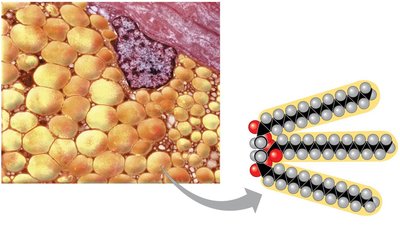
Hydrocarbons are organic molecules consisting entirely of carbon and hydrogen. They are found in many biological molecules, such as fats, and can undergo reactions that release significant energy.
Examples: Fatty acids contain long hydrocarbon tails.
Isomers
Isomers are compounds with the same molecular formula but different structures and properties. The main types include:
Structural isomers: Differ in covalent arrangement of atoms.
Cis-trans (geometric) isomers: Same covalent bonds but different spatial arrangements due to inflexible double bonds.
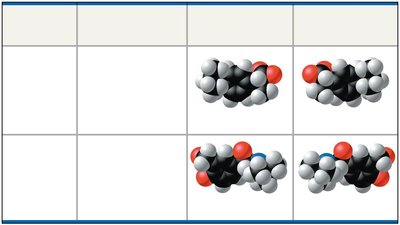
Enantiomers: Mirror images of each other, differing in spatial arrangement around an asymmetric carbon.
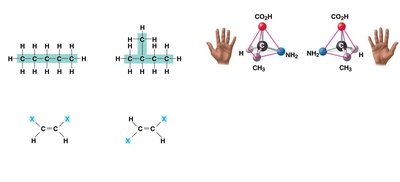
Biological significance: Enantiomers are important in pharmaceuticals, as only one isomer may be biologically active.
Functional Groups
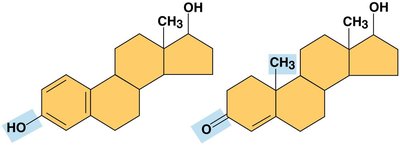
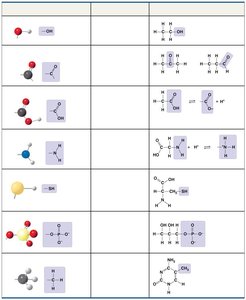
Functional groups are specific groups of atoms attached to carbon skeletons that are commonly involved in chemical reactions. The number and arrangement of these groups give molecules their unique properties.
Estradiol and testosterone: Both are steroids with a common carbon skeleton but differ in functional groups, resulting in different biological activities.
The Seven Most Important Functional Groups in Biology
The following functional groups are most important in the chemistry of life:
Functional Group | Structure | Properties | Example |
|---|---|---|---|
Hydroxyl (—OH) | Alcohol | Polar, forms hydrogen bonds with water | Ethanol |
Carbonyl (C=O) | Ketone (within skeleton), Aldehyde (end of skeleton) | Polar, found in sugars | Acetone, Propanal |
Carboxyl (—COOH) | Carboxylic acid | Acts as an acid (donates H+) | Acetic acid |
Amino (—NH2) | Amine | Acts as a base (accepts H+) | Glycine |
Sulfhydryl (—SH) | Thiol | Forms disulfide bonds | Cysteine |
Phosphate (—OPO32−) | Organic phosphate | Contributes negative charge, energy transfer | Glycerol phosphate |
Methyl (—CH3) | Methylated compound | Affects gene expression | 5-Methylcytosine |
Summary: The versatility of carbon and the diversity of functional groups enable the vast array of organic molecules necessary for life. Understanding these principles is foundational for studying biomolecules and cellular processes.
