뒤로
뒤로Carbon and the Molecular Diversity of Life
스터디 가이드 - 스마트 노트
 자료에 맞춘 맞춤형 노트, 핵심 정의, 예시, 맥락을 확장해 제공합니다.
Carbon: The Backbone of Life
Importance of Carbon in Living Organisms
Carbon is a fundamental element in biology, serving as the backbone for the molecules that make up living organisms. Its unique chemical properties allow it to form a wide variety of complex and diverse molecules essential for life.
Living organisms consist mostly of carbon-based compounds.
Carbon is unparalleled in its ability to form large, complex, and varied molecules.
Proteins, DNA, carbohydrates, and other molecules that distinguish living matter are all composed of carbon compounds.
Organic Chemistry: The Study of Carbon Compounds
Definition and Scope
Organic chemistry is the branch of chemistry that focuses on compounds containing carbon, regardless of their origin. These compounds can range from simple molecules to colossal ones, forming the basis of all living things.
Organic chemistry is the study of compounds that contain carbon.
Organic compounds range from simple molecules to large, complex structures.
The Versatility of Carbon
Major Elements of Life
The major elements of life—carbon (C), hydrogen (H), oxygen (O), nitrogen (N), and phosphorus (P)—are present in similar proportions in all organisms. The diversity of organic molecules is largely due to the versatility of carbon.
The overall percentages of the major elements of life are quite uniform from one organism to another.
Because of carbon's ability to form four bonds, these building blocks can be used to make an inexhaustible variety of organic molecules.
The great diversity of organisms on the planet is due to the versatility of carbon.
Carbon Bonding and Molecular Diversity
Electron Configuration and Bonding
Electron configuration determines the kinds and number of bonds an atom will form with other atoms. Carbon atoms can form diverse molecules by bonding to four other atoms, making them highly versatile in molecular construction.
Electron configuration is the key to an atom's characteristics.
Carbon can form four covalent bonds with a variety of atoms, allowing for complex molecules.
In molecules with multiple carbons, each carbon bonded to four other atoms has a tetrahedral shape.
When two carbon atoms are joined by a double bond, the atoms are in the same plane as the carbons.
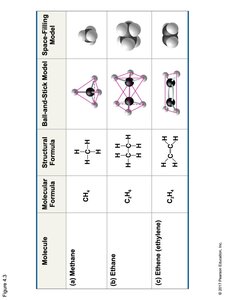
Valence and Covalent Bonding
The number of unpaired electrons in the valence shell of an atom is generally equal to its valence, which determines the number of covalent bonds it can form.
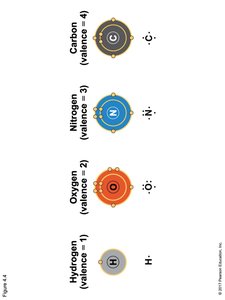
The electron configuration of carbon gives it covalent compatibility with many different elements.
The valences of carbon and its most frequent partners (hydrogen, oxygen, and nitrogen) are the building code for the architecture of living molecules.
Carbon Bonding with Other Elements
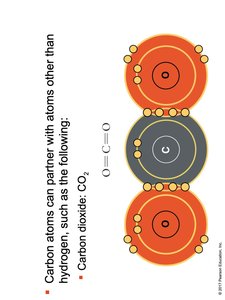
Carbon atoms can partner with atoms other than hydrogen, such as oxygen, to form important molecules like carbon dioxide (CO2).
Molecular Diversity Arising from Variation in Carbon Skeletons
Carbon Skeletons
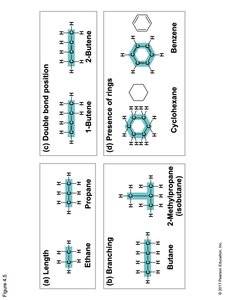
Carbon chains form the skeletons of most organic molecules. These skeletons can vary in length and shape, contributing to the diversity of organic molecules.
Carbon chains vary in length and shape (straight, branched, or arranged in rings).
Hydrocarbons
Definition and Biological Importance
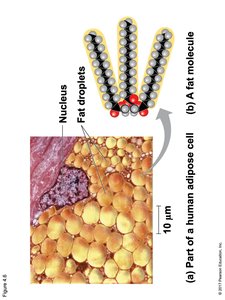
Hydrocarbons are organic molecules consisting only of carbon and hydrogen. Many organic molecules, such as fats, have hydrocarbon components. Hydrocarbons can undergo reactions that release a large amount of energy.
Hydrocarbons are important energy sources in biological systems.
Isomers
Types of Isomers
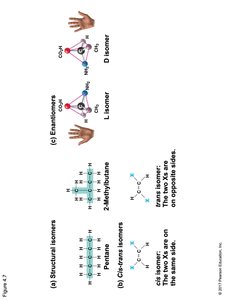
Isomers are compounds with the same molecular formula but different structures and properties. There are three main types:
Structural isomers: Different covalent arrangements of their atoms.
Cis-trans isomers: Same covalent bonds but differ in spatial arrangements.
Enantiomers: Isomers that are mirror images of each other.
Biological Importance of Enantiomers
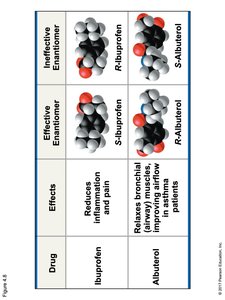
Enantiomers are important in the pharmaceutical industry because two enantiomers of a drug may have different effects. Usually, only one isomer is biologically active, and organisms are sensitive to even subtle variations in molecules.
Functional Groups and Molecular Function
Role of Functional Groups
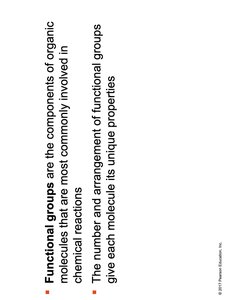
Distinctive properties of organic molecules depend on the carbon skeleton and the chemical groups attached to it. Functional groups are the components of organic molecules that are most commonly involved in chemical reactions.
The number and arrangement of functional groups give each molecule its unique properties.
Chemical Groups Most Important in the Processes of Life
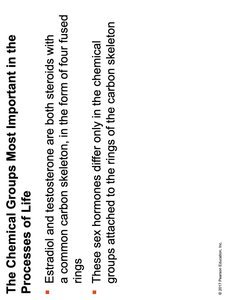
Estradiol and testosterone are both steroids with a common carbon skeleton in the form of four fused rings. These sex hormones differ only in the chemical groups attached to the rings of the carbon skeleton.
The Seven Most Important Functional Groups
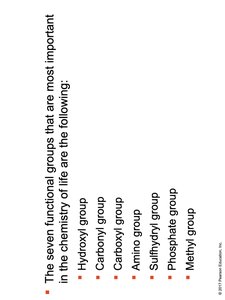
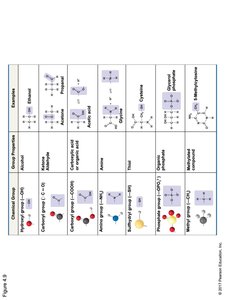
The seven functional groups most important in the chemistry of life are:
Hydroxyl group (–OH)
Carbonyl group (C=O)
Carboxyl group (–COOH)
Amino group (–NH2)
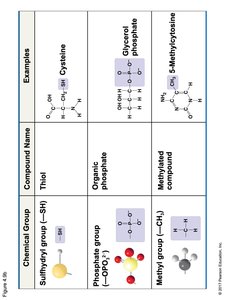
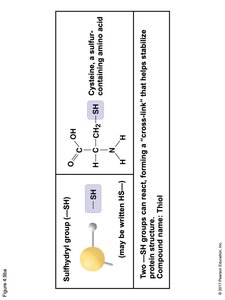
Sulfhydryl group (–SH)
Phosphate group (–OPO32–)
Methyl group (–CH3)
Examples and Properties of Functional Groups
Each functional group imparts specific chemical properties to the molecules they are part of. For example:
Hydroxyl group: Polar, forms hydrogen bonds with water (e.g., ethanol).
Carbonyl group: Found in sugars, can be a ketone or aldehyde (e.g., acetone, propanal).
Carboxyl group: Acts as an acid (e.g., acetic acid).
Amino group: Acts as a base (e.g., glycine).
Sulfhydryl group: Forms "cross-links" that stabilize protein structure (e.g., cysteine).
Phosphate group: Contributes negative charge, releases energy (e.g., glycerol phosphate).
Methyl group: Affects gene expression and molecular shape (e.g., 5-methylcytosine).
ATP: An Important Source of Energy for Cellular Processes
Structure and Function of ATP
Adenosine triphosphate (ATP) is an important organic phosphate that stores the potential to react with water, releasing energy that can be used by the cell.
ATP consists of an organic molecule called adenosine attached to a string of three phosphate groups.
This reaction releases energy that can be used by the cell.