 뒤로
뒤로Cell Communication: Signal Transduction Pathways and Cellular Responses
스터디 가이드 - 스마트 노트
 자료에 맞춘 맞춤형 노트, 핵심 정의, 예시, 맥락을 확장해 제공합니다.
Cell Communication
Overview of Cell Signaling
Cell communication is essential for coordinating cellular activities and responses to environmental changes. Cells detect and respond to signals through a series of well-organized steps, ensuring proper function and survival. The process of cell signaling is highly conserved and fundamental to all living organisms.
Signal Reception: The cell detects an external signaling molecule (ligand) via a specific receptor protein on its surface or inside the cell.
Signal Transduction: The signal is relayed and often amplified through a cascade of intracellular molecules, frequently involving multiple steps and proteins.
Cellular Response: The cell executes a specific response, such as altering gene expression, enzyme activity, or cellular behavior.
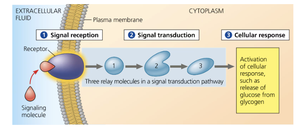
Concept 11.1: External Signals and Cellular Responses
Quorum Sensing and Biofilms in Bacteria
Quorum sensing is a mechanism by which bacteria communicate using chemical signaling molecules to monitor population density. When a threshold concentration is reached, bacteria collectively alter gene expression, often resulting in the formation of biofilms—structured communities attached to surfaces. This process can contribute to disease by coordinating toxin production, allowing bacteria to evade host defenses.
Cell Signaling in Yeast
Yeast cells use chemical signals to identify and mate with cells of the opposite type. The three major steps in this pathway are:
Signal Reception: Detection of a mating factor by a specific receptor.
Signal Transduction: Relay of the signal through intracellular pathways.
Cellular Response: Structural changes leading to cell fusion.
Types of Cell Signaling in Animals
Paracrine Signaling: Local signaling where molecules affect nearby cells.
Synaptic Signaling: Neurotransmitters cross synapses to target cells.
Endocrine (Hormonal) Signaling: Hormones travel through the bloodstream to distant target cells.
Requirements for Signal Reception
Target cells must possess specific receptor proteins that recognize and bind the signaling molecule with high specificity, similar to a lock-and-key mechanism.
Concept 11.2: Signal Reception and Receptors
Ligands and Receptor Types
A ligand is any molecule that specifically binds to another, typically larger, molecule. Cell-surface receptors for water-soluble ligands fall into three main categories:
G protein-coupled receptors (GPCRs)
Receptor tyrosine kinases (RTKs)
Ion channel receptors
G Protein-Coupled Receptors (GPCRs)
GPCRs are a large family of membrane receptors involved in many physiological processes, including vision, smell, taste, and embryonic development. Errors in GPCR signaling can lead to diseases such as cholera and pertussis.
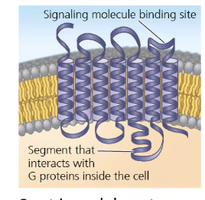
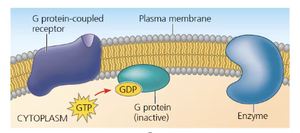
GPCR Signal Transduction Steps
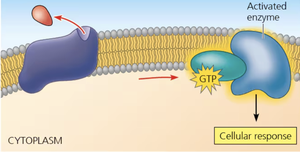
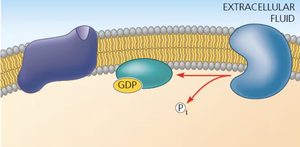
Inactive State: The GPCR is inactive, and the G protein is bound to GDP.
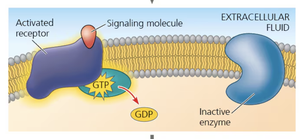
Ligand Binding: The ligand binds to the GPCR, causing a conformational change that activates the G protein by exchanging GDP for GTP.
Activation of Enzyme: The active G protein binds to and activates an enzyme, triggering a cellular response.
Signal Termination: The G protein hydrolyzes GTP to GDP, returning to its inactive state and stopping the signal.
Receptor Tyrosine Kinases (RTKs)
RTKs are membrane receptors that attach phosphates to tyrosines. A single activated RTK dimer can trigger multiple signaling pathways simultaneously, allowing for diverse cellular responses.
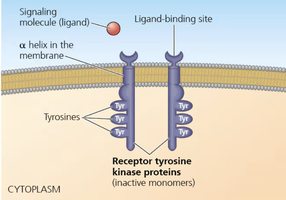
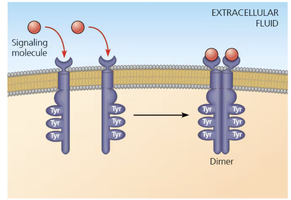
Step 1: Two signaling molecules bind to two separate RTK monomers.
Step 2: The monomers dimerize, activating the kinase domains.
Step 3: Tyrosine residues are phosphorylated using ATP, fully activating the receptor.
Step 4: Multiple relay proteins bind to phosphorylated tyrosines, initiating various transduction pathways.
Ion Channel Receptors
Ion channel receptors open or close in response to ligand binding, allowing specific ions to flow across the membrane. These receptors are especially important in the nervous system for rapid signal transmission.
Intracellular Receptors
Signaling molecules that are hydrophobic or small (e.g., steroid hormones, thyroid hormones, nitric oxide) can cross the plasma membrane and bind to intracellular receptors. The hormone-receptor complex often acts as a transcription factor, regulating gene expression.
Concept 11.3: Signal Transduction Pathways
Phosphorylation Cascades
Signal transduction often involves a cascade of protein kinases, each activating the next by phosphorylation. This allows for signal amplification and precise regulation. Protein phosphatases reverse this process by removing phosphate groups, turning off the signal.
Key Enzymes:
Protein Kinases: Transfer phosphate groups from ATP to proteins.
Protein Phosphatases: Remove phosphate groups from proteins.
Second Messengers
Second messengers are small, non-protein molecules that relay signals inside the cell. Common examples include cyclic AMP (cAMP) and calcium ions (Ca2+).
First Messenger: The extracellular signaling molecule (e.g., hormone).
Second Messenger: Intracellular molecules that propagate the signal (e.g., cAMP).
For example, in the epinephrine pathway, epinephrine (first messenger) activates a GPCR, leading to the production of cAMP (second messenger), which then activates protein kinase A and triggers a cellular response.
Concept 11.4: Cellular Responses and Regulation
Nuclear vs. Cytoplasmic Responses
Nuclear Response: Regulation of gene expression by activating transcription factors, leading to mRNA synthesis and protein production.
Cytoplasmic Response: Activation of enzymes or other proteins, resulting in immediate changes in cell activity (e.g., glycogen breakdown).
Cells can respond differently to the same signal due to variations in receptor types and intracellular relay proteins. Scaffolding proteins enhance signaling efficiency by holding multiple components together.
Signal Termination
Termination of signaling is crucial for proper cellular function. This can occur by ligand dissociation from the receptor or enzymatic degradation of signaling molecules.
Concept 11.5: Integration of Signaling Pathways—Apoptosis
Programmed Cell Death (Apoptosis)
Apoptosis is a controlled process of cell death that removes damaged or unnecessary cells without harming neighboring tissues. It involves DNA fragmentation, organelle breakdown, cell shrinkage, and engulfment by phagocytes.
Normal Functions: Developmental processes, immune system regulation.
Abnormal Functions: Failure of apoptosis can lead to cancer; excessive apoptosis can cause degenerative diseases.
Signals for apoptosis can originate from outside (e.g., death signals from other cells) or inside the cell (e.g., DNA damage, cellular stress).
Summary Table: Types of Cell Surface Receptors
Receptor Type | Ligand Type | Mechanism | Example Response |
|---|---|---|---|
GPCR | Water-soluble | Activates G protein, triggers enzyme or ion channel | Adrenaline response |
RTK | Water-soluble | Dimerization, autophosphorylation, multiple pathways | Cell growth/division |
Ion Channel | Water-soluble | Ligand binding opens/closes channel | Nerve impulse transmission |
