 뒤로
뒤로Chapter 1: Biology – Exploring Life (Campbell Biology: Concepts & Connections, 10th Edition)
스터디 가이드 - 스마트 노트
 자료에 맞춘 맞춤형 노트, 핵심 정의, 예시, 맥락을 확장해 제공합니다.
Biology: Exploring Life
Introduction to Biology
Biology is the scientific study of life, encompassing the structure, function, growth, origin, evolution, and distribution of living organisms. The field seeks to understand the diversity and unity of life, as well as the processes that sustain it.
Biology investigates living systems from molecules to the biosphere.
Key questions include: What is life? How do living things function and interact?
Characteristics of Life
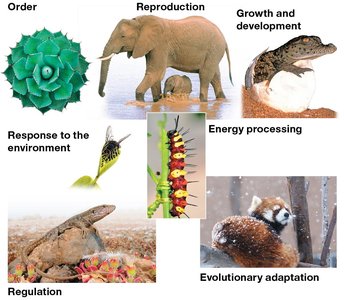
Properties of Life (RAREHOG)
All living things share a set of fundamental characteristics, often summarized by the acronym RAREHOG:
Response to the environment
Adaptation and evolution
Reproduction
Energy processing
Homeostasis (regulation)
Order (cellular organization)
Growth and development
Examples:
Red pandas use camouflage and specialized adaptations for survival.
Corals are living organisms, while crystals are not, despite their ordered structure.
Additional info: Viruses are not considered alive because they cannot reproduce independently or carry out metabolism without a host cell.
Levels of Biological Organization
Hierarchy of Life
Biologists organize life into a hierarchy of structural levels, each with emergent properties:
Molecule → Organelle → Cell → Tissue → Organ → Organ system → Organism → Population → Community → Ecosystem → Biosphere
Emergent properties arise at each level due to the arrangement and interactions of parts.
Classification of Life
The Three Domains
Taxonomists classify life into three domains based on cell structure and genetics:
Bacteria: Prokaryotic, unicellular organisms with simple cells.
Archaea: Prokaryotic, often found in extreme environments.
Eukarya: Eukaryotic organisms, including protists, fungi, plants, and animals.
Example: Humans belong to Domain Eukarya.
The Process of Science
What Is Science?
Science is a systematic way of understanding the natural world through observation and experimentation.
Relies on evidence-based inquiry.
Involves forming hypotheses, making predictions, conducting experiments, and analyzing data.
A scientific theory is a broad explanation supported by extensive evidence.
Scientific laws describe universal phenomena (e.g., gravity).
The Scientific Method
The scientific method is a flexible, iterative process:
Observation
Question
Hypothesis (testable explanation)
Prediction
Experiment or further observation
Data analysis
Conclusion
Variables:
Independent variable: Manipulated by the researcher.
Dependent variable: Measured outcome, depends on the independent variable.
Controlled experiments compare experimental and control groups to isolate the effect of a single variable.
Example: Redi’s Experiment
Francesco Redi tested the hypothesis that maggots do not spontaneously generate on meat by using covered and uncovered containers. Only meat exposed to flies developed maggots, supporting the hypothesis.
Data Types
Quantitative data: Numerical measurements.
Qualitative data: Descriptive observations.
Unifying Themes in Biology
1. Evolution
Evolution is the central theme of biology, explaining both the unity and diversity of life. Charles Darwin’s theory of natural selection describes how species adapt and change over time.
All species share a common ancestry.
Natural selection leads to adaptation and speciation.
2. Information Flow
Life depends on the transmission and use of information, primarily through DNA, which encodes genetic instructions for building and maintaining organisms.
3. Structure and Function
Biological structures are closely related to their functions at all levels of organization. For example, the shape of a protein determines its role in the cell.
4. Energy and Matter
Living systems require energy and matter to grow, develop, and maintain organization. Energy flows through ecosystems, while matter cycles between organisms and the environment.
5. Interactions Within and Between Systems
Emergent properties result from interactions among components of biological systems. Systems biology seeks to understand these complex interactions.
Table: Results from Camouflage Experiment
Habitat | Number of Attacks on Camouflaged Models | Number of Attacks on Noncamouflaged Models | % Attacks on Noncamouflaged Models |
|---|---|---|---|
Beach (light habitat) | 2 | 5 | 71% |
Inland (dark habitat) | 5 | 16 | 76% |
Additional info: This experiment demonstrates the selective advantage of camouflage in reducing predation.
Science, Technology, and Society
Science aims to understand natural phenomena, while technology applies scientific knowledge for practical purposes. Both fields are interdependent and influence society.
Summary Checklist
Seven properties common to all life
Three domains of life
Levels of biological organization
Emergent properties
Difference between hypothesis and theory
Structure of controlled experiments
Role of evolution in biology
Relationship between structure and function
Dynamics of nutrients and energy in ecosystems
Systems biology approach
