 뒤로
뒤로Chapter 1: Biology – Exploring Life (Campbell Biology: Concepts & Connections, 10th Edition)
스터디 가이드 - 스마트 노트
 자료에 맞춘 맞춤형 노트, 핵심 정의, 예시, 맥락을 확장해 제공합니다.
Biology: Exploring Life
Introduction to Biology
Biology is the scientific study of life, encompassing the structure, function, growth, origin, evolution, and distribution of living organisms. The field seeks to understand the diversity and unity of life, as well as the processes that sustain it.
Biology investigates living systems from molecules to the biosphere.
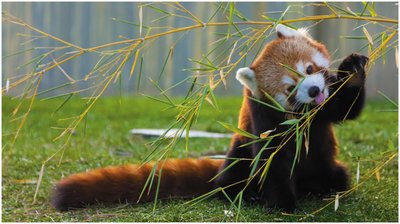
Organisms, such as the red panda (Ailurus fulgens), are adapted to their environments through unique structural and functional traits.
Big Ideas in Biology
Biology is organized around several unifying themes that help explain the complexity of life:
Cellular Basis of Life
Information and Heredity
Matter and Energy
Growth, Development, and Reproduction
Homeostasis
Evolution
Structure and Function
Unity and Diversity of Life
Interdependence in Nature
Science as a Way of Knowing
1.1 Biology is the Scientific Study of Life
Properties of Life
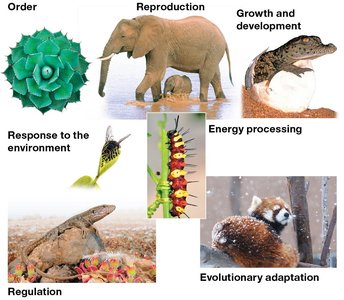
Life is defined by a set of common properties, often summarized by the acronym R.A.R.E.H.O.G.:
Order: Living things exhibit complex but ordered organization.
Reproduction: Organisms reproduce their own kind.
Growth and Development: Inherited information carried by DNA controls the pattern of growth and development.
Energy Processing: Organisms obtain and use energy to power activities.
Regulation (Homeostasis): Organisms regulate their internal environment to maintain stable conditions.
Response to the Environment: Organisms respond to environmental stimuli.
Evolutionary Adaptation: Populations evolve over generations as individuals with traits best suited to their environment have greater reproductive success.
Viruses and Life
Viruses are not considered alive because they lack many properties of life, such as independent reproduction and metabolism.
1.2 The Diversity of Life: Three Domains
Classification of Life
Biologists classify life into three domains based on cellular organization and genetics:
Bacteria: Prokaryotic, unicellular organisms with simple cells.
Archaea: Prokaryotic, often found in extreme environments, genetically distinct from bacteria.
Eukarya: Eukaryotic organisms, including protists, fungi, plants, and animals.
Taxonomists further classify organisms into kingdoms and species within these domains.
1.3 Life’s Hierarchy of Organization
Levels of Biological Organization
Biologists study life at different levels, each with emergent properties:
Biosphere: All environments on Earth that support life.
Ecosystem: All organisms and nonliving components in a particular area.
Community: All organisms in an ecosystem.
Population: All individuals of a species in a specific area.
Organism: An individual living thing.
Organ System: Group of organs working together.
Organ: Structure composed of tissues with specific functions.
Tissue: Group of similar cells performing a function.
Cell: Basic unit of life.
Organelle: Functional components within cells.
Molecule: Cluster of atoms held together by chemical bonds.
Emergent properties arise at each level due to the arrangement and interactions of parts.
The Process of Science
What Is Science?
Science is an evidence-based approach to understanding the natural world. It involves:
Making observations
Formulating hypotheses
Making predictions
Testing hypotheses through experiments or further observations
Analyzing data
A scientific theory is a broad explanation supported by a large body of evidence. Scientific laws describe universal phenomena (e.g., gravity).
Controlled Experiments
Controlled experiments manipulate one variable (independent variable) to observe its effect on another (dependent variable), comparing experimental and control groups.
Independent variable: The factor manipulated by the researcher.
Dependent variable: The factor measured in response to changes in the independent variable.
Example: Francesco Redi’s experiment on spontaneous generation used covered and uncovered meat to test if maggots arose spontaneously.
Data in Science
Quantitative data: Numerical measurements.
Qualitative data: Descriptive observations.
Statistical analysis is often used to interpret scientific data.
Scientific Theories vs. Hypotheses
Hypothesis: A tentative, testable explanation for an observation.
Theory: A well-supported, broad explanation for a range of phenomena.
1.9 Evolution: The Core Theme of Biology
Unity and Diversity of Life
Evolution explains both the unity and diversity of life. It is the process by which modern organisms have descended from ancient ancestors through gradual change.
Charles Darwin proposed the theory of evolution by natural selection.
Each species has a unique evolutionary history, represented as a branch on the tree of life.
Natural Selection
Natural selection is the mechanism by which evolution occurs:
Individuals with traits best suited to their environment are more likely to survive and reproduce.
Over generations, these advantageous traits become more common in the population.
Artificial Selection
Humans influence evolution through selective breeding of plants and animals, a process known as artificial selection.
1.11 Life Depends on the Flow of Information
Information flow is central to life processes:
DNA stores genetic information and directs the synthesis of proteins.
Cells receive and respond to information from their internal and external environments, regulating processes and gene expression.
1.12 Structure and Function Are Related
At all levels of biology, structure and function are closely related. For example:
The shape of hemoglobin enables it to transport oxygen efficiently.
The long extensions of nerve cells facilitate the transmission of nerve impulses.
1.13 Life Depends on the Transfer and Transformation of Energy and Matter
Energy flows through ecosystems, while matter cycles within them:
Sunlight is converted to chemical energy by producers (e.g., plants).
Energy is transferred to consumers and eventually lost as heat.
Matter cycles from the environment through living organisms and back.
1.14 Life Depends on Interactions Within and Between Systems
Biological systems are composed of interacting parts. Systems biology seeks to understand these interactions and emergent properties by modeling complex biological systems.
Table: Results from Camouflage Experiment
This table summarizes the results of an experiment testing the effect of camouflage on predation rates in different habitats.
Habitat | Number of Attacks on Camouflaged Models | Number of Attacks on Noncamouflaged Models | % Attacks on Noncamouflaged Models |
|---|---|---|---|
Beach (light habitat) | 2 | 5 | 71% |
Inland (dark habitat) | 5 | 16 | 76% |
Data from S. N. Vignieri et al., The selective advantage of crypsis in mice, Evolution 64: 2153–8 (2010).
Summary of Key Concepts
Seven properties common to all life (RAREHOG)
Three domains of life: Bacteria, Archaea, Eukarya
Levels of biological organization and emergent properties
Difference between hypothesis and scientific theory
Structure of controlled experiments and the scientific method
Role of evolution in biology
Relationship between structure and function
Energy flow and matter cycling in ecosystems
Systems biology and the importance of interactions
