 뒤로
뒤로Chapter 1: Biology – Exploring Life (Campbell Biology: Concepts & Connections, 10th Edition)
스터디 가이드 - 스마트 노트
 자료에 맞춘 맞춤형 노트, 핵심 정의, 예시, 맥락을 확장해 제공합니다.
Introduction to Biology
What is Biology?
Biology is the scientific study of life. It encompasses the investigation of living organisms, their structure, function, growth, origin, evolution, and distribution. Biologists seek to understand the diversity and complexity of life, from molecules to the biosphere.
Biology is derived from the Greek words bios (life) and logos (study).
It is an evidence-based science, relying on observation, experimentation, and analysis.

Characteristics of Life
Properties of Life (RAREHOG)
All living things share a set of fundamental characteristics, often summarized by the acronym RAREHOG:
Response to the environment
Adaptation & Evolution
Reproduction
Energy processing
Homeostasis (regulation)
Order (organization into cells)
Growth & development
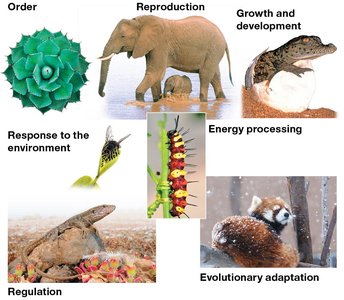
These properties distinguish living organisms from nonliving matter. For example, a crystal has order but does not reproduce or evolve.
Why Are Viruses Not Considered Alive?
Viruses lack cellular structure and cannot reproduce independently; they require a host cell to replicate.
They do not carry out metabolism or maintain homeostasis on their own.
Levels of Biological Organization
Hierarchy of Life
Biologists organize life into a hierarchy of structural levels, each with emergent properties:
Biosphere: All environments on Earth that support life
Ecosystem: All living and nonliving components in a particular area
Community: All organisms in an ecosystem
Population: Individuals of one species in a specific area
Organism: An individual living thing
Organ system: Group of organs working together
Organ: Structure composed of tissues
Tissue: Group of similar cells
Cell: Basic unit of life
Organelle: Functional components within cells
Molecule: Chemical structure consisting of atoms
Emergent properties arise at each level due to the arrangement and interactions of parts.
Classification of Life
The Three Domains of Life
Taxonomists classify life into three domains based on cell structure and genetics:
Bacteria: Prokaryotic, unicellular organisms with simple cells
Archaea: Prokaryotic, often found in extreme environments
Eukarya: Eukaryotic organisms, including protists, fungi, plants, and animals
Humans belong to the domain Eukarya.
The Process of Science
What is Science?
Science is a systematic way of understanding the natural world through observation and experimentation. It is characterized by:
Evidence-based inquiry
Formulation and testing of hypotheses
Development of theories and laws
A scientific theory is a broad explanation supported by extensive evidence. A scientific law describes consistent natural phenomena.
The Scientific Method
The scientific method is a flexible, iterative process involving:
Observation
Question
Hypothesis (a testable explanation)
Prediction
Experiment or further observation
Analysis and conclusion
Variables in experiments:
Independent variable: Manipulated by the researcher
Dependent variable: Measured outcome
Control group: Used for comparison
Types of Data
Quantitative data: Numerical measurements
Qualitative data: Descriptive observations
Controlled Experiments
Controlled experiments test the effect of a single variable by comparing an experimental group to a control group. For example, Francesco Redi's experiment refuted spontaneous generation by showing that maggots only appeared on meat when flies could access it.
Habitat | Attacks on Camouflaged Models | Attacks on Noncamouflaged Models | % Attacks on Noncamouflaged Models |
|---|---|---|---|
Beach (light habitat) | 2 | 5 | 71% |
Inland (dark habitat) | 5 | 16 | 76% |
Additional info: This table demonstrates the advantage of camouflage in reducing predation.
Observational Studies
Not all hypotheses can be tested experimentally. Observational data, such as DNA sequence comparisons, can be used to infer evolutionary relationships, as in the case of red pandas.
The Nature of Scientific Inquiry
Science is repetitive, nonlinear, and collaborative. It involves exploration, feedback from the scientific community, and societal impacts. Hypothesis testing is central to scientific progress.
Unifying Themes in Biology
1. Evolution
Evolution is the central theme of biology, explaining both the unity and diversity of life. Charles Darwin's theory of natural selection describes how species adapt and change over time.
Unequal reproductive success leads to adaptation.
Artificial selection by humans shapes crops and livestock.
2. Information Flow
Life depends on the flow of information, primarily through DNA, which encodes genetic instructions for building and maintaining organisms. Information from the environment also regulates biological processes.
3. Structure and Function
Biological structures are closely related to their functions at all levels, from molecules to organisms. For example, the shape of hemoglobin enables it to transport oxygen, and the structure of nerve cells allows for signal transmission.
4. Energy and Matter
Life requires the transfer and transformation of energy and matter. Energy flows through ecosystems (from sunlight to producers to consumers), while matter cycles between organisms and the environment.
5. Interactions Within and Between Systems
Emergent properties arise from interactions among system components. Systems biology models these interactions to understand complex biological functions.
Biology, Technology, and Society
Science aims to understand natural phenomena, while technology applies scientific knowledge for practical purposes. Both fields are interdependent, and advances in one often drive progress in the other.
Summary Table: Seven Properties of Life (RAREHOG)
Property | Description | Example |
|---|---|---|
Order | Highly ordered structure | Plant leaf arrangement |
Reproduction | Ability to produce offspring | Elephants giving birth |
Growth & Development | Increase in size and complexity | Embryo to adult lizard |
Energy Processing | Use of energy to power activities | Caterpillar eating leaves |
Regulation (Homeostasis) | Maintaining internal balance | Lizard basking to regulate temperature |
Response to Environment | Reacting to stimuli | Bee moving toward flower |
Evolutionary Adaptation | Traits that enhance survival | Red panda's camouflage |
Key Terms and Concepts
Emergent properties: New characteristics that arise at each level of organization
Hypothesis: A testable explanation for an observation
Theory: A broad, well-supported explanation
Control group: Group not exposed to the experimental variable
Artificial selection: Human-driven breeding for desired traits
Natural selection: Differential survival and reproduction due to environmental pressures
