 뒤로
뒤로Chapter 1: Biology – Exploring Life (Mini-Textbook Study Notes)
스터디 가이드 - 스마트 노트
 자료에 맞춘 맞춤형 노트, 핵심 정의, 예시, 맥락을 확장해 제공합니다.
Biology: Exploring Life
Introduction to Biology
Biology is the scientific study of life, encompassing the structure, function, growth, origin, evolution, and distribution of living organisms. Biologists seek to understand the diversity of life and the unifying themes that connect all living things.
Biology: The Scientific Study of Life
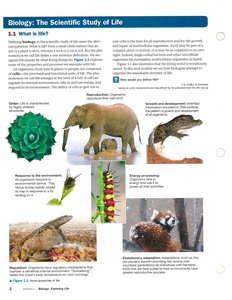
1.1 What is Life?
Life is characterized by a set of properties and processes that distinguish living organisms from nonliving matter. These properties include:
Order: Living things exhibit complex but ordered organization.
Reproduction: Organisms reproduce their own kind.
Growth and Development: Inherited information carried by genes controls the pattern of growth and development.
Energy Processing: Organisms obtain and use energy to power activities and chemical reactions.
Response to the Environment: Living things respond to environmental stimuli.
Regulation: Organisms regulate their internal environment to maintain a stable, constant condition (homeostasis).
Evolutionary Adaptation: Populations evolve over generations as individuals with traits best suited to their environment have greater reproductive success.
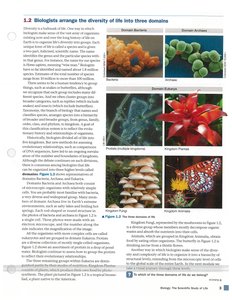
1.2 The Diversity of Life: Three Domains
Biologists classify life into three domains based on cellular organization and genetics:
Bacteria: Prokaryotic, unicellular organisms with simple cell structure.
Archaea: Prokaryotic, unicellular organisms often found in extreme environments; genetically distinct from bacteria.
Eukarya: Organisms with eukaryotic cells, including protists, fungi, plants, and animals.
Each domain is further divided into kingdoms and other taxonomic groups.
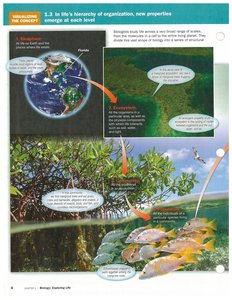
1.3 Life’s Hierarchy of Organization
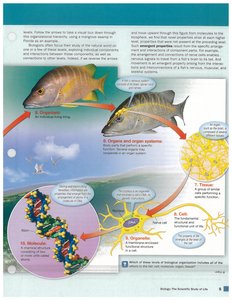
Biological organization is structured in a hierarchy, with each level building on the previous one. The main levels are:
Biosphere
Ecosystem
Community
Population
Organism
Organ System
Organ
Tissue
Cell
Organelle
Molecule
Emergent properties arise at each new level of organization, resulting from the arrangement and interactions of parts as complexity increases.
The Process of Science
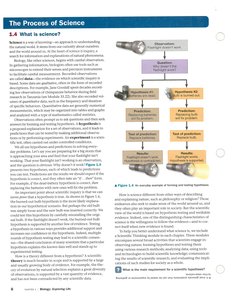
1.4 What is Science?
Science is a systematic approach to understanding the natural world through observation, hypothesis formation, experimentation, and analysis. The scientific method involves:
Making observations
Formulating hypotheses
Designing and conducting experiments
Analyzing data
Drawing conclusions
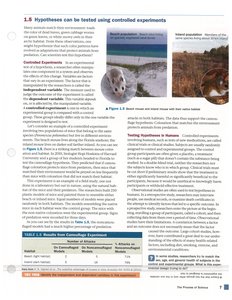
1.5 Hypotheses and Controlled Experiments
A hypothesis is a testable explanation for an observation. Controlled experiments are designed to test hypotheses by changing one variable while keeping others constant. This allows scientists to determine cause-and-effect relationships.
Group | Variable | Result |
|---|---|---|
Experimental | Independent variable manipulated | Effect observed |
Control | No manipulation | Baseline for comparison |
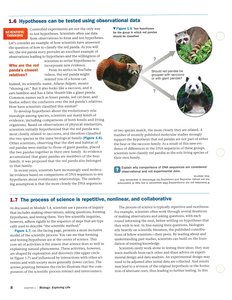
1.6 Observational Data
Not all hypotheses can be tested with controlled experiments. Observational studies collect data in natural settings to test predictions and draw conclusions.
1.7 The Nature of Science
Science is repetitive, nonlinear, and collaborative. Scientists build on previous work, revise hypotheses, and share findings with the scientific community for validation and further exploration.
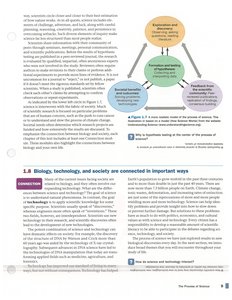
1.8 Biology, Technology, and Society
Biology and technology are interconnected. Advances in biological knowledge drive technological innovation, which in turn enables new discoveries in biology. Societal issues such as health, environment, and ethics are influenced by biological research.
Five Unifying Themes in Biology
1.9 Evolution: The Core Theme of Biology
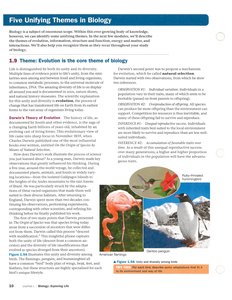
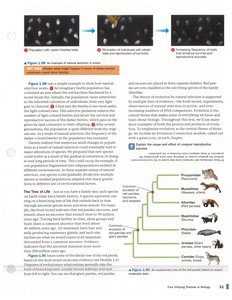
Evolution explains both the unity and diversity of life. Charles Darwin’s theory of natural selection describes how populations change over time as individuals with advantageous traits survive and reproduce. This process leads to adaptation and speciation.
Natural Selection: The differential survival and reproduction of individuals due to differences in phenotype.
Adaptation: Inherited traits that enhance survival and reproductive success in a particular environment.
1.10 Evolution in Everyday Life
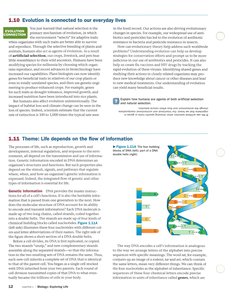
Evolutionary principles are applied in medicine, agriculture, and conservation. For example, understanding antibiotic resistance in bacteria or the development of new crop varieties relies on evolutionary concepts.
1.11 Life Depends on the Flow of Information
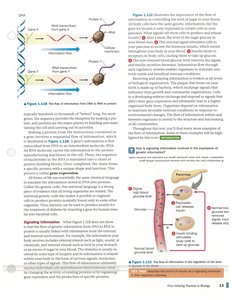
Genetic information is stored in DNA and transmitted from one generation to the next. The flow of information from DNA to RNA to protein is known as the central dogma of molecular biology.
Gene Expression: The process by which information from a gene is used to synthesize a functional gene product (usually a protein).
Signaling Pathways: Cells communicate through chemical signals that regulate gene expression and cellular activities.
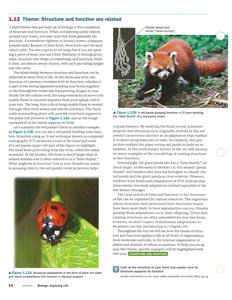
1.12 Structure and Function are Related
Biological structures are closely related to their functions. The shape and composition of molecules, cells, and organs enable them to perform specific tasks essential for life.
Example: The structure of a bird’s wing enables flight; the structure of enzymes allows them to catalyze biochemical reactions.
1.13 Life Depends on the Transfer and Transformation of Energy and Matter
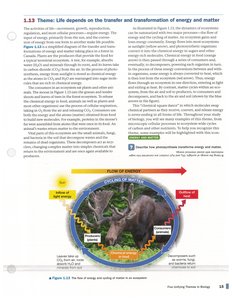
All living organisms require energy to grow, reproduce, and maintain homeostasis. Energy flows through ecosystems, primarily entering as sunlight and exiting as heat, while matter cycles between organisms and the environment.
Producers: Organisms that convert solar energy into chemical energy (e.g., plants).
Consumers: Organisms that obtain energy by eating other organisms.
Decomposers: Organisms that break down dead matter, recycling nutrients.
1.14 Life Depends on Interactions Within and Between Systems
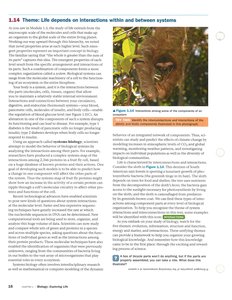
Biological systems are complex networks of interacting components. Interactions within and between systems at all levels of organization are essential for the functioning of life.
Example: The interaction between plants and pollinators, or between organs in the human body.
Chapter Review and Knowledge Testing
Reviewing the Concepts
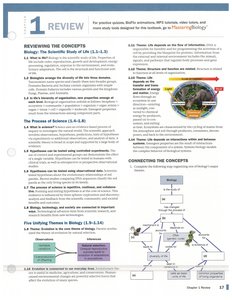
Summarizes the main points of the chapter, including the properties of life, the hierarchy of organization, the process of science, and the five unifying themes of biology.
Testing Your Knowledge
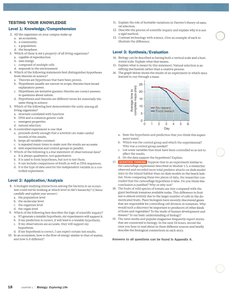
Includes questions for self-assessment, ranging from basic knowledge to application and synthesis of concepts.
Additional info: These notes are based on the introductory chapter of a college-level General Biology textbook and cover foundational concepts essential for further study in biology.
