 뒤로
뒤로Chapter 1: Biology – The Study of Life (General Biology Study Notes)
스터디 가이드 - 스마트 노트
 자료에 맞춘 맞춤형 노트, 핵심 정의, 예시, 맥락을 확장해 제공합니다.
Biology: The Study of Life
Introduction to Biology
Biology is the scientific study of life and living organisms. It encompasses a wide range of topics, from the molecular mechanisms within cells to the interactions of organisms with their environment. Understanding what it means to be alive is foundational to all biological sciences.
1.1 What Does It Mean to Say That Something is Alive?
Five Fundamental Characteristics of Life
Cells: All living organisms are composed of one or more membrane-bound cells, which are the basic units of life.
Replication: All organisms have the capacity to reproduce, ensuring the continuation of their species.
Information: Organisms process hereditary information encoded in genes and respond to information from their environment.
Energy: All organisms acquire and utilize energy to maintain life processes.
Evolution: Populations of organisms evolve over time, adapting to their environments.
Theories in Biology
Definition and Importance of Theories
Theory: An explanation for a broad class of phenomena or observations, supported by a substantial body of evidence. In science, a theory is not a mere guess but a well-substantiated explanation.
Three Foundational Theories in Biology
Cell Theory: Addresses the composition and origin of organisms.
Theory of Evolution by Natural Selection: Explains the relationships and changes among organisms.
Chromosome Theory of Inheritance: Describes how hereditary information is transmitted across generations.
1.2 Life is Cellular and Replicates through Cell Division
Discovery of Cells
The invention of the microscope enabled the discovery of cells. Robert Hooke (1665) observed small compartments in cork tissue, which he called "cells." Anton van Leeuwenhoek later observed single-celled organisms, which he termed "animalcules." These discoveries led to the formulation of the cell theory.
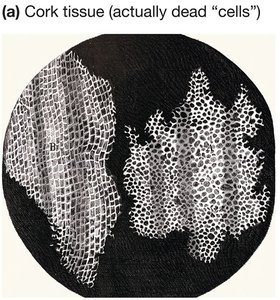
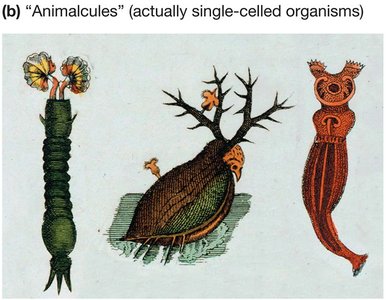
Cell Theory: All organisms are made up of cells, and all cells arise from preexisting cells.
Cells: Highly organized compartments separated from their environment by a membrane.
Scientific Terminology
Hypothesis: A testable statement that explains an observation.
Experiment: A procedure to test the effect of a single, well-defined factor.
Prediction: A measurable or observable result expected if the hypothesis is correct.
Cell Theory vs. Spontaneous Generation
All-cells-from-cells Hypothesis: Cells are produced only by the division of pre-existing cells.
Spontaneous Generation Hypothesis: The belief that organisms could arise spontaneously under certain conditions.
Louis Pasteur’s Experiment
Pasteur tested whether cells arise spontaneously or from other cells. Using swan-necked flasks, he demonstrated that cells arise only from pre-existing cells, refuting spontaneous generation.

Cell Division and Common Lineage
All cells in a multicellular organism descend from a common ancestor cell.
Life likely arose from non-life through chemical evolution early in Earth's history.
1.3 Life Processes Information and Requires Energy
Chromosome Theory of Inheritance
Genes, the units of heredity, are located on chromosomes.
Chromosomes are composed of deoxyribonucleic acid (DNA), which encodes genetic information.
Genes are segments of DNA that code for cell products.
Structure of DNA
DNA is a double helix composed of four types of nucleotides: Adenine (A), Thymine (T), Cytosine (C), and Guanine (G).
Base pairing: A pairs with T, and C pairs with G. This allows DNA to be accurately copied.

The Central Dogma of Molecular Biology
Describes the flow of genetic information: DNA → RNA → Protein.
Messenger RNA (mRNA) is transcribed from DNA and then translated into proteins, which determine an organism’s traits.

Genetic Variation and Evolution
DNA is copied with high fidelity, but mutations (changes in DNA sequence) can occur.
Mutations can alter proteins and lead to heritable variation, which is the basis for evolution and diversity of life.
Energy and Nutritional Needs
Cells require energy for chemical reactions, primarily in the form of adenosine triphosphate (ATP).
Organisms also need molecules to build DNA, RNA, proteins, and other cellular components.
How organisms acquire energy is central to the diversity of life (e.g., photosynthesis in plants, consumption of food in animals).

1.4 Life Evolves
Evolution and Natural Selection
Evolution: The change in characteristics of a population over time; species are related and can change through time.
Population: A group of individuals of the same species living in the same area at the same time.
Darwin and Wallace’s Contributions
Species are related by common ancestry.
Species can change from generation to generation (“descent with modification”).

Mechanism of Natural Selection
Individuals in a population vary in heritable traits.
Certain traits increase reproductive success in a given environment.
Over time, advantageous traits become more common in the population.
Natural selection acts on individuals, but evolutionary change occurs in populations.
Speciation: When populations diverge to form new species.
Fitness and Adaptation
Fitness: The ability of an individual to produce surviving offspring.
Adaptation: A trait that increases an individual’s fitness in a particular environment.
Example: Natural Selection in Finches
Finches with small, pointed beaks had higher fitness when small, soft seeds were abundant.
This adaptation led to an increase in the frequency of small, pointed beaks in the population.
1.5 The Tree of Life Depicts Evolutionary History
Phylogeny and the Tree of Life
The tree of life is a family tree that depicts evolutionary relationships among species, with a single ancestral species at its base.
Phylogeny: The actual genealogical relationships among all organisms.
Genetic data (DNA/RNA sequences) are used to infer phylogenetic relationships.
Analyzing Genetic Variation
Comparing DNA sequences among species reveals evolutionary relationships; fewer differences indicate closer relationships.
Example: Green algae are more closely related to land plants than to brown algae based on DNA sequence similarity.
Major Domains of Life
Three domains: Bacteria, Archaea, and Eukarya.
Eukaryotes have a nucleus; prokaryotes (Bacteria and Archaea) lack a nucleus.
Taxonomy and Classification
Taxonomy: The science of naming and classifying organisms.
Taxon: A named group of organisms.
Domain: The highest taxonomic level, consisting of Bacteria, Archaea, and Eukarya.
Phylum: A major lineage within a domain.
Linnaeus’ System: Each organism is given a unique two-part scientific name (genus and species), e.g., Homo sapiens.
Genus names are capitalized and italicized; species names are italicized but not capitalized.
1.6 Doing Biology
The Nature of Science
Science involves asking testable questions and collecting data to answer them.
Hypotheses are formulated and tested through observation and experimentation.
Hypothesis Testing
State the hypothesis as precisely as possible and list its predictions.
Design an observational or experimental study to test those predictions.
Case Study: Why Do Giraffes Have Long Necks?
Food Competition Hypothesis: Long necks evolved to reach food high in trees. Predictions: neck length is variable and heritable; giraffes feed high in trees.
Research showed giraffes do not usually feed high in trees, refuting this hypothesis.
Sexual Competition Hypothesis: Long necks evolved because longer-necked males win more fights and father more offspring. Data support this hypothesis.
Experimental Design: How Do Ants Navigate?
Experiments allow testing of specific factors. Wittlinger et al. tested how desert ants find their way back to the nest.
Pedometer Hypothesis: Ants track the number of steps and stride length to measure distance.
Null Hypothesis: If the pedometer hypothesis is incorrect, stride length and step number should not affect navigation.
Ants with shortened legs stopped short, typical ants returned to the nest, and ants with lengthened legs overshot the nest, supporting the pedometer hypothesis.
Characteristics of Good Experimental Design
Include a control group to account for other factors.
Keep experimental conditions constant.
Repeat tests and use large sample sizes for reliability.
