 뒤로
뒤로Chapter 1: Biology – The Study of Life (Mini-Textbook Study Notes)
스터디 가이드 - 스마트 노트
 자료에 맞춘 맞춤형 노트, 핵심 정의, 예시, 맥락을 확장해 제공합니다.
Biology: The Study of Life
What is Biology?
Biology is the scientific study of living organisms and their interactions with the environment. All living organisms share five fundamental characteristics: cells, replication, information, energy, and evolution. These characteristics form the basis for understanding what it means to be alive.
Cells: The basic unit of life; all organisms are composed of cells.
Replication: Living organisms reproduce, passing on genetic information.
Information: Organisms process hereditary information encoded in genes.
Energy: Life requires energy for cellular processes and growth.
Evolution: Populations of organisms change over time through evolutionary processes.
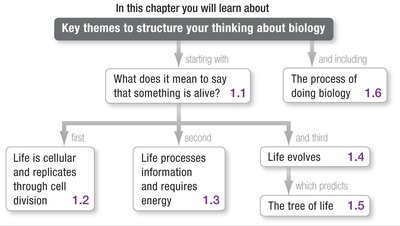
Three Theories Form the Framework of Modern Biology
Modern biology is structured around three foundational theories:
The Cell Theory: All organisms are made of cells, and all cells come from preexisting cells.
The Theory of Evolution by Natural Selection: Explains how populations change over time and how new species arise.
The Chromosome Theory of Inheritance: Describes how hereditary information is transmitted from one generation to the next via chromosomes.
Life is Cellular and Replicates Through Cell Division
The Cell Theory
The cell theory states that all living things are composed of cells, and all cells arise from preexisting cells. Cells are highly organized compartments separated from their environment by a membrane barrier.
Cell Structure: Cells contain genetic material and perform essential functions for life.
Cell Division: Cells replicate by dividing, ensuring continuity of life.
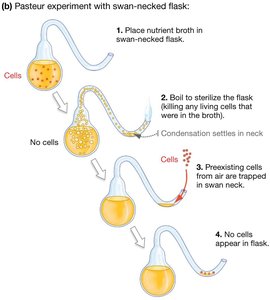
Pasteur’s Experiment: Demonstrated that cells do not arise by spontaneous generation, but from other cells.
Microscopy and Cell Size
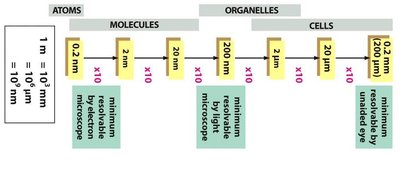
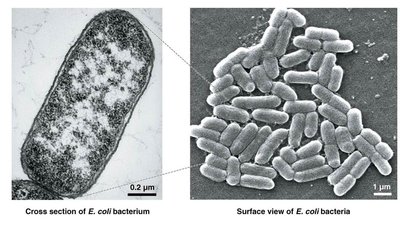
Cells and their components vary greatly in size, from atoms and molecules to organelles and whole cells. Microscopy is essential for visualizing these structures.
Light Microscopy: Resolves structures as small as 200 nm; often uses stains or fluorescent markers.
Electron Microscopy: Resolves structures down to 0.2 nm; includes scanning (SEM) and transmission (TEM) types.
Measurement Units: 1 m = 100 cm = 1,000 mm = 1,000,000 μm = 1,000,000,000 nm.
Life Processes Information and Requires Energy
The Central Dogma of Molecular Biology
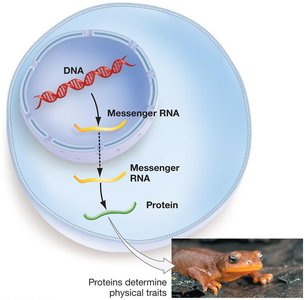
Genetic information is stored in DNA, which is transcribed into RNA and then translated into proteins. This flow of information is known as the Central Dogma.
Genes: Segments of DNA that contain hereditary information.
Transcription: DNA is transcribed into messenger RNA (mRNA).
Translation: mRNA is translated into proteins, which determine physical traits.
Equation:
Energy and Nutritional Needs
All organisms require energy to drive chemical reactions and to build cellular components. Energy is acquired in the form of ATP and through the intake of molecules used as building blocks.
ATP: Adenosine triphosphate is the primary energy carrier in cells.
Building Blocks: Molecules such as amino acids, nucleotides, and sugars are used to construct DNA, RNA, proteins, and other cellular structures.
Life Evolves: The Theory of Evolution by Natural Selection
Evolution and Natural Selection
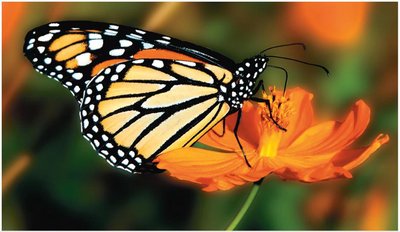
Evolution is the change in the characteristics of a population over time. The theory of natural selection, proposed by Charles Darwin and Alfred Russel Wallace, explains how evolution occurs.
Population Level: Evolution describes changes in populations, not individuals.
Natural Selection: Individuals with advantageous traits are more likely to survive and reproduce, passing those traits to the next generation.
The Tree of Life and Phylogenetic Relationships
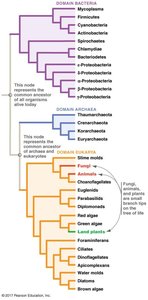
The cell theory and the theory of natural selection together support the concept that all species are related by common ancestry. The Tree of Life is a phylogenetic tree showing relationships among species based on genetic sequence data.
Three Domains: Bacteria, Archaea, and Eukarya.
Prokaryotes: Domains Bacteria and Archaea; unicellular, lack nucleus and membrane-bound organelles.
Eukaryotes: Domain Eukarya; may be multicellular, have nucleus and membrane-bound organelles.
Differences Between Prokaryotes and Eukaryotes
Prokaryotes and eukaryotes differ in cellular structure and complexity.
Prokaryotes: Structurally homogenous, always unicellular, lack nucleus and organelles.
Eukaryotes: Structurally diverse, often multicellular, possess nucleus and organelles.
Viruses: Not Living Organisms
Viruses are not considered living organisms because they are not made of cells and cannot carry out life processes independently. They require a host cell to reproduce and to synthesize proteins.
No Cellular Structure: Viruses lack cell membranes and organelles.
Dependence on Host: Viruses rely on host cells for energy and molecular building blocks.
Doing Biology: The Nature of Science
The Scientific Method and Hypothesis Testing
Biologists use the scientific method to answer questions about the natural world. This involves making observations, forming hypotheses, designing experiments, and testing predictions.
Hypothesis: A testable statement explaining an observation.
Experiment: A controlled study to test the effect of a variable.
Prediction: A measurable or observable result expected if the hypothesis is valid.
Control: A standard for comparison in experimental design.
Hypothesis testing is a two-step process:
State the hypothesis and list its predictions.
Design an observational or experimental study to test those predictions.
Summary Table: Prokaryotes vs. Eukaryotes
Feature | Prokaryotes | Eukaryotes |
|---|---|---|
Cellularity | Unicellular | Unicellular or multicellular |
Nucleus | Absent | Present |
Membrane-bound organelles | Absent | Present |
Domains | Bacteria, Archaea | Eukarya |
Summary Table: Fundamental Characteristics of Life
Characteristic | Description |
|---|---|
Cells | All living things are composed of cells |
Replication | Ability to reproduce and pass on genetic information |
Information | Processing hereditary information (DNA/RNA) |
Energy | Acquisition and use of energy for cellular processes |
Evolution | Change in populations over time |
Additional info: Academic context was added to clarify the scientific method, cell theory, and the Central Dogma, as well as to provide definitions and comparisons for prokaryotes, eukaryotes, and viruses.
