 뒤로
뒤로Chapter 1: Biology—The Study of Life (Mini-Textbook Study Notes)
스터디 가이드 - 스마트 노트
 자료에 맞춘 맞춤형 노트, 핵심 정의, 예시, 맥락을 확장해 제공합니다.
Biology: The Study of Life
1.1 What Does It Mean to Say That Something is Alive?
Biologists define life by a set of five fundamental characteristics shared by all living organisms. Understanding these characteristics helps distinguish living things from non-living matter.
Cells: All organisms are composed of one or more membrane-bound cells, which are the basic units of life.
Replication: All living things are capable of reproduction, ensuring the continuation of their species.
Information: Organisms process hereditary information encoded in genes and respond to information from their environment.
Energy: All organisms acquire and use energy to maintain their internal order and support life processes.
Evolution: Populations of organisms evolve over time, adapting to their environments through changes in heritable traits.
Theories in Biology
A theory in science is a well-supported explanation for a broad range of phenomena, distinct from the everyday use of the word as a mere guess. Three foundational theories underpin modern biology:
Cell Theory: All organisms are made of cells, and all cells come from preexisting cells.
Theory of Evolution by Natural Selection: Explains how organisms are related and how they change over time.
Chromosome Theory of Inheritance: Describes how hereditary information is transmitted from one generation to the next.
Life is Cellular and Replicates through Cell Division
Discovery of Cells
The development of microscopes in the 17th century allowed scientists like Robert Hooke and Anton van Leeuwenhoek to observe cells for the first time. Their discoveries led to the formulation of the cell theory.
Robert Hooke: Observed small compartments in cork, which he called "cells." (30x magnification)
Anton van Leeuwenhoek: Observed single-celled organisms, or "animalcules," using a more powerful microscope (300x magnification).
Cells are highly organized compartments separated from their environment by a membrane. The cell theory states:
All organisms are made up of cells.
All cells come from preexisting cells.
Scientific Terminology
Hypothesis: A testable statement explaining an observation.
Experiment: A procedure to test the effect of a single factor.
Prediction: A measurable or observable result expected if the hypothesis is correct.
Cell Theory vs. Spontaneous Generation
The cell theory challenged the idea of spontaneous generation, which held that life could arise from non-living matter. Louis Pasteur's experiments demonstrated that cells arise only from preexisting cells, not spontaneously.
Cell Division and Common Lineage
Cell division is essential for life. All cells in a multicellular organism descend from a common ancestor, supporting the idea of a shared lineage. Evidence suggests that life originated from non-life through chemical evolution.
Life Processes Information and Requires Energy
Chromosome Theory of Inheritance
Hereditary information is encoded in genes, which are located on chromosomes. In the 1950s, it was established that chromosomes are made of DNA (deoxyribonucleic acid), and genes are segments of DNA that code for cell products.
Structure of DNA
DNA is a double helix composed of four types of nucleotides: A (adenine), T (thymine), C (cytosine), and G (guanine). The sequence of these bases encodes genetic information.
A pairs with T
C pairs with G
This pairing allows DNA to be accurately copied during cell division.
The Central Dogma of Molecular Biology
The central dogma describes the flow of genetic information in cells:
DNA is transcribed into RNA.
RNA is translated into proteins.
Proteins perform most cellular functions, including structural roles and catalyzing chemical reactions.
Genetic Variation and Evolution
DNA is copied with high fidelity, but occasional mutations can lead to changes in proteins and, consequently, in an organism's traits. These heritable variations are the basis for the diversity of life.
Energy and Nutritional Needs
All organisms require energy to drive chemical reactions and building blocks to synthesize DNA, RNA, proteins, and other molecules. Organisms acquire energy in diverse ways, such as photosynthesis in plants and bacteria or by consuming other organisms.
Life Evolves
Evolution and Natural Selection
Evolution is the change in the characteristics of a population over time. Charles Darwin and Alfred Russel Wallace proposed that species are related by common ancestry and that traits can change from generation to generation (descent with modification).
Population: A group of individuals of the same species living in the same area at the same time.
Natural selection explains how evolution occurs. Two conditions are required:
Individuals vary in heritable traits.
Certain traits increase reproductive success in a given environment.
Natural selection acts on individuals, but evolutionary change occurs in populations. Speciation can occur when populations diverge genetically.
Fitness and Adaptation
Fitness: The ability of an individual to produce surviving offspring.
Adaptation: A trait that increases an individual's fitness in a particular environment.
Example: On the Galápagos Islands, finches with small, pointed beaks had higher fitness when small, soft seeds were abundant. This adaptation increased their survival and reproduction.
The Tree of Life Depicts Evolutionary History
Phylogeny and the Tree of Life
The tree of life is a family tree that depicts the evolutionary relationships among species. Phylogeny refers to the actual genealogical relationships among all organisms.
Genetic variation is analyzed by comparing DNA or RNA sequences. Fewer differences indicate a closer relationship.
Example: DNA sequence comparisons show that green algae are more closely related to land plants than to brown algae.
Major Groups of Life
The tree of life reveals three major domains:
Bacteria (prokaryotes, lack a nucleus)
Archaea (prokaryotes, lack a nucleus)
Eukarya (eukaryotes, have a nucleus)
Taxonomy and Classification
Taxonomy is the science of naming and classifying organisms. The highest taxonomic level is the domain, followed by phylum, genus, and species. Scientific names are always italicized, with the genus capitalized and the species lowercase (e.g., Homo sapiens).
Doing Biology: The Scientific Method
The Nature of Science
Science is based on asking testable questions and collecting data. The process involves formulating hypotheses and testing them through observation or experimentation.
Hypothesis Testing
Hypothesis testing involves two main steps:
State the hypothesis and list its predictions.
Design an observational or experimental study to test those predictions.
Case Study: Why Do Giraffes Have Long Necks?
The food competition hypothesis suggested that long necks evolved to help giraffes reach food high in trees. However, data showed that giraffes do not usually feed at the highest levels, challenging this hypothesis.
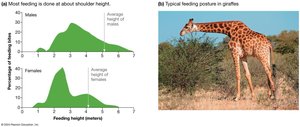
The sexual competition hypothesis proposes that longer-necked males win more fights and father more offspring. Data support this alternative explanation.
Experimental Design: How Do Ants Navigate?
Experiments allow researchers to test the effect of a single variable. Wittlinger and colleagues tested how desert ants find their way back to their nest by manipulating their leg length to change stride length.
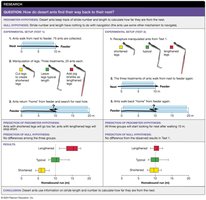
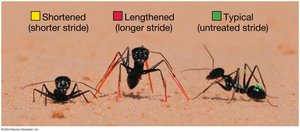
Results showed that ants with shortened legs stopped short of the nest, typical ants returned accurately, and ants with lengthened legs overshot the nest. This supports the pedometer hypothesis: ants use stride length and number to estimate distance.
Characteristics of Good Experimental Design
Include a control group (e.g., typical ants).
Keep experimental conditions constant.
Repeat tests and use large sample sizes for reliability.
