 뒤로
뒤로Chapter 1: Evolution, the Themes of Biology, and Scientific Inquiry – Study Notes
스터디 가이드 - 스마트 노트
 자료에 맞춘 맞춤형 노트, 핵심 정의, 예시, 맥락을 확장해 제공합니다.
Introduction to Biology
The Scope and Themes of Biology
Biology is the scientific study of life, encompassing a vast range of topics from molecular processes to global ecosystems. The discipline is unified by several key themes that help organize our understanding of living systems.
Organization: Life is structured in hierarchical levels, from molecules to the biosphere.
Information: Genetic information is stored and transmitted within and between generations.
Energy and Matter: Life depends on the transfer and transformation of energy and matter.
Interactions: Living systems interact internally and with their environment.
Evolution: Evolution explains both the unity and diversity of life.
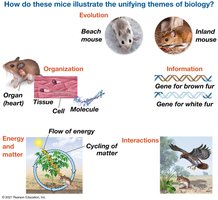
Additional info: These themes are foundational for all subsequent chapters in General Biology.
Properties of Life
Seven Properties of Living Organisms
Living things exhibit distinct properties that distinguish them from nonliving matter.
Order: Highly ordered structure is a hallmark of life.
Evolutionary Adaptation: Organisms adapt to their environment over generations.
Regulation: Homeostasis maintains internal conditions.
Reproduction: Living things reproduce, passing genetic information to offspring.
Energy Processing: Organisms obtain and use energy for growth and maintenance.
Growth and Development: Organisms grow and develop according to inherited instructions.
Response to the Environment: Living things respond to environmental stimuli.
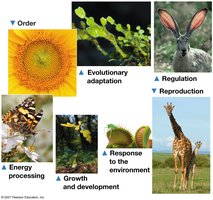
Biological Organization
Levels of Biological Organization
Life can be studied at multiple levels, from the smallest molecules to the entire biosphere. Each level exhibits emergent properties not found in the preceding level.
Biosphere: All life on Earth and its environments.
Ecosystems: Communities and their physical environment.
Communities: All organisms in a particular area.
Populations: Individuals of the same species in an area.
Organisms: Individual living entities.
Organs and Organ Systems: Body parts with specific functions.
Tissues: Groups of cells with a common function.
Cells: Basic unit of life.
Organelles: Functional components within cells.
Molecules: Chemical structures consisting of two or more atoms.
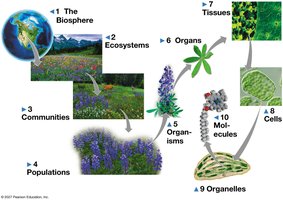
Additional info: Emergent properties arise at each new level of complexity.
The Cell: Basic Unit of Structure and Function
Cell Theory and Types of Cells
The cell is the fundamental unit of life. All living organisms are composed of cells, which are classified as prokaryotic or eukaryotic.
Prokaryotic Cells: Simpler, smaller, lack a nucleus and membrane-bound organelles. Found in Bacteria and Archaea.
Eukaryotic Cells: Larger, more complex, contain a nucleus and membrane-bound organelles. Found in plants, animals, fungi, and protists.
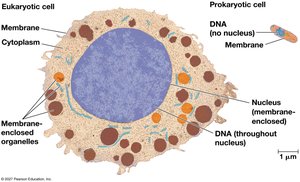
Genetic Information and Gene Expression
DNA: The Genetic Material
Within cells, chromosomes contain DNA, the molecule that stores genetic information. DNA directs the development and functioning of organisms.
Genes: Units of inheritance, encode instructions for building proteins.
DNA Structure: Double helix composed of nucleotides (A, T, C, G).
Gene Expression: DNA is transcribed into RNA, which is translated into protein.
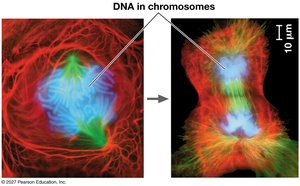
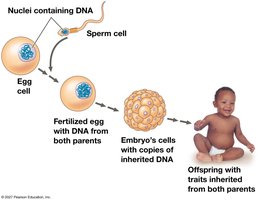
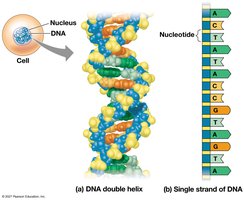
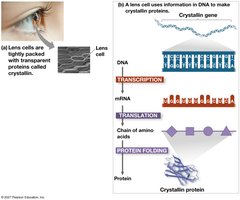
Additional info: The central dogma of molecular biology is summarized as:
Genomics and Proteomics
Large-Scale Analysis of DNA and Proteins
Genomics is the study of entire sets of genes, while proteomics focuses on the complete set of proteins expressed by a cell, tissue, or organism.
Genome: The complete genetic material of an organism.
Proteome: The entire set of proteins produced by an organism.
Bioinformatics: Computational tools for analyzing large biological datasets.
Additional info: High-throughput technologies have revolutionized biological research.
Energy and Matter in Biological Systems
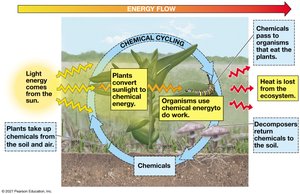
Energy Flow and Chemical Cycling
Life depends on the input of energy, primarily from the sun, and the cycling of matter within ecosystems. Energy flows through ecosystems, while chemicals are recycled.
Producers: Organisms (e.g., plants) that convert sunlight to chemical energy.
Consumers: Organisms that feed on other organisms.
Decomposers: Organisms that recycle nutrients back to the environment.
Interactions and Regulation
Feedback Mechanisms
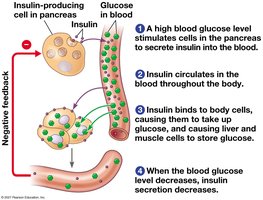
Biological systems regulate themselves through feedback mechanisms. Negative feedback opposes changes, while positive feedback amplifies them.
Negative Feedback: The response reduces the initial stimulus (e.g., regulation of blood glucose).
Positive Feedback: The response enhances the initial stimulus.
Interactions in Ecosystems
Organismal and Environmental Interactions
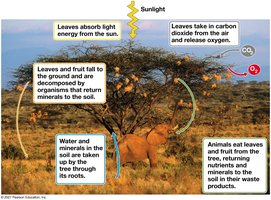
Organisms interact with each other and with their physical environment. These interactions can be beneficial, neutral, or harmful, and are essential for ecosystem function.
Biotic Interactions: Relationships among living organisms.
Abiotic Interactions: Relationships with nonliving environmental factors.
Evolution: The Core Theme of Biology
Unity and Diversity of Life
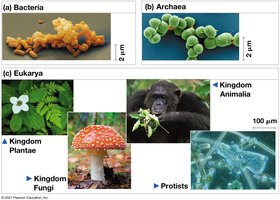
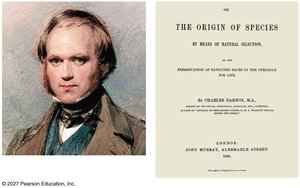
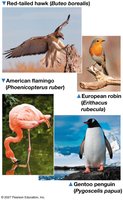
Evolution explains both the similarities and differences among living organisms. All life shares a common ancestry, but adaptation leads to diversity.
Descent with Modification: Species evolve from common ancestors.
Natural Selection: The mechanism by which advantageous traits become more common in a population.
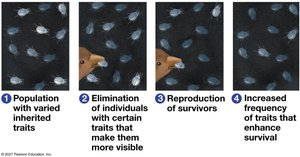
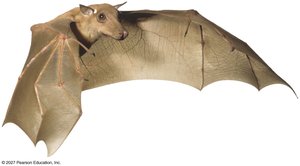
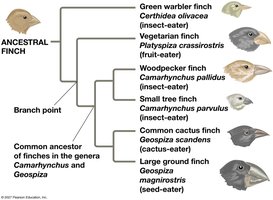
Additional info: The process of natural selection is summarized as:
Scientific Inquiry
The Process of Science
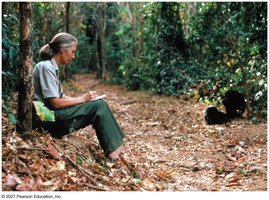
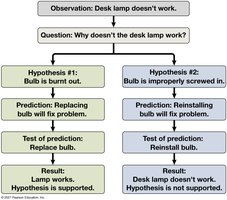
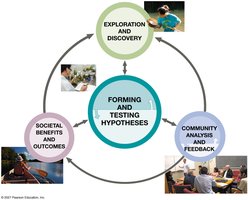
Science is a process of inquiry involving observation, hypothesis formation, experimentation, and analysis. Both inductive and deductive reasoning are used to draw conclusions.
Observation: Gathering information about the natural world.
Hypothesis: A testable explanation for an observation.
Experiment: A controlled test of a hypothesis.
Data: Qualitative or quantitative information collected during experiments.
Inductive Reasoning: Generalizations from specific observations.
Deductive Reasoning: Predictions from general premises.
Case Study: Mouse Coat Coloration
Scientific Inquiry in Action
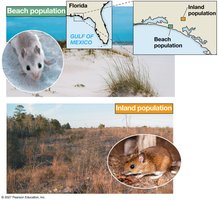
Researchers investigated how coat coloration in beach and inland mice affects predation rates. The experiment tested the hypothesis that camouflage provides a selective advantage.
Hypothesis: Mice matching their habitat are less likely to be preyed upon.
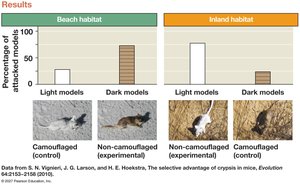
Experiment: Model mice with different coloration placed in different habitats.
Control Group: Camouflaged mice.
Experimental Group: Non-camouflaged mice.
Independent Variable: Coat coloration.
Dependent Variable: Predation rate.
Summary Tables
Key Concepts and Data Interpretation
Tables are used to summarize experimental results and key concepts in biology.
Habitat | Model Type | Predation Rate |
|---|---|---|
Beach | Light (Camouflaged) | Low |
Beach | Dark (Non-camouflaged) | High |
Inland | Dark (Camouflaged) | Low |
Inland | Light (Non-camouflaged) | High |
Additional info: This table summarizes the selective advantage of camouflage in mouse populations.
Cooperation and Diversity in Science
Scientific Collaboration and Peer Review
Science advances through collaboration, communication, and peer review. Diverse viewpoints and teamwork are essential for robust scientific progress.
Peer Review: Evaluation of research by experts before publication.
Model Organisms: Species used for research due to their ease of study.
Additional info: Ethical, societal, and technological considerations are integral to scientific advancement.
