 뒤로
뒤로Chapter 1: Evolution, Themes of Biology, and Scientific Inquiry – Guided Study Notes
스터디 가이드 - 스마트 노트
 자료에 맞춘 맞춤형 노트, 핵심 정의, 예시, 맥락을 확장해 제공합니다.
Q1. Use examples to illustrate each theme of this book.
Background
Topic: Unifying Themes of Biology
This question asks you to connect real-world examples to the major themes that organize biological study, such as order, evolutionary adaptation, regulation, energy processing, growth and development, response to the environment, and reproduction.
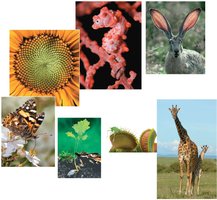
Key Terms:
Order: The complex organization of living things.
Evolutionary adaptation: Traits that enhance survival and reproduction in a particular environment.
Regulation: Mechanisms that maintain an organism's internal environment.
Energy processing: The use of energy to power activities and chemical reactions.
Growth and development: Consistent growth and development controlled by inherited DNA.
Response to the environment: Reacting to environmental stimuli.
Reproduction: The ability to produce new individuals.
Step-by-Step Guidance
Identify each theme (property of life) shown in the image and in your text.
For each theme, think of a specific example from nature or daily life that demonstrates it. For example, for 'order,' consider the structure of a sunflower.
Write a brief description of how your example illustrates the theme. For instance, explain how the sunflower's pattern shows order.
Repeat this process for all seven themes: order, evolutionary adaptation, regulation, energy processing, growth and development, response to the environment, and reproduction.
Check your examples to ensure each one clearly matches the theme it is meant to illustrate.
Try solving on your own before revealing the answer!
Final Answer:
Order: The sunflower's spiral pattern shows the highly ordered structure of living things.
Evolutionary adaptation: The pygmy seahorse's camouflage helps it survive in its environment.
Regulation: The jackrabbit's ears help regulate body temperature by adjusting blood flow.
Energy processing: The butterfly uses nectar for energy to power flight.
Growth and development: The oak seedling grows and develops according to genetic instructions.
Response to the environment: The Venus flytrap closes in response to a grasshopper landing on it.
Reproduction: The adult and juvenile giraffes show that organisms reproduce their own kind.
Each example demonstrates a fundamental property of life, helping you connect abstract themes to real biological phenomena.
Q2. What are emergent properties? Give two examples.
Background
Topic: Biological Organization and Emergent Properties
This question focuses on the concept that new properties arise at each level in the biological hierarchy that are not present at the preceding level.
Key Terms:
Emergent properties: Characteristics that appear as complexity increases, due to the arrangement and interactions of parts as complexity increases.
Step-by-Step Guidance
Define 'emergent properties' in your own words, focusing on how they result from the arrangement and interaction of parts within a system.
Think of an example from biology where a property emerges at a higher level of organization that is not present at the lower level (e.g., a functioning heart vs. heart cells).
Come up with a second example, possibly from a different level of biological organization (e.g., consciousness in the brain vs. individual neurons).
Write a brief explanation for each example, showing how the property emerges from the interaction of simpler components.
Try solving on your own before revealing the answer!
Final Answer:
Example 1: A single heart cell cannot pump blood, but the whole heart (an organ) can pump blood—this is an emergent property.
Example 2: Individual neurons cannot think, but the brain as a whole can produce consciousness and thought.
Emergent properties arise from the arrangement and interactions of parts within a system, and are not present in the individual components alone.
Q6. All organisms, from bacteria to you, produce proteins from DNA instructions. Refer to Figure 1.8b in your text, and then label the gene, DNA, RNA, amino acids and protein on the figure below. Next label the three steps in the process and describe each.
Background
Topic: The Central Dogma of Molecular Biology
This question is about the flow of genetic information from DNA to RNA to protein, a fundamental process in all living organisms.
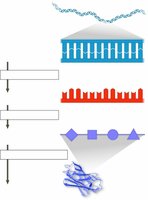
Key Terms and Steps:
Gene: A segment of DNA that codes for a protein.
DNA: The molecule that stores genetic information.
RNA: A molecule transcribed from DNA that carries the code for protein synthesis.
Amino acids: The building blocks of proteins.
Protein: A functional molecule made of one or more polypeptides folded into a specific structure.
Transcription: The process of copying DNA into RNA.
Translation: The process of converting RNA into a chain of amino acids (protein).
Protein folding: The process by which a polypeptide folds into its functional shape.
Step-by-Step Guidance
Identify the gene as a specific segment of DNA in the diagram.
Label the process of transcription, where DNA is used as a template to make RNA.
Label the process of translation, where RNA is used to assemble a chain of amino acids.
Label the process of protein folding, where the amino acid chain folds into a functional protein.
Describe each step briefly: what happens during transcription, translation, and protein folding.
Try solving on your own before revealing the answer!
Final Answer:
Gene: A segment of DNA that contains the instructions for making a protein.
Transcription: DNA is transcribed into messenger RNA (mRNA).
Translation: mRNA is translated into a chain of amino acids.
Protein folding: The amino acid chain folds into a specific three-dimensional protein.
This process is summarized as: DNA (gene) --transcription--> RNA --translation--> amino acids --folding--> protein.
Q14. Study Figure 1.20 from your text (shown in the following), which shows an evolutionary “tree.” What is indicated by each twig? What do the branch points represent? Label the branch point that represents the ancestral point for all species of finch.
Background
Topic: Evolutionary Trees and Phylogeny
This question is about interpreting evolutionary trees (phylogenies), which show relationships among species and their common ancestors.
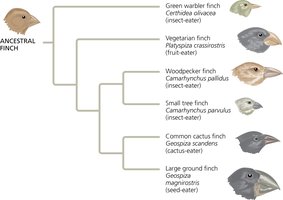
Key Terms:
Evolutionary tree (phylogeny): A diagram that shows evolutionary relationships among species.
Twig: Represents a current species or group.
Branch point (node): Represents a common ancestor shared by the lineages branching from that point.
Step-by-Step Guidance
Look at the tips (twigs) of the tree and identify what each one represents (usually a current species).
Examine the branch points (nodes) and consider what they represent in terms of evolutionary history (common ancestors).
Find the branch point that is the most recent common ancestor for all the finch species shown.
Label this branch point as the ancestral finch in your diagram or notes.
Think about how the tree structure helps you understand evolutionary relationships and descent from common ancestors.
Try solving on your own before revealing the answer!
Final Answer:
Each twig represents a different species of Galapagos finch.
Each branch point represents a common ancestor shared by the species that branch from it.
The branch point at the base of the tree (labeled "Ancestral Finch") is the common ancestor of all the finch species shown.
This evolutionary tree visually demonstrates how all the finch species are related through descent from a common ancestor.
