 뒤로
뒤로Chapter 1: Introduction—Evolution & Foundations of Biology Study Notes
스터디 가이드 - 스마트 노트
 자료에 맞춘 맞춤형 노트, 핵심 정의, 예시, 맥락을 확장해 제공합니다.
Introduction to Biology
Studying Life and Its Diversity
Biology is the natural science dedicated to the study of life and living organisms. Organisms adapt to their environment, and evolution is the process of change that leads to the diversity of life on Earth. Understanding biology involves exploring how life is organized, how information is transmitted, how energy and matter flow, and how organisms interact and evolve.
Unifying Themes for Studying Life
Major Themes in Biology
Organization: Structure dictates function at all levels of biological organization.
Information: Genetic information is stored, transmitted, and expressed in living organisms.
Energy & Matter: Life depends on the origin and flow of energy and the cycling of matter.
Interactions: Organisms interact with each other and their environment.
Evolution: The process that explains the unity and diversity of life.
Theme 1: Biological Organization
Levels of Biological Organization
Life is organized into hierarchical levels, from molecules to the biosphere. Studying simpler components (reductionism) helps us understand complex systems.
Biosphere: All life on Earth and the places where life exists.
Ecosystems: All living and non-living things in a particular area.
Communities: Different populations of organisms in an ecosystem.
Populations: Individuals of a species living in a specified area.
Organisms: Individual living things.
Organs: Body parts with specific functions, made of tissues.
Tissues: Groups of cells working together for a function.
Cells: Fundamental units of life.
Organelles: Functional components within cells.
Molecules: Chemical structures consisting of two or more atoms.
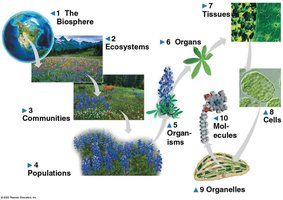
Prokaryotic & Eukaryotic Cells
All cells share basic features, such as a cell membrane. Eukaryotic cells contain membrane-enclosed organelles, including a nucleus. Prokaryotic cells lack a nucleus and organelles and are generally smaller.
Theme 2: Expression & Transmission of Genetic Information
Genetic Material and Gene Expression
Chromosomes contain a cell’s genetic material in the form of DNA. DNA holds hundreds to thousands of genes, which are units of inheritance transmitting information from parents to offspring. As cells grow and divide, DNA directs cell development.
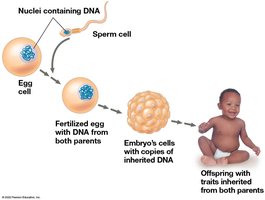
DNA Structure and Function
DNA consists of two long chains in a double helix, made up of four nucleotide building blocks: A, T, C, and G. DNA provides blueprints for making proteins, which are essential for building and maintaining cells.
Gene Expression (Central Dogma)
Gene expression is the process of converting information from a gene to its cellular product. The Central Dogma describes the flow of genetic information: DNA is transcribed to RNA, which is translated to protein.
Transcription: DNA → RNA
Translation: RNA → Protein
The genome is an organism’s entire set of genetic instructions. Genomics is the study of sets of genes within and between species.
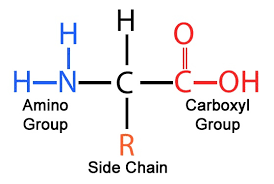
Amino acids are the building blocks of proteins, each containing an amino group, a carboxyl group, and a side chain.
Theme 3: Transformation of Energy & Matter
Energy Flow and Matter Cycling
Life requires the input of energy, mainly from the sun, which is transformed from one form to another. Producers (such as plants) convert sunlight into chemical energy, which is used to do work. Energy flows through ecosystems, entering as light and exiting as heat, while chemical elements are recycled.
Theme 4: Interactions with Other Organisms and Environment
Types of Interactions
Organisms interact with each other and their environment in various ways:
Mutualism: Both species benefit (e.g., fish eat parasites off turtles).
Predation/Parasitism: One benefits, one is harmed (e.g., lion eating zebra).
Competition: Both are harmed (e.g., plants competing for soil resources).
Commensalism: One benefits, one is unaffected (e.g., cattle egrets and buffalo).
Amensalism: One is harmed, one is unaffected (e.g., elephant walking on grass).
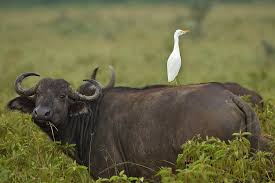
Theme 5: Evolution—Unity & Diversity of Life
Evolution and Classification
Evolution is the process by which species accumulate differences from their ancestors as they adapt to different environments over time. It occurs at the population level, not the individual level.
Classifying the Diversity of Life
Organisms are grouped according to similarities and relationships. The three domains of life are Bacteria, Archaea, and Eukarya. Domain Eukarya includes three multicellular kingdoms: Plantae, Fungi, and Animalia.
Unity in Diversity
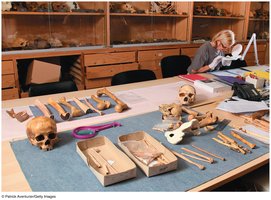
DNA is the universal genetic language common to all organisms. Fossils and other evidence document the evolution of life on Earth over billions of years.
Charles Darwin and Theory of Natural Selection
Darwin’s Contributions
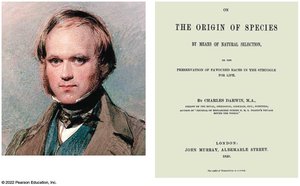
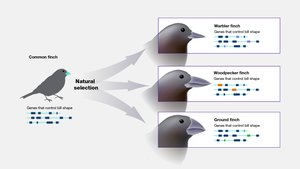
Charles Darwin, biologist and author of "The Origin of Species," proposed that species show evidence of "descent with modification" from common ancestors. Natural selection is the primary cause of descent with modification.
Individuals best suited to their environment are more likely to survive and reproduce.
Over generations, advantageous traits become more common in the population.
Studying Life: Forming & Testing Hypotheses
Scientific Method in Biology
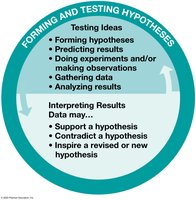
Biologists use careful observations and recorded data to describe natural structures and processes. Data can be qualitative (descriptions) or quantitative (measurements). Inductive reasoning is used to draw conclusions from data.
Hypotheses and Experiments
A hypothesis is an explanation based on observations and assumptions that leads to a testable prediction. Experiments are scientific tests carried out under controlled conditions, with experimental and control groups. The independent variable is manipulated, and the dependent variable is measured.
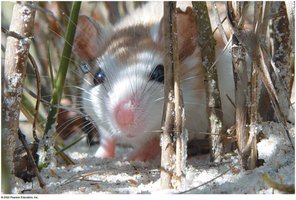
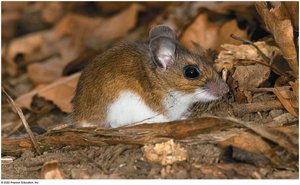
Example: Camouflage and Predation in Mice
Prediction: Mice with coloration that does not match their habitat suffer heavier predation than well-matched mice. Coat color is the independent variable; amount of predation is the dependent variable. Results showed camouflaged models suffered lower predation rates.
Scientific Theories
Theories are broader in scope than hypotheses. They are general enough to lead to new testable hypotheses and are supported by a large body of evidence. Theories may be modified or rejected if new research contradicts them.
