 뒤로
뒤로Chapter 1 Study Guide: Evolution and Foundations of Biology
스터디 가이드 - 스마트 노트
 자료에 맞춘 맞춤형 노트, 핵심 정의, 예시, 맥락을 확장해 제공합니다.
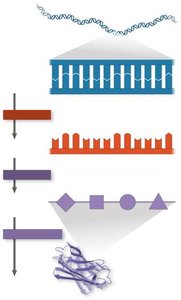
Q6. Label the gene, DNA, RNA, amino acids, and protein on the figure below. Next, label the three steps in the process and describe each.
Background
Topic: Central Dogma of Molecular Biology
This question tests your understanding of how genetic information flows from DNA to RNA to protein, a fundamental concept in biology.
Key Terms and Formulas:
Gene: A segment of DNA that codes for a specific protein.
DNA: Deoxyribonucleic acid, the molecule that stores genetic information.
RNA: Ribonucleic acid, a molecule transcribed from DNA that helps in protein synthesis.
Amino acids: The building blocks of proteins.
Protein: A molecule made of amino acids that performs various functions in the cell.
Three steps: Transcription, Translation, Folding.
Step-by-Step Guidance
Identify the DNA strand at the top of the figure. This represents the genetic material containing the gene.
Label the process of transcription, where the DNA sequence is copied into RNA. The RNA strand is shown as a single line below the DNA.
Next, label the translation step, where the RNA sequence is used to assemble a chain of amino acids. The shapes below the RNA represent amino acids.
Finally, recognize that the chain of amino acids folds into a functional protein, shown at the bottom of the figure.
Describe each step: Transcription (DNA to RNA), Translation (RNA to amino acids), Folding (amino acids to protein).
Try solving on your own before revealing the answer!
Final Answer:
The figure shows the flow of genetic information:
Top: DNA (gene)
Transcription: DNA is copied to RNA
Translation: RNA is used to assemble amino acids
Folding: Amino acids form a protein
The three steps are:
Transcription: DNA → RNA
Translation: RNA → Amino acids
Folding: Amino acids → Protein
This illustrates how cells use DNA instructions to produce proteins, which carry out cellular functions.
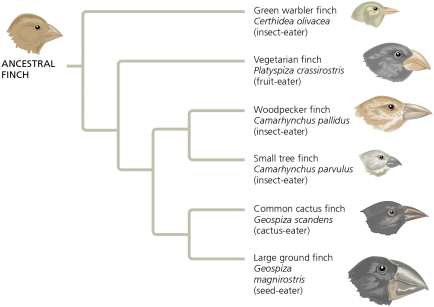
Q17. Study Figure 1.16 from your text, which shows an evolutionary “tree.” What is indicated by each twig? What do the branch points represent? Label the branch point that represents the ancestral point for all species of finch.
Background
Topic: Evolutionary Trees and Phylogeny
This question tests your understanding of how evolutionary relationships are depicted using phylogenetic trees, and how common ancestry is represented.
Key Terms and Formulas:
Phylogenetic tree: A diagram showing evolutionary relationships among species.
Twig: Represents a current species or group.
Branch point: Represents a common ancestor shared by descendant species.
Ancestral point: The origin from which all species in the tree diverged.
Step-by-Step Guidance
Examine the tree diagram. Each twig at the end of a branch represents a distinct species of finch.
Identify the branch points where two or more branches split. These represent common ancestors shared by the descendant species.
Find the base of the tree, which is the ancestral point for all finch species shown. This is where the original ancestral finch diverged into different species.
Label the twigs with the names of the finch species and their dietary habits.
Label the branch point at the base as the ancestral finch.
Try solving on your own before revealing the answer!
Final Answer:
Each twig represents a different finch species. Branch points represent common ancestors from which descendant species diverged. The branch point at the base of the tree is the ancestral finch, the common ancestor of all the finch species shown.
This tree visually demonstrates how evolution leads to both unity (shared ancestry) and diversity (different species).
