 뒤로
뒤로Chapter 13: Meiosis and Sexual Life Cycles – Study Notes
스터디 가이드 - 스마트 노트
 자료에 맞춘 맞춤형 노트, 핵심 정의, 예시, 맥락을 확장해 제공합니다.
Meiosis and Sexual Life Cycles
Concept 13.1: Offspring Acquire Genes from Parents by Inheriting Chromosomes
Genetic inheritance is the process by which offspring receive genes from their parents, ensuring continuity of traits across generations. Each gene occupies a specific locus on a chromosome. The mode of reproduction—asexual or sexual—determines the genetic similarity between parents and offspring.
Asexual reproduction: A single parent produces genetically identical offspring through mitosis.
Sexual reproduction: Genes from two parents combine, resulting in offspring with genetic variation.
Resemblance vs. Identity: Human offspring resemble their parents due to inherited genes, but are not identical because of genetic recombination and independent assortment during meiosis.
Key term: Chromosome – a structure carrying genetic material.
Concept 13.2: Fertilization and Meiosis Alternate in Sexual Life Cycles
Sexual life cycles involve the alternation of meiosis and fertilization, which maintains chromosome number across generations. The life cycles of animals and plants differ in the timing and role of these processes.
Meiosis: Reduces chromosome number from diploid (2n) to haploid (n).
Fertilization: Restores diploid chromosome number by combining haploid gametes.
Animal life cycle: Gametes are the only haploid cells; fertilization produces a diploid zygote.
Plant life cycle: Alternates between multicellular diploid (sporophyte) and haploid (gametophyte) stages.
Concept 13.3: Meiosis Reduces the Number of Chromosome Sets from Diploid to Haploid
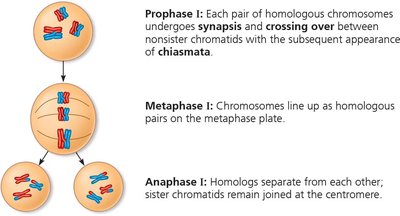
Meiosis consists of two consecutive cell divisions—meiosis I and meiosis II—resulting in four haploid daughter cells. The reduction from diploid to haploid occurs during meiosis I, which is characterized by three unique events.
Meiosis I: Homologous chromosomes separate, reducing chromosome number.
Meiosis II: Sister chromatids separate, similar to mitosis.
Three events unique to meiosis I:
Synapsis and crossing over: Homologous chromosomes pair and exchange genetic material, forming chiasmata.
Homologous chromosome alignment: Chromosomes line up as pairs at the metaphase plate.
Separation of homologs: Homologous chromosomes move to opposite poles, while sister chromatids remain together.
Sister chromatid cohesion: Cohesins hold chromatids together until anaphase.
Crossing over: Occurs during prophase I, not prophase II.
Concept 13.4: Genetic Variation Produced in Sexual Life Cycles Contributes to Evolution
Sexual reproduction generates genetic variation, which is essential for evolution by natural selection. Three processes contribute to this variation:
Independent assortment: Chromosomes are randomly distributed to gametes during meiosis I.
Crossing over: Exchange of genetic material between nonsister chromatids during meiosis I.
Random fertilization: Any sperm can fertilize any egg, increasing genetic diversity.
Mutation: The original source of genetic variation; recombination further increases diversity.
Process | Contribution to Variation |
|---|---|
Independent Assortment | Random distribution of maternal and paternal chromosomes |
Crossing Over | Exchange of genetic material between homologous chromosomes |
Random Fertilization | Any sperm can fertilize any egg, creating unique combinations |
Mutation | Creates new alleles and genetic diversity |
Key Equations
The number of possible combinations due to independent assortment is given by:
where n is the haploid number of chromosomes.
Example: In humans, n = 23, so possible combinations.
Additional info: Genetic variation is fundamental for populations to adapt to changing environments and is the basis for evolutionary processes.
