 뒤로
뒤로Chapter 2: The Chemical Context of Life – Study Notes
스터디 가이드 - 스마트 노트
 자료에 맞춘 맞춤형 노트, 핵심 정의, 예시, 맥락을 확장해 제공합니다.
Chapter 2: The Chemical Context of Life
Learning Objectives
Describe matter, chemical elements, and chemical compounds.
Explain how atomic structure determines element properties.
Identify and describe types of chemical bonds and their effects on molecular shape.
Interpret chemical reactions and their significance in biology.
Concept 2.1: Matter and Elements
Definition of Matter and Elements
Matter is anything that has mass and occupies space. All organisms are composed of matter, which is made up of chemical elements. An element is a substance that cannot be broken down into other substances by chemical reactions.
Chemical Composition of the Human Body
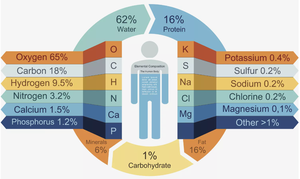
The human body is primarily composed of a few key elements. The most abundant are oxygen, carbon, hydrogen, and nitrogen, which together with calcium and phosphorus, make up 99% of living matter.
Concept 2.2: Atomic Structure and Properties
Atomic Structure
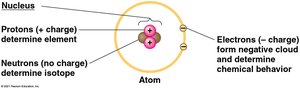
An atom is the smallest unit of matter that retains the properties of an element. Atoms are composed of three types of subatomic particles:
Protons: Positively charged particles found in the nucleus; determine the element.
Neutrons: Neutral particles found in the nucleus; determine the isotope.
Electrons: Negatively charged particles that orbit the nucleus; determine chemical behavior.
Atomic Number and Atomic Mass
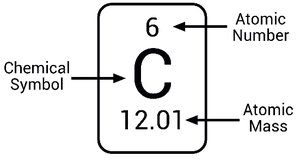
The atomic number is the number of protons in an atom's nucleus. The mass number is the sum of protons and neutrons. Atomic mass is the average mass of all isotopes of an element, weighted by their natural abundance.
Isotopes
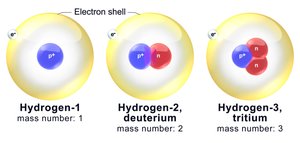
Isotopes are atoms of the same element that differ in the number of neutrons. Some isotopes are radioactive and decay spontaneously, releasing energy.
Energy Levels of Electrons
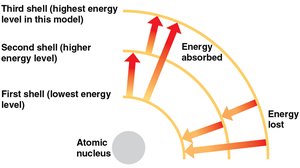
Electrons occupy energy levels or shells around the nucleus. The further an electron is from the nucleus, the higher its potential energy. Electrons can move between shells by absorbing or releasing energy.
Electron Distribution and Chemical Properties
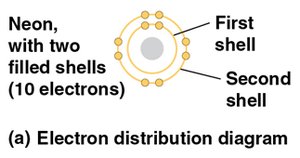
The chemical behavior of an atom is largely determined by the distribution of electrons in its electron shells, especially the valence electrons in the outermost shell. Atoms with full valence shells are chemically inert.
Electron Orbitals
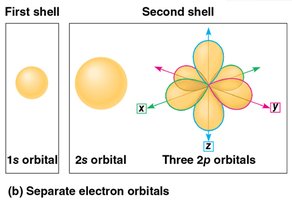
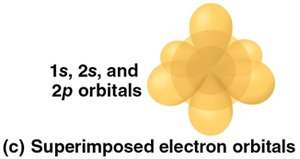
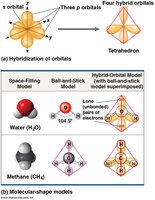
Orbitals are three-dimensional regions around the nucleus where electrons are likely to be found. Each orbital can hold up to two electrons. The arrangement of orbitals influences molecular shape and bonding.
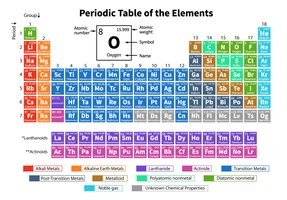
The Periodic Table
The periodic table organizes elements by increasing atomic number and similar chemical properties. Elements in the same column have similar valence electron configurations and chemical behaviors.
Concept 2.3: Chemical Bonds and Molecular Structure
Chemical Bonds
Atoms with incomplete valence shells can share or transfer electrons, forming chemical bonds. The main types of bonds are covalent, ionic, and hydrogen bonds.
Covalent Bonds
A covalent bond involves the sharing of a pair of valence electrons between two atoms. Covalent bonds can be single (one pair shared) or double (two pairs shared). The number of bonds an atom can form is called its valence.

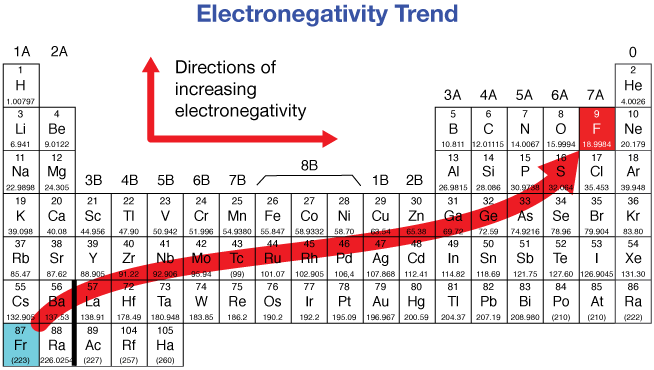
Electronegativity and Bond Polarity
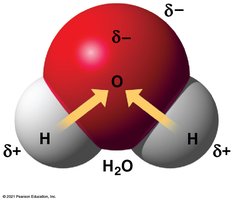
Electronegativity is an atom's ability to attract electrons in a covalent bond. If atoms have similar electronegativities, the bond is nonpolar covalent (electrons shared equally). If one atom is more electronegative, the bond is polar covalent (electrons shared unequally), resulting in partial charges.
Ionic Bonds
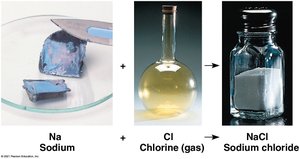
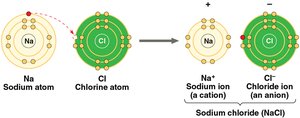
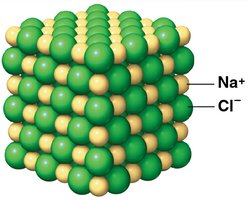
Ionic bonds form when one atom transfers electrons to another, creating oppositely charged ions (cations and anions) that attract each other. Ionic compounds, such as salts, are often crystalline in structure.
Weak Chemical Interactions
Weak bonds, such as hydrogen bonds and van der Waals interactions, play crucial roles in stabilizing biological molecules and allowing reversible interactions.
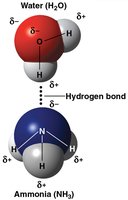
Hydrogen bonds occur when a hydrogen atom covalently bonded to an electronegative atom is attracted to another electronegative atom (often O or N).
Van der Waals interactions are weak attractions due to transient local charges.

Molecular Shape and Function
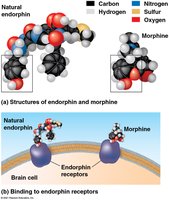
The shape of a molecule is determined by the positions of its atoms' orbitals and is critical for its biological function. Molecular recognition, such as hormone-receptor binding, depends on complementary shapes.
Concept 2.4: Chemical Reactions
Chemical Reactions
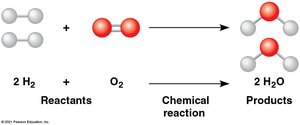
Chemical reactions involve the making and breaking of chemical bonds, transforming reactants into products. All reactions are reversible, and equilibrium is reached when the forward and reverse reactions occur at the same rate.
Photosynthesis Example
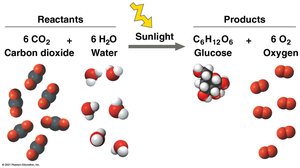
Photosynthesis is a key biological reaction where sunlight powers the conversion of carbon dioxide and water into glucose and oxygen:
Chemical Equilibrium
At chemical equilibrium, the concentrations of reactants and products remain constant because the forward and reverse reactions occur at the same rate. This is represented by a double arrow () in chemical equations.
Summary Table: Types of Chemical Bonds
Bond Type | Description | Relative Strength | Example |
|---|---|---|---|
Covalent | Sharing of electron pairs between atoms | Strong | H2, H2O |
Ionic | Transfer of electrons from one atom to another, forming ions | Strong (in dry conditions) | NaCl |
Hydrogen | Attraction between a hydrogen atom and an electronegative atom | Weak (individually) | Between water molecules |
Van der Waals | Weak attractions due to transient local charges | Very weak (individually) | Gecko toe adhesion |
Key Terms
Element: Substance that cannot be broken down by chemical means.
Atom: Smallest unit of an element retaining its properties.
Isotope: Atoms of the same element with different numbers of neutrons.
Covalent bond: Sharing of electrons between atoms.
Ionic bond: Attraction between oppositely charged ions.
Hydrogen bond: Weak attraction between a hydrogen atom and an electronegative atom.
Valence electrons: Electrons in the outermost shell, involved in bonding.
Electronegativity: Atom's attraction for electrons in a bond.
Chemical reaction: Process of making and breaking chemical bonds.
Chemical equilibrium: State where forward and reverse reactions occur at the same rate.
