 뒤로
뒤로Chapter 3: Water and Life – Properties of Water
스터디 가이드 - 스마트 노트
 자료에 맞춘 맞춤형 노트, 핵심 정의, 예시, 맥락을 확장해 제공합니다.
Properties of Water
Chemical Properties of Water
Water is essential for life and exhibits unique chemical properties that make it indispensable for biological systems. Its molecular structure and interactions underlie many of its remarkable behaviors.
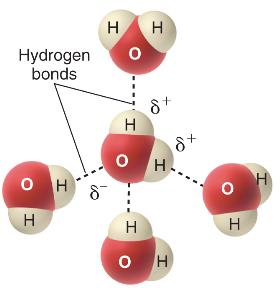
Water exists in three states: solid (ice), liquid, and gas (vapor). The state depends on temperature and the hydrogen bonding between molecules.
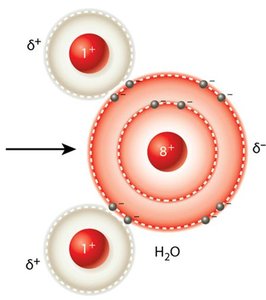
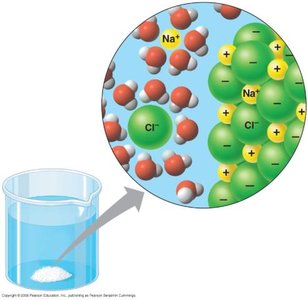
Water readily dissolves polar molecules: Due to its polarity, water acts as an excellent solvent for ionic and polar substances.
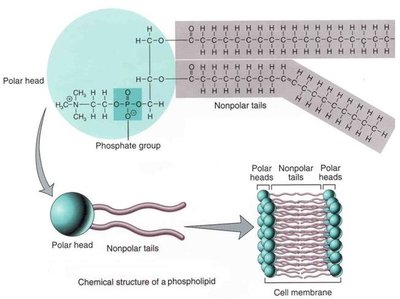
Molecules have different affinities for water: Hydrophilic molecules interact with water, while hydrophobic molecules repel it. Amphipathic molecules have both properties.
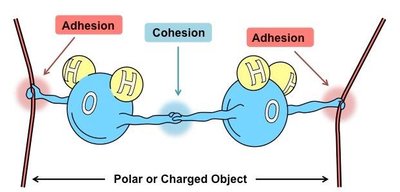
Water displays cohesion and adhesion: Cohesion is the attraction between water molecules; adhesion is the attraction to other substances.
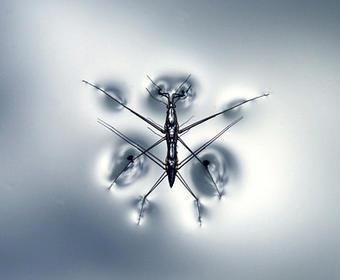
Water displays surface tension: The cohesive forces at the surface of water create a 'skin' that resists external force.
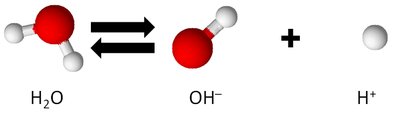
Water dissociates: Water can split into hydrogen (H+) and hydroxide (OH-) ions, affecting pH.
Importance of Water for Life
Water is the medium for most biochemical reactions and is vital for the structure and function of cells and organisms.
Comprises 60-70% of body weight in animals; up to 95% in some plants.
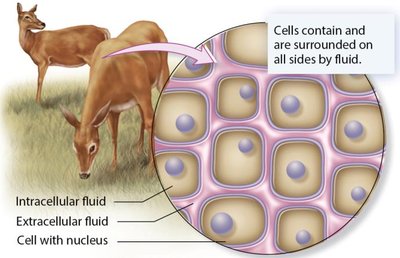
Cells are surrounded by and filled with water, facilitating nutrient transport and waste removal.
Most chemical reactions in nature occur in aqueous solutions.
Physical States of Water
Solid, Liquid, and Gas
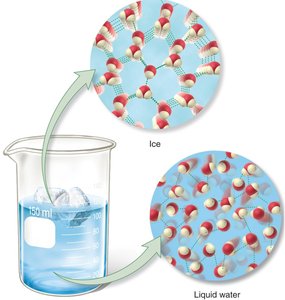
Water's ability to exist in three states is due to hydrogen bonding. At moderate temperatures, water is liquid because hydrogen bonds are constantly breaking and reforming. As temperature increases, bonds break more rapidly, leading to vaporization. As temperature decreases, bonds form stable, ordered structures, resulting in ice.
Ice is less dense than liquid water: In ice, water molecules form a crystalline lattice that spaces them farther apart than in liquid water, making ice float.
Water as a Solvent
Dissolving Polar Molecules
Water's polarity allows it to dissolve many substances, making it the 'universal solvent.' Solutes are substances dissolved in a solvent, and a solution is a homogeneous mixture of solute and solvent. An aqueous solution is one where water is the solvent.
Example: Sodium chloride (NaCl) dissolves in water because the positive (Na+) and negative (Cl-) ions are attracted to the partial charges on water molecules, separating and surrounding the ions.
Hydrophilic, Hydrophobic, and Amphipathic Molecules
Affinities for Water
Molecules interact with water based on their polarity:
Hydrophilic: 'Water-loving' molecules that dissolve or interact with water via hydrogen bonds (e.g., salts, sugars).
Hydrophobic: 'Water-fearing' molecules that do not dissolve in water (e.g., oils, fats).
Amphipathic: Molecules with both hydrophilic and hydrophobic regions (e.g., phospholipids), crucial for forming biological membranes.
Cohesion, Adhesion, and Water Transport
Cohesion and Adhesion
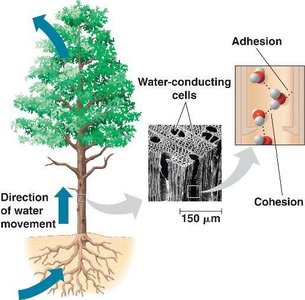
Cohesion refers to the attraction between water molecules due to hydrogen bonding, while adhesion is the attraction of water molecules to other polar or charged surfaces. These properties are essential for processes like water transport in plants.
Cohesion: Responsible for surface tension and the formation of droplets.
Adhesion: Enables water to climb up plant vessels against gravity (capillary action).
Surface Tension
Surface Tension of Water
Surface tension is a measure of the force needed to break the surface of a liquid. Water's high surface tension allows small organisms, like water striders, to move across its surface without sinking.
Example: Water striders exploit surface tension to walk on water.
Dissociation of Water and pH
Water Dissociation
Water molecules can dissociate into hydrogen ions (H+) and hydroxide ions (OH-):
In pure water, the concentrations of H+ and OH- are both M, resulting in a neutral pH of 7.
The pH Scale
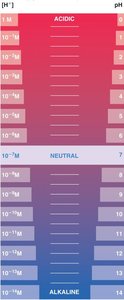
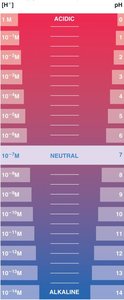
The pH scale measures the concentration of hydrogen ions in a solution. It is logarithmic, so each unit change represents a tenfold difference in [H+].
Formula:
Acids increase [H+] and lower pH; bases decrease [H+] and raise pH.
Buffers help maintain stable pH in biological systems.

Acids, Bases, and Buffers
Acids are substances that release H+ ions in solution, while bases release OH- ions or remove H+ from solution. Buffers are compounds that minimize changes in pH by absorbing or releasing H+ or OH- as needed.
Importance of pH: Small changes in pH can affect protein structure, enzyme activity, and the solubility of molecules, impacting cellular function and survival.

Biological Importance of pH
Cells function within a narrow pH range. Deviations can disrupt protein structure, enzyme activity, and molecular interactions, leading to harmful effects on cellular processes and organismal health.
Changes in pH can alter the rates of chemical reactions and the ability of molecules to dissolve or interact.
Buffers in biological fluids help maintain homeostasis.
