 뒤로
뒤로Chemical Bonds and the Chemistry of Water: Foundations for Life
스터디 가이드 - 스마트 노트
 자료에 맞춘 맞춤형 노트, 핵심 정의, 예시, 맥락을 확장해 제공합니다.
Chemical Bonds
Types of Chemical Bonds
Chemical bonds are the forces that hold atoms together in molecules and compounds. Atoms form bonds to achieve stable electron configurations, often by completing their valence shells. The two strongest types of chemical bonds are covalent and ionic bonds.
Covalent Bonds: Atoms share pairs of valence electrons. These bonds are directional and give molecules distinct three-dimensional shapes. Covalent bonds typically form between non-metal atoms.
Ionic Bonds: One atom completely transfers one or more electrons to another atom, resulting in the formation of oppositely charged ions (cations and anions). The electrostatic attraction between these ions forms the ionic bond. Ionic bonds usually occur between metals and non-metals.
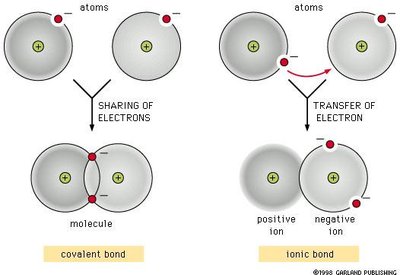
Example: In a water molecule (H2O), the oxygen and hydrogen atoms are held together by covalent bonds. In sodium chloride (NaCl), sodium donates an electron to chlorine, forming Na+ and Cl- ions held together by ionic bonds.
Electronegativity and Bond Polarity
Electronegativity is the ability of an atom to attract electrons in a chemical bond. When two atoms have similar electronegativities, they form non-polar covalent bonds, sharing electrons equally. When there is a significant difference, a polar covalent bond forms, with electrons drawn closer to the more electronegative atom, creating partial charges (δ+ and δ-).
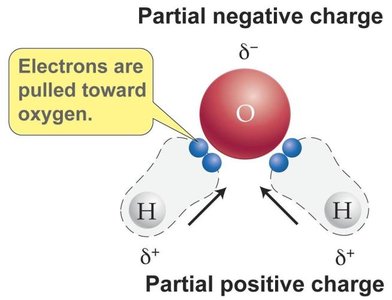
Example: In H2O, oxygen is more electronegative than hydrogen, resulting in a polar molecule with a partial negative charge near the oxygen and partial positive charges near the hydrogens.
Formation of Ions and Ionic Compounds
When the difference in electronegativity is very large, one atom strips an electron from another, forming ions. The resulting cations (positive) and anions (negative) are attracted to each other, forming ionic compounds. Unlike covalent molecules, ionic compounds do not have a fixed size but are defined by the ratio of their constituent ions.
Weak Chemical Bonds
In biological systems, weak bonds such as hydrogen bonds and van der Waals interactions play crucial roles in maintaining the structure and function of large molecules. These bonds are reversible, allowing dynamic interactions essential for life.
Hydrogen Bonds
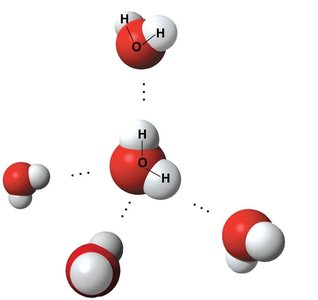
A hydrogen bond forms when a hydrogen atom covalently bonded to an electronegative atom (like oxygen or nitrogen) is attracted to another electronegative atom. Hydrogen bonds are responsible for the unique properties of water and the structure of biological macromolecules such as DNA.
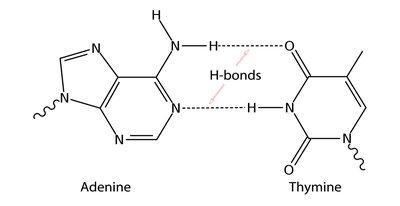
Example: Hydrogen bonds between complementary bases hold the two strands of DNA together.
Van der Waals Forces
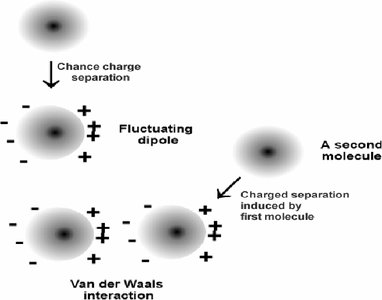
Van der Waals interactions are weak attractions that occur when transient local partial charges develop in non-polar molecules due to momentary uneven electron distribution. While individually weak, collectively they can stabilize large biological structures.
The Chemistry of Water
Structure and Properties of Water
Water is essential for life and exhibits unique properties due to its molecular structure and hydrogen bonding. Each water molecule can form up to four hydrogen bonds, leading to a highly cohesive and structured liquid.
Emergent Properties of Water
Water's properties that support life include:
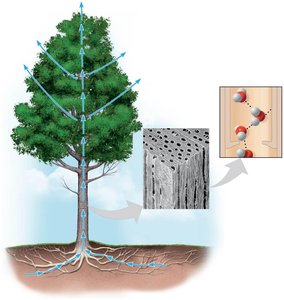
Cohesion: Water molecules stick together due to hydrogen bonding, aiding in the transport of water in plants.
Adhesion: Water molecules can also stick to other substances, such as plant cell walls, facilitating capillary action.
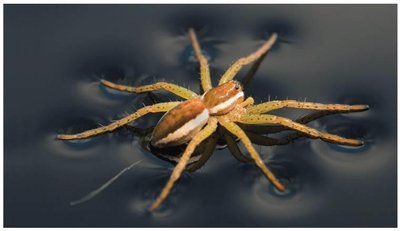
Surface Tension: Water has a high surface tension, allowing small organisms to move across its surface.
High Specific Heat: Water can absorb or release large amounts of heat with little temperature change, stabilizing environments.
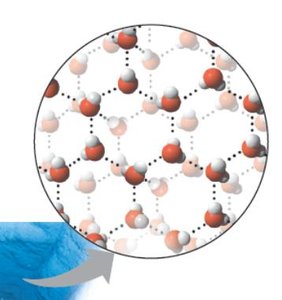
Expansion Upon Freezing: Ice is less dense than liquid water, so it floats, insulating aquatic life in winter.
Versatility as a Solvent: Water dissolves many substances, making it the medium for most biochemical reactions.
Cohesion and Adhesion
Cohesion allows water to be pulled upward in plants, while adhesion helps water cling to cell walls.
Surface Tension
Surface tension enables certain organisms, like water striders, to walk on water.
High Specific Heat and Temperature Moderation
Water's high specific heat (1 cal/g°C) is due to hydrogen bonding. It helps moderate Earth's climate and organisms' internal temperatures.
Formula: (where q is heat, m is mass, c is specific heat, ΔT is temperature change)
Expansion Upon Freezing
Hydrogen bonds in ice are more ordered, making ice less dense than liquid water. This property is vital for aquatic life survival in cold climates.
Water as a Solvent
Water's polarity allows it to dissolve ionic and polar substances, forming hydration shells around ions and molecules.
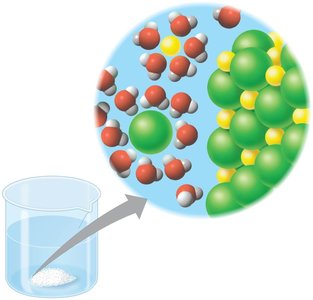
Example: Table salt (NaCl) dissolves in water as Na+ and Cl- ions become surrounded by water molecules.
Hydrophilic and Hydrophobic Substances
Hydrophilic substances have an affinity for water (e.g., salts, sugars), while hydrophobic substances do not (e.g., oils). Hydrophobic molecules are major components of cell membranes.
Solute Concentration and Molarity
Chemical reactions in cells often occur in aqueous solutions. The concentration of solutes is measured in moles per liter (molarity, M).
Mole: 1 mol = molecules (Avogadro's number)
Molarity (M):
Acids, Bases, and pH
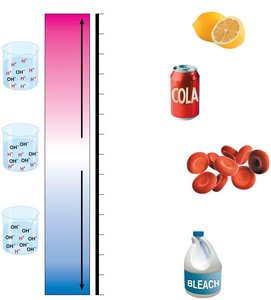
Water can dissociate into hydrogen ions (H+) and hydroxide ions (OH-). The concentration of these ions determines the acidity or basicity of a solution.
Acid: Increases H+ concentration (e.g., HCl)
Base: Reduces H+ concentration (e.g., NaOH, NH3)
pH Scale:
Neutral solution: pH = 7; Acidic: pH < 7; Basic: pH > 7
At 25°C:
Buffers
Buffers are substances that minimize changes in pH by reversibly binding H+ ions. Most biological fluids are buffered to maintain a stable pH, crucial for cellular function.
Example: The bicarbonate buffer system in blood helps maintain pH near 7.4.
Acidification and Environmental Impact
Human activities, such as burning fossil fuels, increase atmospheric CO2, which dissolves in oceans and forms carbonic acid, leading to ocean acidification. This process threatens marine life by reducing carbonate ion availability, essential for shell and coral formation.
Summary Table: Types of Chemical Bonds
Bond Type | Mechanism | Relative Strength | Biological Importance |
|---|---|---|---|
Covalent | Sharing of electron pairs | Strongest in aqueous environments | Forms stable molecules (e.g., DNA, proteins) |
Ionic | Transfer of electrons, attraction between ions | Strong in dry compounds, weaker in water | Formation of salts, nerve function |
Hydrogen Bond | Attraction between H (δ+) and electronegative atom (δ-) | Weaker than covalent/ionic | Stabilizes DNA, proteins, water properties |
Van der Waals | Transient dipole interactions | Weakest | Stabilizes large molecules, cell membranes |
Additional info: This guide expands on the lecture content by providing definitions, examples, and a summary table for clarity and exam preparation.
