 뒤로
뒤로Chemical Reactions, Water, and pH Chemistry in Biology
스터디 가이드 - 스마트 노트
 자료에 맞춘 맞춤형 노트, 핵심 정의, 예시, 맥락을 확장해 제공합니다.
Chemical Bonds and Molecular Polarity
Nonpolar and Polar Covalent Bonds
Chemical bonds are the forces that hold atoms together in molecules. The type of bond formed depends on the difference in electronegativity between the atoms involved.
Nonpolar Covalent Bonds: Electrons are shared equally between identical atoms, resulting in no partial charges.
Polar Covalent Bonds: Electrons are shared unequally between atoms with different electronegativities, creating partial positive (δ+) and negative (δ−) charges.
Electronegativity: The tendency of an atom to attract electrons in a bond.
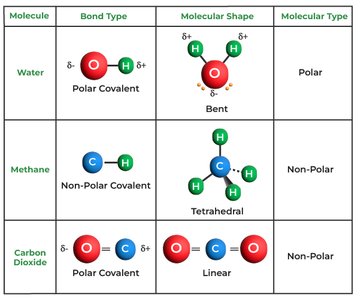
Example: Water (H2O) is a polar molecule due to the difference in electronegativity between hydrogen and oxygen, while methane (CH4) is nonpolar.
Chemical Reactions and Equilibrium
Formation and Breaking of Bonds
Chemical reactions involve the making and breaking of chemical bonds, transforming reactants into products. The law of conservation of mass states that the number of atoms remains unchanged during a reaction.
Equilibrium: The state where the rate of the forward reaction equals the rate of the reverse reaction.
Factors Influencing Reactions: Temperature, concentration of reactants/products, and catalysts.
Example: Photosynthesis:
Energy in Chemistry
Kinetic and Potential Energy
Energy is the capacity to do work. In biological systems, energy exists in various forms and can be transformed from one type to another.
Kinetic Energy: Energy of motion.
Potential Energy: Stored energy due to position or structure.
Energy can be converted between kinetic and potential forms.
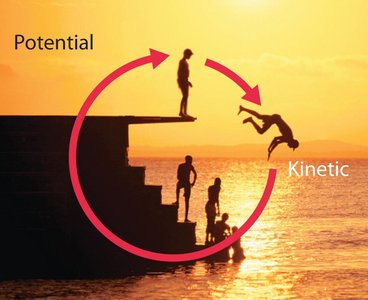
Example: A diver on a platform has potential energy, which is converted to kinetic energy as they jump.
Thermodynamics in Biology
First and Second Laws of Thermodynamics
Thermodynamics describes how energy is transformed in biological systems.
First Law: Energy cannot be created or destroyed, only transformed.
Second Law: Energy transformations are not 100% efficient; some energy is lost as heat, increasing disorder (entropy).
Systems tend to move from more ordered (less stable) to less ordered (more stable) states.
Example: Melting ice in water demonstrates the increase in entropy as solid becomes liquid.
Gibbs Free Energy
Energy Available to Do Work
Gibbs free energy (G) measures the energy available to do work in a system at constant temperature and pressure.
Equation:
ΔG: Change in free energy
ΔH: Change in enthalpy (bond energy)
T: Temperature in Kelvin
ΔS: Change in entropy (disorder)
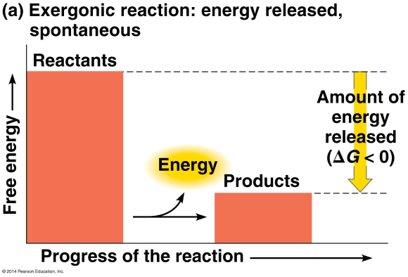
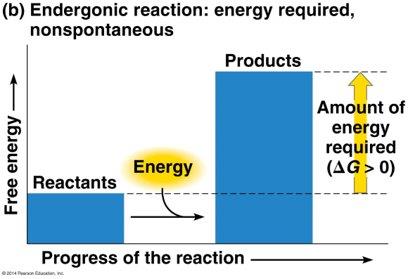
Exergonic reactions (ΔG < 0) release energy and are spontaneous. Endergonic reactions (ΔG > 0) require energy input and are nonspontaneous.
Activation Energy and Catalysts
Initiating Chemical Reactions
Most chemical reactions require an initial input of energy, called activation energy (EA), to destabilize bonds and start the reaction.
Catalysts: Substances that lower activation energy, increasing reaction rate without being consumed.
Enzymes: Biological catalysts that speed up reactions in living organisms.
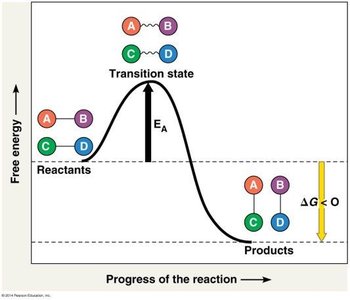
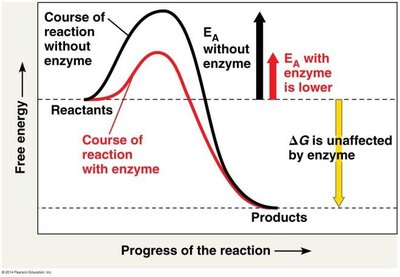
Example: Enzymes in cells lower the activation energy required for metabolic reactions.
Redox Reactions
Electron Transfer in Biology
Redox (reduction-oxidation) reactions involve the transfer of electrons between molecules.
Oxidation: Loss of electrons by a molecule or atom.
Reduction: Gain of electrons by a molecule or atom.
Redox reactions are always coupled; one molecule is oxidized while another is reduced.
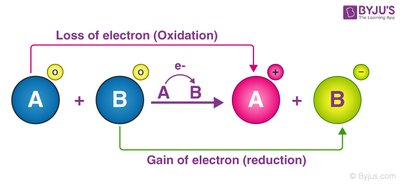
Example: Cellular respiration involves a series of redox reactions to extract energy from glucose.
Water and Its Properties
Importance of Water in Life
Water is essential for life due to its unique chemical and physical properties, many of which arise from its polarity and ability to form hydrogen bonds.
Cohesion: Attraction between water molecules due to hydrogen bonding.
Adhesion: Attraction between water molecules and other polar substances.
High Specific Heat: Water absorbs and releases heat slowly, stabilizing temperatures.
High Heat of Vaporization: Large amount of energy required to convert water from liquid to gas.
Lower Density of Ice: Ice floats because solid water is less dense than liquid water.
Solvent Properties: Water dissolves many substances, facilitating chemical reactions.
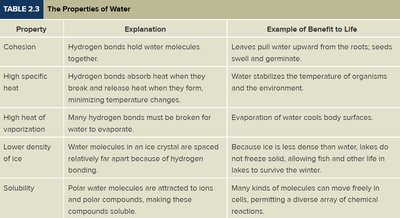
Example: Water's high specific heat helps organisms maintain stable internal temperatures.
Cohesion and Adhesion
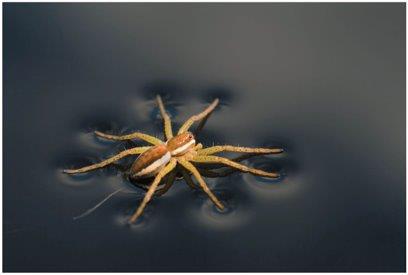
Cohesion and adhesion are responsible for phenomena such as surface tension and capillary action.
Surface Tension: The cohesive forces at the surface of water allow small objects or organisms to rest on it.
Capillary Action: The movement of water within narrow spaces due to adhesion and cohesion.
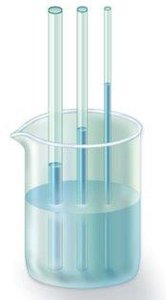
Example: Water moves up plant stems through capillary action.
Temperature Regulation and Density
Water's thermal properties and density changes are vital for life on Earth.
Specific Heat: Amount of heat needed to change 1 g of water by 1°C.
Heat of Vaporization: Energy required to convert 1 g of water from liquid to gas.
Density of Ice: Hydrogen bonds in ice keep molecules farther apart, making ice less dense than liquid water.
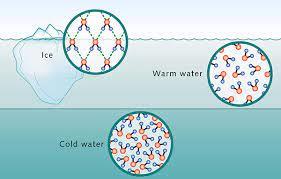
Example: Ice floating on water insulates aquatic life during winter.
Water as a Solvent
Water's polarity allows it to dissolve ionic and polar substances, forming hydration shells around solutes.
Hydration Shell: Water molecules surround ions or polar molecules, preventing them from associating with other molecules.
Solute: Substance dissolved in water.
Solubility: Ability of a substance to dissolve in water.
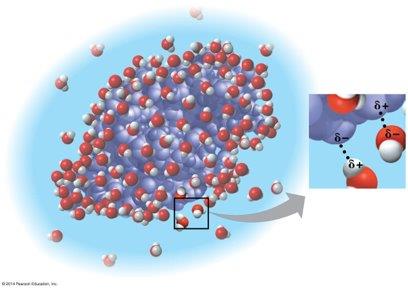
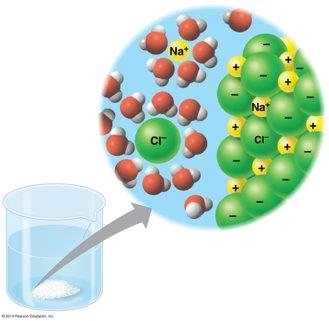
Example: Table salt (NaCl) dissolves in water as Na+ and Cl− ions are surrounded by water molecules.
pH Chemistry
Acids, Bases, and pH Scale
The pH scale measures the concentration of hydrogen ions (H+) in a solution, indicating its acidity or basicity.
pH:
Acids: Increase [H+], lowering pH.
Bases: Decrease [H+], raising pH.
Small changes in pH can be harmful to living organisms.
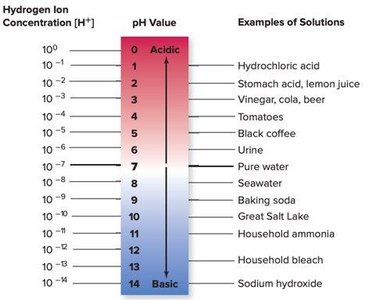
Example: Human blood has a pH around 7.4; deviations can be life-threatening.
Buffers and pH Regulation
Buffers are substances that help maintain a stable pH in biological systems by absorbing or releasing H+ ions as needed.
Buffer: Substance that resists changes in pH.
Bicarbonate (HCO3−): The most important buffer in human blood.
Buffers maintain homeostasis by stabilizing pH.
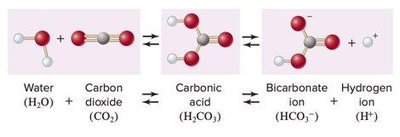
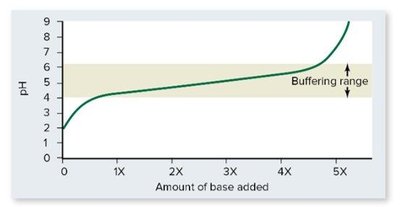
Example: The bicarbonate buffer system helps maintain blood pH within a narrow range.
