뒤로
뒤로Chemistry and Water: The Chemical Basis of Life
스터디 가이드 - 스마트 노트
 자료에 맞춘 맞춤형 노트, 핵심 정의, 예시, 맥락을 확장해 제공합니다.
Ch 2 – Chemistry and Water
Atomic Structure
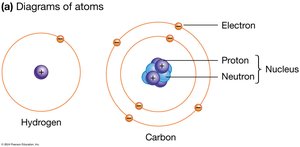
The structure of atoms forms the foundation of all chemical interactions in biology. Atoms consist of three main subatomic particles: protons, neutrons, and electrons.
Protons: Positively charged particles found in the nucleus; determine the atomic number and element identity.
Neutrons: Neutral particles in the nucleus; contribute to atomic mass and isotope formation.
Electrons: Negatively charged particles orbiting the nucleus; involved in chemical bonding and reactions.
Isotopes: Variants of elements with different numbers of neutrons; some are radioactive or magnetically active, useful in biological experiments.
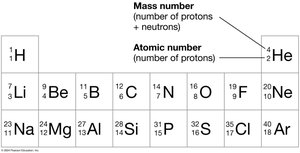
The Periodic Table and Biological Elements
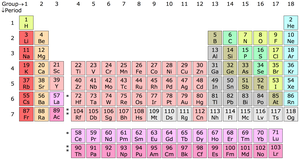
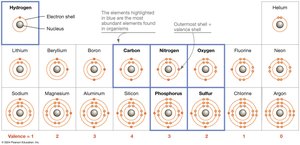
The periodic table organizes elements by atomic number and properties. Four elements—hydrogen, carbon, nitrogen, and oxygen—make up 96% of living matter.
Valence electrons: Electrons in the outermost shell; determine chemical bonding behavior.
Bond formation: Atoms form bonds to achieve a full valence shell, resulting in stability.
Chemical Bonding
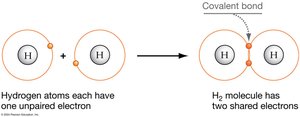
Chemical bonds are essential for the structure and function of biological molecules. The main types are covalent, ionic, hydrogen bonds, and hydrophobic interactions.
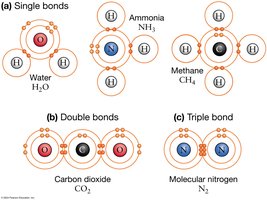
Covalent bonds: Atoms share electrons; can be single, double, or triple bonds.
Ionic bonds: Attraction between oppositely charged ions formed by electron transfer.
Hydrogen bonds: Weak attractions between a hydrogen atom (partial positive) and another atom (partial negative, usually O or N).
Hydrophobic interactions: Nonpolar molecules aggregate to avoid water.
Electronegativity and Bond Polarity
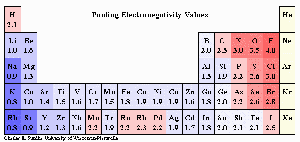
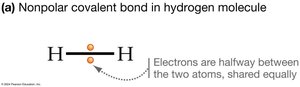
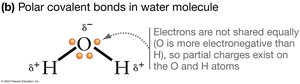
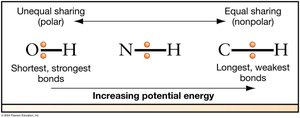
Electronegativity is the tendency of an atom to attract electrons. It determines whether a covalent bond is polar or nonpolar.
Polar covalent bonds: Electrons are unequally shared, creating partial charges (e.g., O-H in water).
Nonpolar covalent bonds: Electrons are equally shared (e.g., H-H).
Electronegativity order: O > N > C ~ H ~ S ~ P
Ionic Bonds
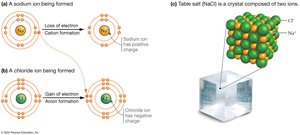
Ionic bonds result from the transfer of electrons, creating charged ions that attract each other.
Cation: Positively charged ion (loss of electron).
Anion: Negatively charged ion (gain of electron).
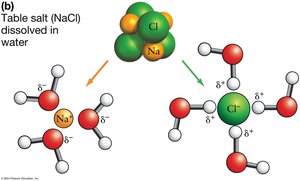
Example: Sodium chloride (NaCl) forms from Na+ and Cl-.
Water: Structure and Properties
Water is vital for life due to its unique chemical properties. Most biological reactions occur in aqueous environments.
Hydrogen bonding: Water molecules form hydrogen bonds, leading to emergent properties.
Solution: A mixture of solute (dissolved substance) and solvent (agent for dissolving).
Hydrogen Bonding in Water
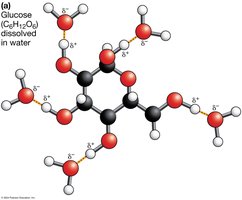
Hydrogen bonds form between the partial positive charge of hydrogen and partial negative charge of oxygen or nitrogen in adjacent molecules.
Dissolving and Solubility
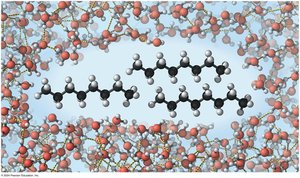
Solubility depends on molecular polarity. Polar molecules are hydrophilic and dissolve in water, while nonpolar molecules are hydrophobic and do not.
Hydrophilic: "Water-loving"; polar molecules interact with water.
Hydrophobic: "Water-fearing"; nonpolar molecules aggregate to avoid water.
Dissolving Ionic Compounds
Ionic compounds dissolve when water molecules surround and separate the ions, stabilizing them in solution.
Emergent Properties of Water
Water exhibits several emergent properties critical for life:
Universal solvent: Dissolves many substances, facilitating biochemical reactions.
Cohesion and adhesion: Water molecules stick to each other and to surfaces, enabling capillary action and high surface tension.
Density: Water is denser as a liquid than as a solid; ice floats, insulating aquatic environments.
High specific heat and heat of vaporization: Water absorbs and releases heat slowly, stabilizing temperatures.
Acids, Bases, and pH
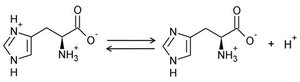
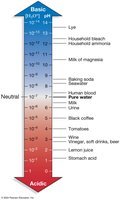
Acids and bases are defined by their ability to donate or accept protons (H+). Water can act as both, leading to the concept of pH.
Acid: Donates a proton (H+).
Base: Accepts a proton (H+).
pH: Measures hydrogen ion concentration; calculated as .
Relationship: As [H+] increases, pH decreases (more acidic).
Buffers
Buffers minimize changes in pH by absorbing or releasing H+, maintaining homeostasis. The carbonic acid/bicarbonate system is a key buffer in blood.
Energy and Entropy in Biological Systems
Energy and entropy drive biochemical reactions. Energy exists in various forms, and entropy measures disorder.
Potential energy: Stored in chemical bonds.
Kinetic energy: Energy of motion.
Chemical energy: Potential energy in molecular bonds.
Thermal energy: Kinetic energy of molecular motion.
Entropy: Degree of disorder; increases as energy disperses.
Drawing Organic Molecules
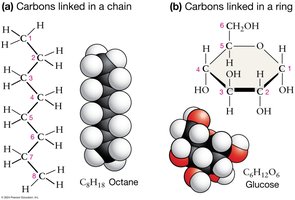
Organic molecules can be represented as chains or rings of carbon atoms, with different functional groups attached.
Octane: C8H18, a hydrocarbon chain.
Glucose: C6H12O6, a carbohydrate ring.
Functional Groups in Biological Molecules
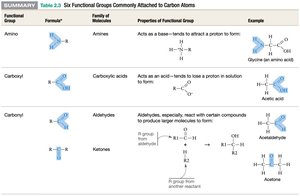
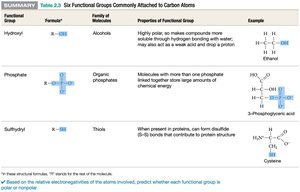
Functional groups are specific clusters of atoms that confer distinct chemical properties to molecules. Six major functional groups are commonly found in biological molecules.
Functional Group | Formula | Family of Molecules | Properties | Example |
|---|---|---|---|---|
Amino | -NH2 | Amines | Acts as a base; tends to attract a proton | Glycine (amino acid) |
Carboxyl | -COOH | Carboxylic acids | Acts as an acid; tends to lose a proton | Acetic acid |
Carbonyl | -CO | Aldehydes, Ketones | Forms larger molecules; reacts with certain compounds | Acetaldehyde, Acetone |
Hydroxyl | -OH | Alcohols | Highly polar; forms hydrogen bonds | Ethanol |
Phosphate | -PO4 | Organic phosphates | Stores chemical energy | 3-Phosphoglycerate |
Sulfhydryl | -SH | Thiols | Forms disulfide bonds in proteins | Cysteine |
Condensation and Hydrolysis Reactions
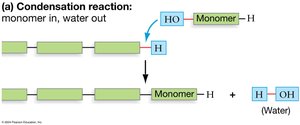
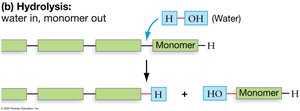
Large biological molecules are formed and broken down by condensation and hydrolysis reactions.
Condensation (dehydration) reaction: Joins monomers by removing water.
Hydrolysis reaction: Breaks polymers into monomers by adding water.