 뒤로
뒤로Chemistry Foundations for Biology: Atoms, Bonds, and Chemical Reactions
스터디 가이드 - 스마트 노트
 자료에 맞춘 맞춤형 노트, 핵심 정의, 예시, 맥락을 확장해 제공합니다.
Chemistry and Life
The Role of Chemistry in Biology
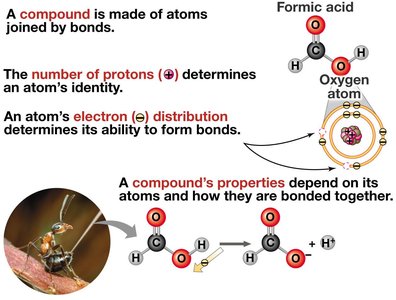
All living organisms are composed of chemical substances, and their structure and function depend on chemical reactions. Understanding the basics of chemistry is essential for studying biological processes, as life is fundamentally a series of chemical interactions and transformations.
Biological molecules are assembled from chemical elements through specific bonding patterns.
Organisms use chemical reactions to obtain energy, build structures, and maintain homeostasis.
Examples include the defensive use of formic acid by ants.

Atoms: The Building Blocks of Matter
Atomic Structure
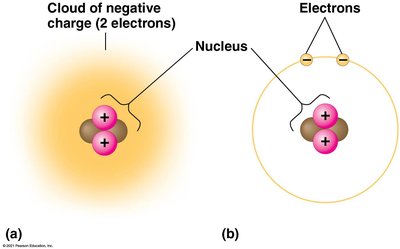
Atoms are the smallest units of matter that retain the properties of an element. Each atom consists of a nucleus containing protons and neutrons, surrounded by electrons in motion.
Protons (p+): Positively charged particles in the nucleus; the number of protons defines the element.
Neutrons (n0): Neutral particles in the nucleus; contribute to atomic mass.
Electrons (e-): Negatively charged particles orbiting the nucleus; involved in chemical bonding.
Electron Energy Levels
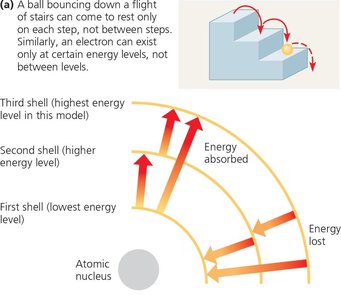
Electrons occupy specific energy levels or shells around the nucleus. The energy of an electron depends on its distance from the nucleus; electrons further away have higher potential energy.
Electrons can move between energy levels by absorbing or releasing energy.
Matter tends to move toward the lowest possible state of potential energy.
Chemical Bonds and Interactions
Valence Electrons and Reactivity
The chemical behavior of an atom is largely determined by the number of electrons in its outermost shell, known as valence electrons. Atoms with incomplete valence shells are chemically reactive and tend to form bonds to achieve stability.
Atoms with full valence shells are chemically inert (e.g., noble gases).
Atoms with incomplete valence shells can share or transfer electrons to form chemical bonds.
Types of Chemical Bonds
Atoms form chemical bonds to achieve stable electron configurations. The main types of bonds in biological systems are covalent, ionic, and hydrogen bonds.
Covalent Bonds
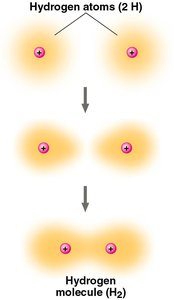
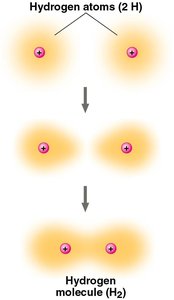
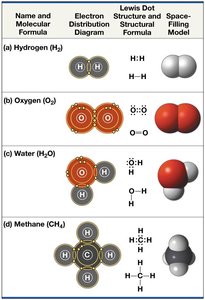
Covalent bonds involve the sharing of pairs of valence electrons between atoms. These bonds are strong and form the backbone of biological molecules.
Nonpolar covalent bonds: Electrons are shared equally between atoms (e.g., H2).
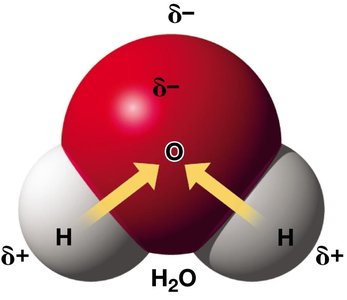
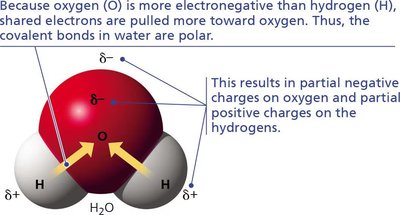
Polar covalent bonds: Electrons are shared unequally, resulting in partial charges (e.g., H2O).
Electronegativity
Electronegativity is the tendency of an atom to attract electrons in a covalent bond. Differences in electronegativity between atoms lead to polar covalent bonds.
Oxygen is more electronegative than hydrogen, making water a polar molecule.
Ionic Bonds
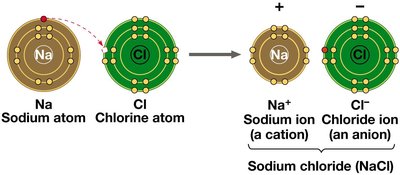
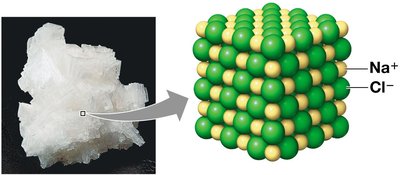
Ionic bonds form when one atom transfers an electron to another, resulting in oppositely charged ions that attract each other. These bonds are weaker in aqueous environments and are easily reversible.
Cation: Positively charged ion (e.g., Na+).
Anion: Negatively charged ion (e.g., Cl-).
Example: Sodium chloride (NaCl) forms from the transfer of an electron from sodium to chlorine.
Hydrogen Bonds
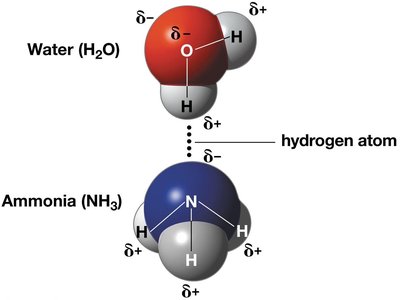
Hydrogen bonds are weak attractions between a hydrogen atom with a partial positive charge and an electronegative atom (such as oxygen or nitrogen) with a partial negative charge. These bonds are crucial for the structure and function of biological molecules, such as DNA and proteins.
Hydrogen bonds are individually weak but collectively strong in large numbers.
They are responsible for many of water's unique properties.
Chemical Reactions
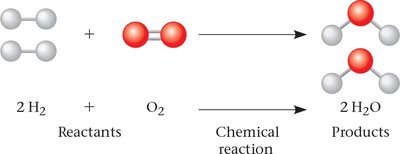
Chemical reactions involve the making and breaking of chemical bonds, resulting in the rearrangement of atoms to form new substances. These reactions are the basis of all biological processes, including metabolism, growth, and reproduction.
Reactants are transformed into products through chemical changes.
Example: The reaction of hydrogen and oxygen to form water.
Summary Table: Types of Chemical Bonds
Bond Type | Mechanism | Relative Strength | Biological Example |
|---|---|---|---|
Covalent | Sharing of electron pairs | Strong | Peptide bonds in proteins |
Ionic | Transfer of electrons; attraction between ions | Moderate (weak in water) | Sodium chloride (NaCl) |
Hydrogen | Attraction between partial charges | Weak (individually) | Hydrogen bonds in water, DNA base pairing |
Key Terms and Concepts
Atom: The smallest unit of an element, consisting of protons, neutrons, and electrons.
Element: A substance that cannot be broken down into other substances by chemical means.
Compound: A substance formed by the chemical combination of two or more elements in fixed ratios.
Valence shell: The outermost electron shell of an atom, involved in bonding.
Electronegativity: The ability of an atom to attract electrons in a covalent bond.
Chemical reaction: The process of making and breaking chemical bonds to form new substances.
Practice Example
Example: In water (H2O), oxygen is more electronegative than hydrogen, resulting in polar covalent bonds. This polarity allows water molecules to form hydrogen bonds with each other, giving water its unique properties essential for life.
