 뒤로
뒤로Bio 100 LEC Chapter 16 Module 3
스터디 가이드 - 스마트 노트
 자료에 맞춘 맞춤형 노트, 핵심 정의, 예시, 맥락을 확장해 제공합니다.
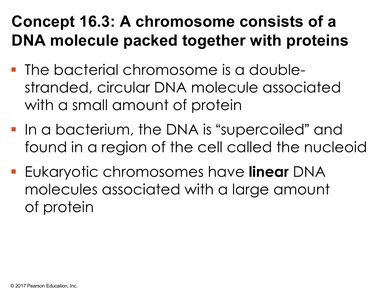
Bacterial vs. Eukaryotic Chromosomes
Chromosomes are essential structures that package genetic material within cells. Their organization and composition differ between prokaryotes and eukaryotes.
Bacterial Chromosomes: Double-stranded, circular DNA molecules with minimal protein association. DNA is often supercoiled and located in the nucleoid region of the cell.
Eukaryotic Chromosomes: Linear DNA molecules associated with a large amount of protein, allowing for complex packaging and regulation.
Chromatin Structure and DNA Packaging
Levels of Chromatin Organization
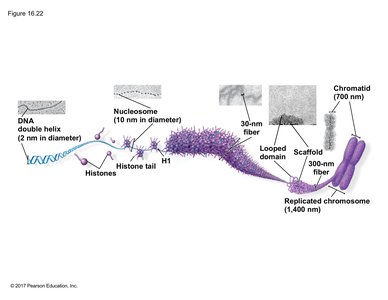
In eukaryotic cells, DNA is combined with proteins to form chromatin. Chromatin undergoes multiple levels of folding to fit within the nucleus, involving specialized proteins called histones.
Double Helix: DNA exists as a double helix with a diameter of 2 nm.
Nucleosome: The basic unit of DNA packaging, consisting of DNA wrapped around histone proteins (diameter ~10 nm).
Beads-on-a-string: Unfolded chromatin appears as nucleosomes connected by linker DNA.
30-nm Fiber: Nucleosomes are further packed into a fiber of 30 nm diameter.
Looped Domains: 30-nm fibers form loops attached to a protein scaffold.
Chromatid: Highly condensed chromatin forms chromatids during cell division.
Chromatin Accessibility and Regulation
Euchromatin vs. Heterochromatin
Chromatin can exist in two main states, affecting gene expression and accessibility:
Euchromatin: Loosely packed chromatin, accessible for transcription, typically present during interphase.
Heterochromatin: Densely packed chromatin, transcriptionally inactive, often formed prior to mitosis.
Histone Modifications
Chromatin structure is regulated by chemical modifications to histones:
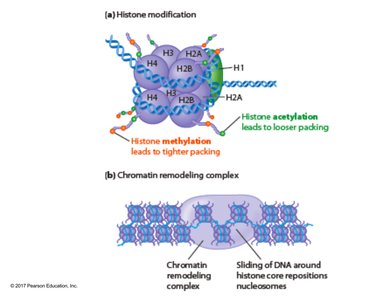
Histone Methylation: Addition of methyl groups (often to lysine residues) generally leads to tighter packing and gene silencing, though effects can vary.
Histone Acetylation: Addition of acetyl groups promotes decondensation, increasing accessibility for transcription.
Chromatin Remodeling
Chromatin remodeling complexes reposition nucleosomes, further regulating accessibility to DNA.
Types of Heterochromatin
Facultative vs. Constitutive Heterochromatin
Heterochromatin can be classified based on its ability to change state:
Facultative Heterochromatin: Can switch between heterochromatin and euchromatin, depending on cellular activity (e.g., gene silencing during embryonic development).
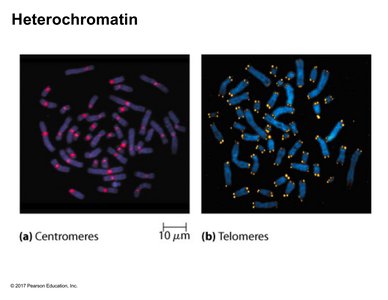
Constitutive Heterochromatin: Permanently condensed, typically found at centromeres and telomeres. These regions contain repetitive DNA sequences and are essential for chromosome stability and cell division.
Summary Table: Chromatin States and Functions
Chromatin Type | Packing | Transcriptional Activity | Location/Function |
|---|---|---|---|
Euchromatin | Loose | Active | Gene-rich regions, interphase |
Facultative Heterochromatin | Variable | Inactive (can become active) | Developmental gene silencing |
Constitutive Heterochromatin | Dense | Inactive | Centromeres, telomeres |
Key Terms and Concepts
Chromatin: Complex of DNA and protein in eukaryotic cells.
Nucleosome: Basic unit of DNA packaging, consisting of DNA wrapped around histone proteins.
Histone: Protein that helps package DNA into chromatin.
Centromere: Chromosome region essential for proper segregation during cell division.
Telomere: Chromosome end region with repetitive DNA, protecting against degradation.
Histone Methylation: Chemical modification leading to chromatin compaction.
Histone Acetylation: Chemical modification leading to chromatin relaxation.
Equations and Additional Info
DNA Packaging: The degree of compaction can be described by the diameter of chromatin fibers:
Repetitive DNA in Telomeres: Human telomere repeat sequence: (repeated thousands of times)
Additional info: Histone modifications and chromatin remodeling are central to epigenetic regulation, affecting gene expression without altering DNA sequence. Proper conversion between chromatin states is essential for normal development and cell function; errors can lead to disease.
