 뒤로
뒤로Communities and Ecosystems: Structure, Interactions, and Conservation
스터디 가이드 - 스마트 노트
 자료에 맞춘 맞춤형 노트, 핵심 정의, 예시, 맥락을 확장해 제공합니다.
Communities and Ecosystems
Introduction
Communities and ecosystems are fundamental units of ecological study, focusing on the interactions among living organisms and their physical environments. Understanding these relationships is crucial for grasping how biodiversity is maintained and how human activities impact the natural world.
Biodiversity
Overview of Biodiversity
Biodiversity refers to the variety of living things in a given area, encompassing genetic, species, and ecosystem diversity. High biodiversity increases ecosystem resilience and provides resources for medicine, agriculture, and economic value.
Genetic Diversity: Variation in genes within a species; provides raw material for natural selection and adaptation.
Species Diversity: The number and relative abundance of species in a community; important for ecosystem stability.
Ecosystem Diversity: The variety of ecosystems in a region, including both biotic (living) and abiotic (non-living) components.
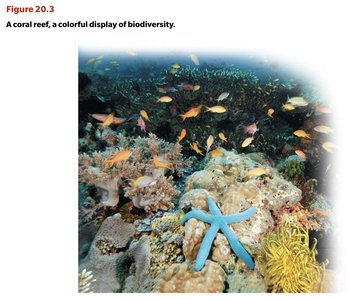
Declining Biodiversity: Causes and Consequences
HIPPCO: Major Threats to Biodiversity
The acronym HIPPCO summarizes the main causes of declining biodiversity:
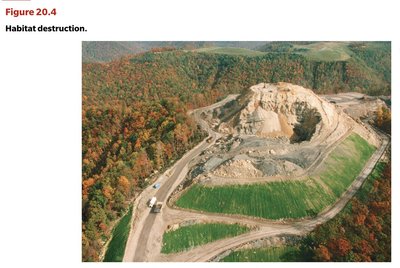
Habitat Loss & Degradation: Destruction or alteration of habitats due to agriculture, urbanization, and resource extraction.
Invasive Species: Non-native organisms that spread rapidly and disrupt native communities.
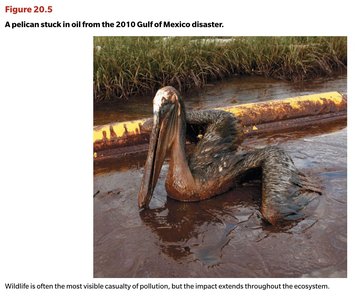
Pollution: Introduction of harmful substances, such as plastics and chemicals, into ecosystems.
Population Growth: Human population expansion increases resource demand and environmental pressure.
Climate Change: Alters habitats and species distributions, often with negative effects.
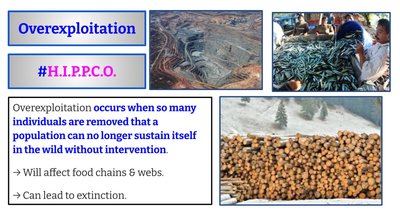
Overexploitation: Unsustainable harvesting of resources, leading to population declines and extinction.
Community Ecology
Community Structure and Interactions
A community consists of all the organisms inhabiting and potentially interacting in a particular area. Community ecology studies the interactions among species and how these shape community structure.
Ecological Niche: The sum of a species’ use of biotic and abiotic resources in its environment.
Interspecific Interactions: Relationships between species, including competition, mutualism, predation, herbivory, parasitism, and commensalism.
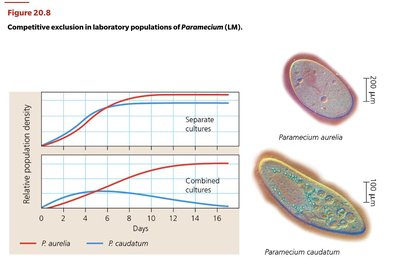
Competition (-/-)
Competition occurs when species vie for the same resources. The competitive exclusion principle states that two species with identical niches cannot coexist indefinitely.
Resource Partitioning: Species may evolve to use different resources or habitats to reduce competition.
Mutualism (+/+)
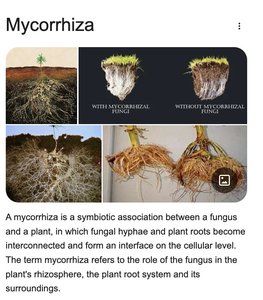
Mutualism is an interaction where both species benefit. Examples include bees pollinating flowers, coral and algae, and mycorrhizal fungi with plant roots.
Bee and Flower: Bees obtain nectar; flowers are pollinated.
Coral and Algae: Algae provide food via photosynthesis; coral offers protection.
Mycorrhizae: Fungi enhance water/nutrient uptake for plants; plants supply carbohydrates.

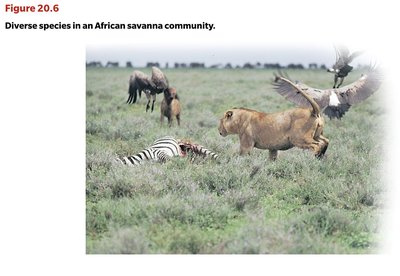
Predation (+/-)
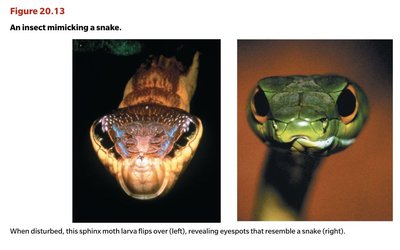
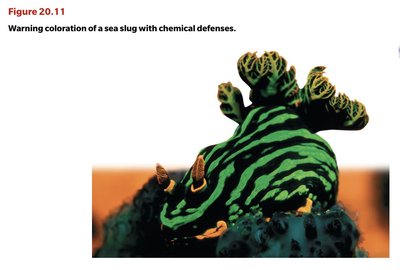
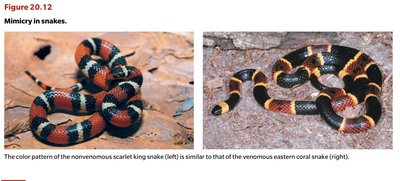
Predation involves one organism (predator) killing and eating another (prey). Prey species have evolved various defenses:
Camouflage: Blending in with the environment to avoid detection.
Warning Coloration: Bright colors signal toxicity or danger.
Mimicry: Imitating another species for protection.
Herbivory (+/-)
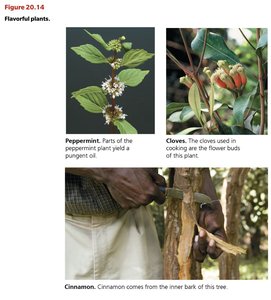
Herbivory is the consumption of plant parts or algae by animals. Plants have evolved defenses such as thorns, spines, and chemical toxins to deter herbivores.
Parasitism and Pathogens (+/-)
Parasitism benefits one organism (parasite) at the expense of another (host). Pathogens are disease-causing organisms, including bacteria, viruses, fungi, and protists.
Example: Ticks feeding on mammals; fungal infections in plants.
Commensalism (+/0)
Commensalism is an interaction where one species benefits and the other is neither helped nor harmed. Example: barnacles on whales.
Trophic Structure
Food Chains and Food Webs
Trophic structure describes the feeding relationships among species in a community. Energy flows from producers to various levels of consumers and decomposers.
Producers: Autotrophs (e.g., plants, algae) that convert solar energy to chemical energy.
Primary Consumers: Herbivores that eat producers.
Secondary Consumers: Carnivores that eat herbivores.
Tertiary/Quaternary Consumers: Higher-level carnivores.
Decomposers: Break down dead organic matter, recycling nutrients.
Food web: A complex network of interconnected food chains, reflecting the diversity of feeding relationships in a community.
Species Diversity and Keystone Species
Components of Species Diversity
Species Richness: The number of different species in a community.
Relative Abundance: The proportion of each species in the community.
Keystone Species: Species with a disproportionately large effect on community structure, despite their low abundance.
Disturbance and Succession
Disturbance
Disturbances are events that alter communities by destroying organisms and changing resource availability (e.g., storms, fires, floods).
Succession
Primary Succession: Occurs in lifeless areas with no soil; pioneer species such as lichens and autotrophic bacteria colonize first.
Secondary Succession: Occurs where soil remains after a disturbance; faster recovery due to existing seed banks and nutrients.
Ecosystem Ecology
Energy Flow and Chemical Cycling
An ecosystem includes all organisms in a community plus abiotic factors. Energy flows through ecosystems, while chemicals are recycled.
Biomass: The total mass of living organisms in an ecosystem.
Primary Production: The conversion of solar energy to chemical energy by producers; only about 1% of visible light is converted via photosynthesis.
Chemical Cycling
Life depends on the recycling of chemicals through biogeochemical cycles, which involve both biotic and abiotic components. Major cycles include:
Carbon Cycle: Carbon moves between the atmosphere, organisms, fossil fuels, and oceans.
Phosphorus Cycle: Phosphorus is essential for nucleic acids, phospholipids, ATP, and bones; its main reservoirs are rocks and ocean sediments.
Nitrogen Cycle: Nitrogen is vital for proteins and nucleic acids; atmospheric N2 is converted to usable forms by bacteria (nitrogen fixation).
Nutrient Pollution and Conservation
Nutrient Pollution
Low nutrient levels limit growth in ecosystems, but human activities can add excess nitrogen and phosphorus, leading to problems such as algal blooms in aquatic systems.
Conservation Biology and Restoration
Landscape Ecology: Studies patterns and interactions across multiple ecosystems.
Bioremediation: Using living organisms to detoxify polluted environments (e.g., bacteria cleaning oil spills).
Sustainable Development: Meeting present needs without compromising future generations.
Summary Table: Major Biogeochemical Cycles
Cycle | Main Reservoir | Key Biological Importance |
|---|---|---|
Carbon | Atmosphere, fossil fuels, oceans | Organic molecules (carbohydrates, proteins, lipids, nucleic acids) |
Nitrogen | Atmosphere, soil | Proteins, nucleic acids |
Phosphorus | Rocks, ocean sediments | DNA, RNA, ATP, bones, teeth |
Key Equations
Photosynthesis:
Cellular Respiration:
Review Questions
What does H.I.P.P.C.O. stand for?
Name two different chemical cycles in an ecosystem.
Describe three different interspecific interactions.
How does energy flow through an ecosystem?
