 뒤로
뒤로Descent with Modification: Darwinian Evolution and Its Evidence
스터디 가이드 - 스마트 노트
 자료에 맞춘 맞춤형 노트, 핵심 정의, 예시, 맥락을 확장해 제공합니다.
Chapter 22 – Descent with Modification
I. Introduction to Evolution
Evolution is the process by which species accumulate differences from their ancestors as they adapt to different environments over time. This concept is encapsulated in Darwin’s phrase descent with modification, which describes how organisms change across generations, leading to the diversity of life observed today.
II. Historical Perspectives on Evolution
A. Early Scientific Views
Aristotle (384–322 BCE) believed species were fixed and arranged them on a scale of increasing complexity (scala naturae).
Carolus Linnaeus (1707–1778) developed a nested classification system and the binomial nomenclature for naming species (e.g., Homo sapiens).
B. Fossils and Paleontology
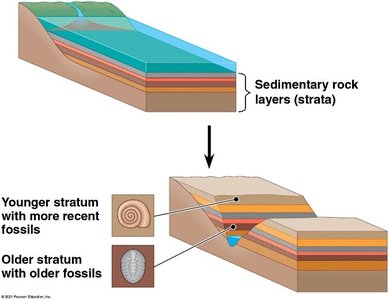
Fossils, the remains or traces of organisms from the past, are often found in sedimentary rock layers called strata. The study of fossils (paleontology) was pioneered by Georges Cuvier, who observed that older strata contain fossils less similar to current organisms than more recent strata. He proposed that boundaries between strata represent sudden catastrophic events.
C. Gradualism and Geologic Change
James Hutton (1726–1797) suggested that Earth's geologic features formed gradually (e.g., valleys formed by rivers).
Charles Lyell (1797–1875) argued that the same geologic processes operate today as in the past, implying Earth is much older than previously thought.
D. Lamarck’s Hypothesis
Jean-Baptiste de Lamarck (1744–1829) proposed two principles: use and disuse (body parts used extensively become larger and stronger) and inheritance of acquired characteristics (modifications acquired in one’s lifetime can be passed to offspring). This mechanism is not supported by experimental evidence.
III. Darwin’s Theory: Descent with Modification by Natural Selection
A. Darwin’s Journey and Observations
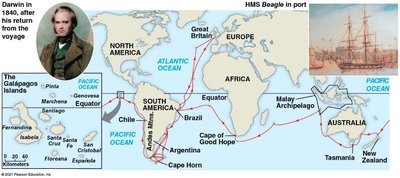
Charles Darwin (1809–1882) traveled as a naturalist on the HMS Beagle, collecting specimens and observing that fossils resembled living species from the same area, and that living species resembled those from nearby regions. On the Galápagos Islands, he noted that animals unique to the islands resembled species on the South American mainland, leading him to hypothesize that mainland species colonized and diversified on the islands.
B. Adaptation and Natural Selection
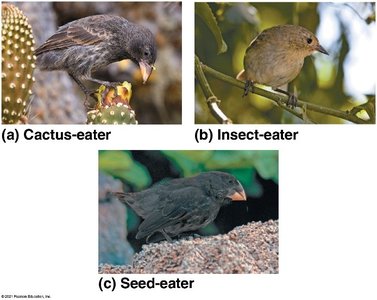
Darwin observed adaptations—heritable traits that enhance survival and reproduction in specific environments. He perceived that new species could arise from ancestral forms through gradual accumulation of adaptations, as seen in the diverse Galápagos finches.
Adaptations: Inherited characteristics that improve an organism’s survival and reproduction.
Natural Selection: The process in which individuals with certain inherited traits survive and reproduce at higher rates because of those traits.
C. The Origin of Species and the Tree of Life
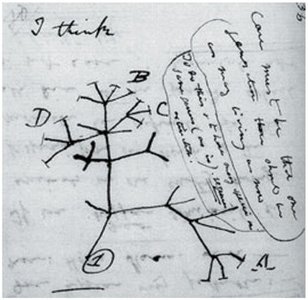
Darwin described the history of life as a tree, with multiple branchings from a common trunk. Labeled branches represent groups of organisms living today, while unlabeled branches represent extinct groups. A fork represents the most recent common ancestor of all lines branching from that point.
D. Artificial Selection vs. Natural Selection
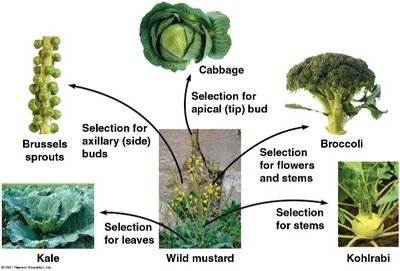
Humans modify species through artificial selection, breeding only individuals with desired traits. This process has produced crops, livestock, and pets that often bear little resemblance to their wild ancestors.
E. Theory of Natural Selection
Observation #1: Members of a population often vary in their inherited traits.
Observation #2: All species can produce more offspring than the environment can support; many fail to survive and reproduce.
Inference #1: Individuals with traits that increase survival and reproduction tend to produce more offspring.
Inference #2: The unequal ability to survive and reproduce leads to the accumulation of favorable traits in the population over generations.
F. Key Features of Natural Selection
Individuals with certain heritable traits survive and reproduce at a higher rate.
Natural selection increases the frequency of favorable adaptations.
If the environment changes, natural selection may drive adaptation to new conditions, leading to new species.
Individuals do not evolve; populations evolve over time.
Natural selection acts only on heritable traits that are variable in a population.
The environment varies, so favorable traits vary with it.
IV. Scientific Evidence for Evolution
A. Direct Observations
Biologists have documented evolutionary change in thousands of studies, including natural selection in response to introduced species and the evolution of drug-resistant bacteria.
B. Homology
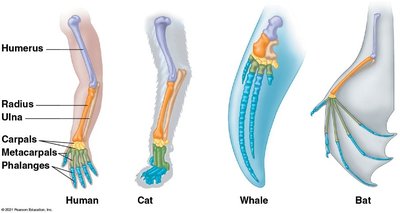
Homology is similarity resulting from common ancestry. Related species can have characteristics with underlying similarity but different functions. Homologous structures are anatomical resemblances that represent variations on a structural theme present in a common ancestor.
For example, the forelimbs of all mammals have the same arrangement of bones but serve different functions.
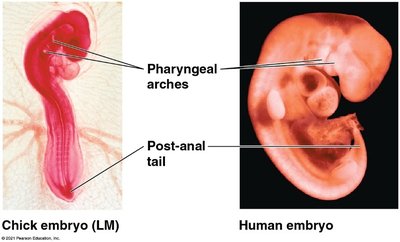
Comparative embryology reveals anatomical homologies not visible in adult organisms. All vertebrate embryos have a post-anal tail and pharyngeal arches, which develop into structures with different functions in adults from different groups.
Vestigial structures are remnants of features that served a function in ancestors (e.g., snakes retain vestiges of pelvis and leg bones).
C. Convergent Evolution
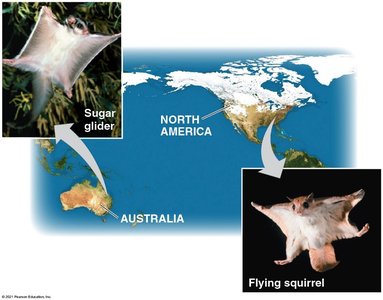
Convergent evolution is the evolution of similar, or analogous, features in distantly related groups. Analogous traits arise not through common ancestry, but through independent adaptation to similar environments.
Example: The sugar glider (Australian marsupial) and the flying squirrel (North American eutherian) have similar adaptations for gliding, but are not closely related.
D. The Fossil Record
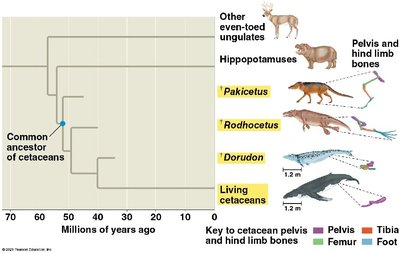
The fossil record provides evidence of the extinction of species, the origin of new groups, and changes within groups over time. Fossils can document important transitions, such as the transition from land to sea in the ancestors of cetaceans (whales, dolphins).
E. Biogeography
Species distributions are influenced by continental drift, the gradual movement of Earth’s landmasses. Understanding continental drift and modern species distribution helps predict when and where different groups evolved.
Example: Freshwater fish in the family Galaxiidae live in South America and Australia, separated by wide stretches of ocean, but share an ancestor dating back to the time these continents broke away from Pangea.
