 뒤로
뒤로Evolution and Earth's Environmental History: Origins and Milestones
스터디 가이드 - 스마트 노트
 자료에 맞춘 맞춤형 노트, 핵심 정의, 예시, 맥락을 확장해 제공합니다.
Evolution: Earth's Environmental History
Introduction
Earth's environmental history is fundamental to understanding the evolution of life. Over the past 4.6 billion years, the planet has undergone dramatic changes, shaping the conditions for the origin, diversification, and extinction of organisms. This section explores the environmental milestones that contributed to the emergence and evolution of life.
Early Earth Conditions
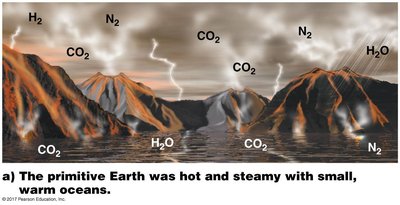
Initially, Earth was inhospitable, characterized by extreme heat, volcanic activity, and a hostile atmosphere. These conditions set the stage for the chemical processes that would eventually lead to life.
Atmosphere Composition: Early atmosphere contained CO2, H2, N2, CH4, NH3, and H2O, but lacked oxygen (O2).
Surface Conditions: The planet was very hot, with no oceans or fresh water. Molten rock and hot gases were released from cracks in the surface.
Radiation: Without an ozone layer, Earth was bombarded by intense radiation.
Formation of Oceans: As the atmosphere cooled, water vapor condensed, eventually forming small, warm oceans.

Formation of Organic Molecules
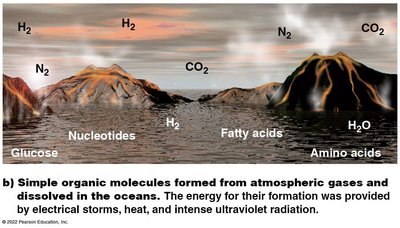
Extreme environmental energy facilitated the synthesis of simple organic compounds, which are the building blocks of life.
Energy Sources: Electrical storms, heat, and ultraviolet radiation provided energy for chemical reactions.
Organic Compounds: Amino acids, simple sugars, fatty acids, and nucleotides formed from atmospheric gases and dissolved in the oceans.
Scientific Evidence: Laboratory experiments (e.g., Miller-Urey experiment) support the spontaneous formation of organic molecules under early Earth conditions.
Key Terms: Amino acids (protein building blocks), nucleotides (DNA/RNA building blocks), glucose (simple sugar), fatty acids (lipid building blocks).
Origin of Self-Replicating Molecules and Cells
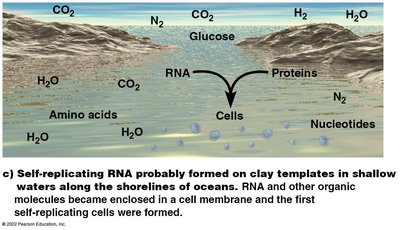
The next major step was the formation of self-replicating molecules, particularly RNA, which led to the development of the first cells.
RNA Formation: RNA likely formed on clay templates in shallow waters along ocean shorelines.
Cell Membranes: Organic molecules became enclosed in membranes, creating the first self-replicating cells.
Transition to DNA: DNA is believed to have evolved from RNA early in the history of life.
Prokaryotes: The first living cells were prokaryotes—simple, single-celled organisms without a nucleus.
Photosynthesis and Oxygen Accumulation
The evolution of photosynthesis was a pivotal event, transforming Earth's atmosphere and enabling the rise of aerobic life forms.
Photosynthesis: Cells began to use CO2, water, and sunlight to produce complex organic molecules.
Oxygen By-product: Photosynthesis released oxygen, which accumulated in the atmosphere.
Aerobic Metabolism: The presence of oxygen allowed for the evolution of aerobic organisms, leading to the extinction of many anaerobic species.
Equation for Photosynthesis:
Major Evolutionary Milestones
Earth's environmental changes led to several key evolutionary milestones, marking the progression from simple cells to complex life forms.
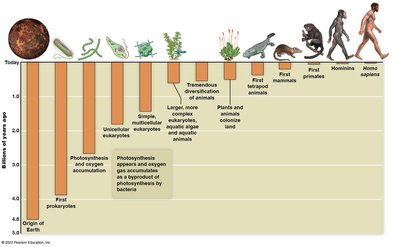
1.8 billion years ago: DNA became enclosed in a nucleus, forming eukaryotic cells (Endosymbiont Theory).
1.4 billion years ago: First multicellular organisms appeared.
600 million years ago: Diversification of animals and plants.
65 million years ago: Extinction of dinosaurs.
6.5 million years ago: Emergence of distinctly human ancestors.
Summary Table: Evolutionary Milestones
Time (billion years ago) | Milestone |
|---|---|
4.6 | Origin of Earth |
3.8 | First prokaryotes |
3.0 | Photosynthesis and oxygen accumulation |
1.8 | Unicellular eukaryotes |
1.4 | Multicellular eukaryotes |
0.6 | Diversification of animals and plants |
0.065 | Extinction of dinosaurs |
0.0065 | Emergence of human ancestors |
Conclusion
Earth's environmental history is a story of transformation, from a hostile planet to one teeming with diverse life. Understanding these milestones provides insight into the processes that shaped the evolution of life and the conditions necessary for its persistence.
