 뒤로
뒤로Evolution and the Foundations of Biology: Interactions, Diversity, and Scientific Inquiry
스터디 가이드 - 스마트 노트
 자료에 맞춘 맞춤형 노트, 핵심 정의, 예시, 맥락을 확장해 제공합니다.
Evolution and the Foundations of Biology
Introduction to Evolution and Biology
Biology is the scientific study of life, focusing on the diversity and unity of living organisms. Evolution provides the central framework for understanding how life changes over time and how different forms of life are related through common ancestry.
Organisms Interact with Other Organisms and the Physical Environment
Types of Species Interactions
Organisms are constantly interacting with each other and their environment, forming complex ecological relationships that shape ecosystems.
Mutualism: Both organisms benefit from the interaction.
Competition: Both organisms are negatively affected due to shared limitations in resources.
Predation/Parasitism: One organism benefits while the other is harmed.
Commensalism: One organism benefits while the other is unaffected.
Feedback: Interactions can create feedback loops that stabilize or destabilize ecosystems.
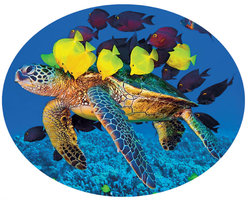
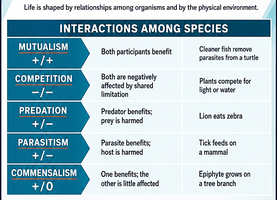
Example: Cleaner fish remove parasites from a turtle (mutualism); plants compete for light or water (competition); lion eats zebra (predation); tick feeds on a mammal (parasitism); epiphyte grows on a tree branch (commensalism).
Humans, Climate, and Biodiversity
Human Impact on Ecosystems
Human activities are major drivers of environmental change, affecting climate and biodiversity. These changes can lead to species extinction if organisms cannot adapt or migrate quickly enough.
Key Drivers: Greenhouse-gas emissions, habitat loss, ocean acidification, and overexploitation.
Extinction Risk: Increases when environmental changes outpace the ability of species to adapt.
Biological Consequences: Range shifts, reduced population size, and loss of genetic diversity.
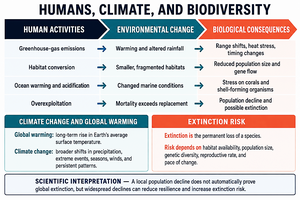
Example: Overexploitation of species, habitat conversion, and greenhouse-gas emissions all contribute to biodiversity loss.
Evolution for the Unity and Diversity of Life
Principles of Evolution
Evolution is the process by which species accumulate differences from their ancestors, resulting in the diversity of life. Similar traits in different species are explained by descent from a common ancestor.
Descent with Modification: Species change over generations, inheriting traits from ancestors but also acquiring new differences.
Unity and Diversity: Evolution explains both the similarities (unity) and differences (diversity) among living organisms.
Classifying the Diversity of Life
The Three Domains of Life
Biologists classify life into three domains based on genetic and cellular differences: Bacteria, Archaea, and Eukarya. Each domain contains multiple kingdoms.
Bacteria: Prokaryotic, unicellular organisms.
Archaea: Prokaryotic, often found in extreme environments.
Eukarya: Eukaryotic organisms, including plants, fungi, and animals.
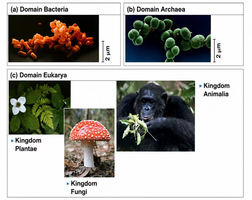
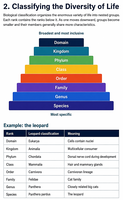 Taxonomy and the Hierarchical Classification System
Taxonomy organizes life into a nested hierarchy from the broadest category (Domain) to the most specific (Species). This system helps scientists communicate about the diversity of life and understand evolutionary relationships.
Hierarchy: Domain > Kingdom > Phylum > Class > Order > Family > Genus > Species
Example: The leopard (Panthera pardus) is classified from Domain Eukarya down to its species name.
Additional info: The diagram's text labels may be inverted; Domain is the broadest, Species is the most specific.
Darwin and Natural Selection
Darwin’s Theory of Evolution
Charles Darwin proposed that natural selection is the primary mechanism of evolution. His observations and reasoning led to the understanding that species adapt to their environments over generations.
Variation: Individuals in a population vary in their traits, many of which are heritable.
Overproduction: More offspring are produced than can survive, leading to competition.
Adaptation: Individuals best suited to their environment are more likely to survive and reproduce.
Natural Selection: Over generations, advantageous traits become more common in the population.
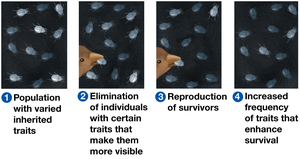
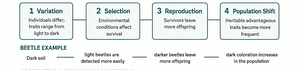
Example: In a population of beetles on dark soil, dark-colored beetles are less visible to predators and thus survive and reproduce more, increasing the frequency of dark coloration in the population.
The Scientific Process in Biology
Scientific Inquiry and Method
Science is a process that involves observation, hypothesis formation, experimentation, and evaluation. Biologists use both qualitative and quantitative data to draw conclusions about the natural world.
Qualitative Data: Descriptions rather than measurements (e.g., animal behavior).
Quantitative Data: Numerical measurements, often organized into tables and graphs.
Inductive Reasoning: Drawing general conclusions from specific observations.
Deductive Reasoning: Making specific predictions based on general principles.
Example: Jane Goodall’s observations of chimpanzee behavior are qualitative data; measuring the number of offspring in a population is quantitative data.
Additional info: The scientific method is iterative and involves creativity, patience, and persistence.
