 뒤로
뒤로Evolution and the Foundations of Biology: Unifying Themes and Biological Organization
스터디 가이드 - 스마트 노트
 자료에 맞춘 맞춤형 노트, 핵심 정의, 예시, 맥락을 확장해 제공합니다.
Evolution and the Foundations of Biology
The Five Unifying Themes of Biology
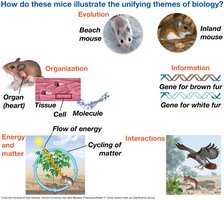
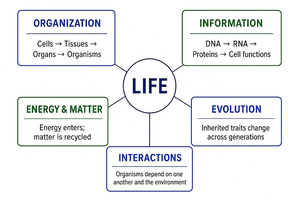
Biology is organized around several unifying themes that help explain the complexity and diversity of life. These themes provide a framework for understanding biological processes at all levels, from molecules to ecosystems.
Organization: Life is structured hierarchically, from molecules to the biosphere. Each level exhibits emergent properties that arise from the arrangement and interaction of its parts.
Information: Genetic information, primarily in the form of DNA, is transmitted from one generation to the next and guides cellular functions.
Energy and Matter: Life requires the transfer and transformation of energy and the cycling of matter within ecosystems.
Interactions: Organisms interact with each other and their environment, influencing survival and reproduction.
Evolution: Evolution explains the unity and diversity of life, as inherited traits change across generations.
Levels of Biological Organization
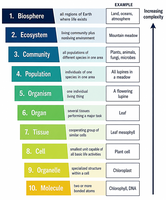
Biological systems are organized into a hierarchy of structural levels, each with increasing complexity. Understanding these levels is essential for studying emergent properties and the correlation between structure and function.
Molecule: Two or more bonded atoms (e.g., DNA, chlorophyll)
Organelle: Specialized structures within cells (e.g., chloroplast)
Cell: Basic unit of life (e.g., plant cell)
Tissue: Group of similar cells (e.g., leaf mesophyll)
Organ: Structure performing a specific function (e.g., leaf)
Organism: Individual living thing (e.g., flowering plant)
Population: Individuals of one species in an area
Community: All populations in an area (plants, animals, fungi, microbes)
Ecosystem: Living community plus nonliving environment (e.g., mountain meadow)
Biosphere: All regions of Earth where life exists
Emergent Properties, Reductionism, and Systems Biology
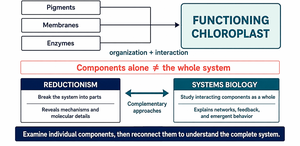
Emergent properties arise from the arrangement and interaction of parts within a system. Reductionism breaks complex systems into simpler components for study, while systems biology analyzes interactions among parts to understand the whole system.
Emergent Properties: New characteristics that appear at each level of organization due to interactions among components.
Reductionism: Approach that simplifies complex systems by studying their individual parts.
Systems Biology: Integrative approach that examines how components interact to produce emergent behaviors.
Structure and Function: Biological structures often provide clues to their functions.
The Cell: An Organism’s Basic Unit of Structure and Function
Prokaryotic vs. Eukaryotic Cells
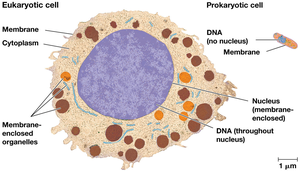
The cell is the smallest unit of life capable of performing all life activities. Cells are classified as prokaryotic or eukaryotic based on their internal structure.
Prokaryotic Cells: Lack a nucleus and membrane-bound organelles; DNA is found in the cytoplasm.
Eukaryotic Cells: Contain membrane-enclosed organelles, including a nucleus that houses DNA.
All Cells: Enclosed by a membrane and share basic characteristics.
Chloroplasts: Organelles found only in photosynthetic eukaryotes.
DNA: The Genetic Material
Chromosomes, Genes, and DNA Structure
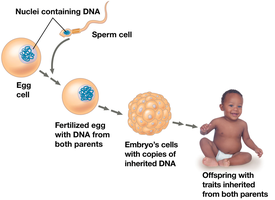
Chromosomes contain a cell’s genetic material in the form of DNA. Genes are segments of DNA that encode instructions for building proteins, which are essential for cellular structure and function.
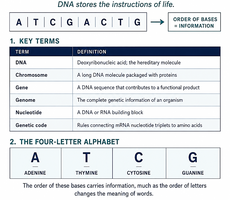
DNA: Deoxyribonucleic acid, composed of two strands forming a double helix.
Genes: Units of inheritance; sections of DNA along chromosomes.
Chromosomes: Long DNA molecules packaged with proteins.
Inheritance: Genetic information is transmitted from parents to offspring during cell division.
Gene Expression: From DNA to Protein
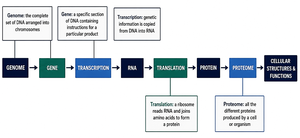
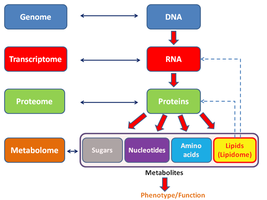
Gene expression is the process by which information from a gene is used to synthesize a functional product, typically a protein. The flow of genetic information involves transcription and translation.
Transcription: DNA is copied into RNA.
Translation: RNA is used to assemble proteins.
Proteins: Major players in building and maintaining cells.
Proteome: The entire set of proteins expressed by a cell, tissue, or organism.
Genome: The complete set of DNA in an organism.
Bioinformatics and Proteomics
Bioinformatics uses computational tools to store, organize, and analyze biological data. Proteomics studies the properties and functions of proteins expressed by cells, tissues, or organisms.
Bioinformatics: Essential for managing large volumes of genetic and protein data.
Proteomics: Focuses on the proteome and its role in cellular function.
Transfer and Transformation of Energy and Matter
Energy Flow and Matter Cycling in Ecosystems
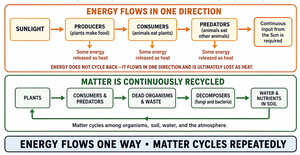
Life depends on the input of energy, mainly from the sun, and the transformation of energy from one form to another. Matter cycles within ecosystems, being used and recycled by organisms and decomposers.
Producers: Convert sunlight into chemical energy (e.g., plants).
Consumers: Obtain energy by feeding on other organisms.
Decomposers: Return chemical elements to the environment.
Energy Flow: Energy enters as light and exits as heat; it flows in one direction.
Matter Cycling: Matter is recycled among organisms, soil, water, and the atmosphere.
Quiz Questions and Academic Context
Q1: The correct hierarchical sequence of structural organization in living things is: Cells → Tissues → Organs → Organisms
Q2: The genome is the complete set of DNA, while the proteome is all the different proteins produced by a cell.
Q3: Ecosystems require a continuous input of sunlight because energy flows in one direction and is ultimately lost as heat.
Additional info: These foundational concepts are essential for understanding subsequent chapters in General Biology, including cell structure, genetics, metabolism, and ecology.
