 뒤로
뒤로Evolution: The Path to Homo sapiens
스터디 가이드 - 스마트 노트
 자료에 맞춘 맞춤형 노트, 핵심 정의, 예시, 맥락을 확장해 제공합니다.
Evolution of Humans and Primates
Common Ancestry of Humans and Primates
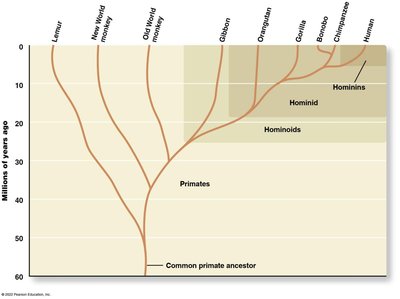
The evolutionary history of humans is deeply intertwined with that of other primates. All primates, including humans, share a common ancestor that lived approximately 60 million years ago. This group is characterized by several adaptations for life in trees, such as five digits on hands and feet, flat fingernails, forward-facing eyes, and opposable thumbs.
Order Primata (Primates): Mammals with specialized adaptations for arboreal life.
Key Features: Five digits, flat nails, forward-facing eyes, opposable thumbs.
Evolutionary Evidence: Fossil records and comparative anatomy support a shared ancestry.
Classification within the Primate Lineage
Hominoids: A subgroup of primates with larger bodies, bigger brains, no tails, and complex social behaviors.
Hominids: Includes all living and extinct primate ancestors of modern humans.
Hominins: Refers specifically to living and extinct human ancestors.
The Evolutionary Path to Homo sapiens
Overview of Hominin Evolution
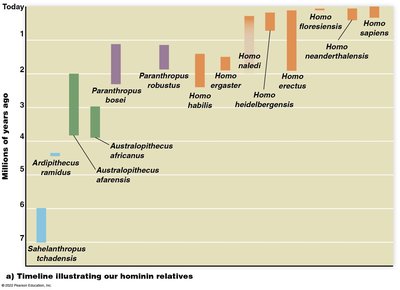
The evolutionary pathway from early primates to modern humans is complex and 'bushy,' with many overlapping species. Key trends include bipedalism, increased brain size, changes in facial structure, reduced teeth size, and the development of culture and technology.
Bipedalism: Walking upright on two legs.
Increased Brain Size: Associated with advanced cognitive abilities.
Manual Dexterity: Enhanced ability to manipulate objects, leading to tool use.
Cultural Evolution: Evidence of language, tool-making, group cooperation, and use of fire.
Key Hominin Fossils and Species
Sahelanthropus tchadensis: Lived about 6.5–7 million years ago in Chad; represents the divergence of chimpanzee and human lines.
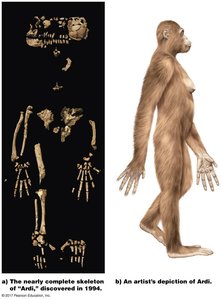
Ardipithecus ramidus: Appeared in Africa about 4.4 million years ago; could walk upright but retained adaptations for climbing.
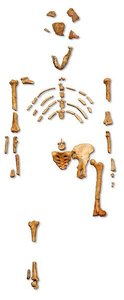
Australopithecus africanus and A. afarensis: Lived around 3.2 million years ago. Australopithecus afarensis ('Lucy') is a famous fossil found in Ethiopia, showing clear evidence of bipedalism.
The Genus Homo
The genus Homo marks a significant step in human evolution, with increased brain size and advanced tool use. The transition from australopithecines to early Homo species is not well documented in the fossil record.
Homo habilis: Appeared about 2.4 million years ago in Africa; associated with primitive stone tools. Tool use may have begun even earlier.
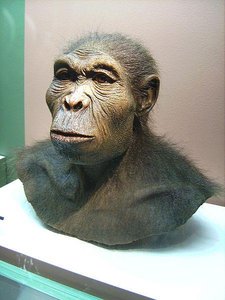
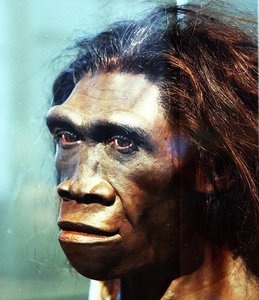
Homo erectus: First appeared 1.9 million years ago; first hominin to migrate out of Africa. Known for more sophisticated tools, use of fire, and social behaviors such as pair bonding and group hunting.
Co-existence and Extinction of Other Homo Species
Homo heidelbergensis: Inhabited Europe, Asia, and Indonesia; made specialized tools and cared for the sick. Ancestor to Neanderthals.
Homo neanderthalensis (Neanderthals): Became extinct about 28,000 years ago; some interbreeding with Homo sapiens occurred.
Homo floresiensis: Discovered in Indonesia; existed as recently as 12,000 years ago.
Emergence and Spread of Homo sapiens
Homo sapiens evolved in Africa between 160,000 and 300,000 years ago, showing further brain development and the emergence of spoken language. Modern humans migrated out of Africa 50,000–70,000 years ago, eventually populating the globe and replacing other Homo species. Genetic evidence shows some interbreeding with Neanderthals and Denisovans.
Migration: Out of Africa, across the Red Sea, into Eurasia, and eventually to all continents.
Replacement: Other Homo species disappeared, possibly due to competition, disease, or interbreeding.
Summary Table: Major Hominin Species and Key Features
Species | Time Period (mya) | Key Features | Significance |
|---|---|---|---|
Sahelanthropus tchadensis | 6.5–7 | Earliest known hominin | Divergence from chimpanzee line |
Ardipithecus ramidus | 4.4 | Partial bipedalism, grasping hands/feet | Early upright walking |
Australopithecus afarensis | 3.2 | Bipedal, small brain | "Lucy" fossil, clear bipedalism |
Homo habilis | 2.4 | Stone tools, larger brain | First toolmaker |
Homo erectus | 1.9–0.2 | Migration, fire use, advanced tools | First out of Africa |
Homo neanderthalensis | 0.4–0.028 | Robust build, cared for sick, burial | Coexisted and interbred with H. sapiens |
Homo sapiens | 0.3–present | Large brain, language, culture | Modern humans |
