 뒤로
뒤로Evolutionary Mechanisms and Speciation: Study Notes for General Biology
스터디 가이드 - 스마트 노트
 자료에 맞춘 맞춤형 노트, 핵심 정의, 예시, 맥락을 확장해 제공합니다.
Evolutionary Mechanisms
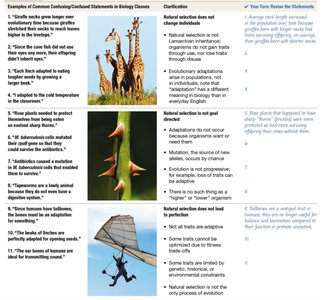
Common Misconceptions about Evolution
Understanding evolution requires dispelling several common misconceptions. Evolution does not occur because organisms "want" or "need" to change, nor does it always produce optimal traits. Natural selection acts on existing variation, and not all traits are adaptive.
Misconception 1: Evolutionary change occurs in individuals. Correction: Evolution occurs in populations over generations, not within an individual's lifetime.
Misconception 2: Adaptations arise because organisms need them. Correction: Adaptations result from random mutations and selection, not from need or desire.
Misconception 3: Natural selection produces perfect organisms. Correction: Natural selection can only act on available variation and is limited by historical constraints and trade-offs.
Hardy-Weinberg Equilibrium and Population Genetics
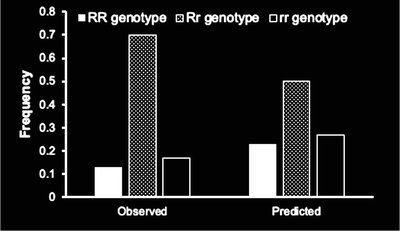
The Hardy-Weinberg principle provides a mathematical model to study genetic variation in populations. It predicts genotype frequencies under the absence of evolutionary forces.
Equation: and where p and q are allele frequencies.
Genotype frequencies:
p2: frequency of homozygous dominant (RR)
2pq: frequency of heterozygotes (Rr)
q2: frequency of homozygous recessive (rr)
Deviations from Hardy-Weinberg equilibrium indicate that evolution is occurring due to selection, genetic drift, gene flow, mutation, or non-random mating.
Four Evolutionary Mechanisms
There are four main mechanisms that drive evolution in populations:
Natural Selection: Differential survival and reproduction of individuals due to differences in phenotype. Only mechanism that consistently leads to adaptation.
Genetic Drift: Random changes in allele frequencies, especially significant in small populations. Can lead to loss or fixation of alleles.
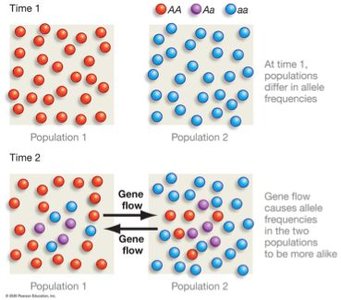
Gene Flow: Movement of alleles between populations, which tends to reduce differences between populations.
Mutation: Random changes in DNA sequence, introducing new alleles into a population.
Genetic Drift: Founder Effect and Bottleneck
Genetic drift can occur through two main processes:
Founder Effect: When a new population is established by a small number of individuals, leading to reduced genetic variation.
Bottleneck Effect: A sudden reduction in population size due to environmental events, resulting in loss of genetic diversity.
Mutation
Mutations are the ultimate source of genetic variation. They can be:
Point mutations: Change in a single base pair.
Chromosomal mutations: Large-scale changes affecting chromosome structure or number.
Lateral gene transfer: Movement of genetic material between organisms other than by descent.
Sexual Selection
Types of Sexual Selection
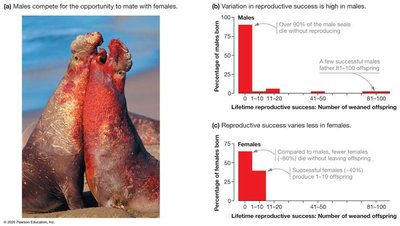
Sexual selection is a form of natural selection related to mating success. It can be:
Intersexual selection: Mate choice, often by females selecting males based on traits such as coloration or courtship behavior.
Intrasexual selection: Competition among individuals of the same sex (usually males) for access to mates.

Speciation
Definition and Process
Speciation is the process by which one species splits into two or more distinct species. It involves:
Genetic isolation: Barrier to gene flow isolates populations.
Genetic divergence: Isolated populations evolve independently through mutation, selection, and drift.
Modes of Speciation
Allopatric speciation: Occurs when populations are geographically separated.
Sympatric speciation: Occurs without geographic separation, often through polyploidy or behavioral isolation.
Species Concepts
Biologists use several concepts to define and identify species:
Biological species concept: Species are groups of actually or potentially interbreeding populations that are reproductively isolated from other groups.
Morphospecies concept: Species are distinguished by morphological differences.
Phylogenetic species concept: Species are the smallest monophyletic groups on a phylogenetic tree.
Reproductive Isolation Mechanisms
Reproductive isolation prevents gene flow between species and can be:
Prezygotic barriers: Prevent mating or fertilization (e.g., habitat, temporal, behavioral, mechanical, gametic isolation).
Postzygotic barriers: Prevent hybrid offspring from developing into viable, fertile adults (e.g., reduced hybrid viability or fertility).
Morphospecies Concept Example
Different species may look similar (cryptic species), or a single species may have multiple phenotypes (polymorphism). For example, two stingray species can be distinguished by their coloration and spot patterns.
Phylogenetic Species Concept
Phylogenies are constructed using DNA, fossils, anatomy, and other traits. A species is defined as the smallest group sharing a common ancestor and unique traits (synapomorphies).
Study and Exam Preparation Tips
Teach each other figures from the textbook.
Cover up labels on figures and fill them in yourself.
Turn outlines into concept maps to visualize relationships.
Practice recalling information from memory and identify gaps in understanding.
