 뒤로
뒤로Fundamental Chemistry and Cell Structure for General Biology
스터디 가이드 - 스마트 노트
 자료에 맞춘 맞춤형 노트, 핵심 정의, 예시, 맥락을 확장해 제공합니다.
Introduction to Biology
Levels of Biological Organization
Biology studies life at multiple levels, from atoms and molecules to cells and organisms. Understanding these levels is essential for grasping how life functions.
Atoms: Basic units of matter, composed of protons, neutrons, and electrons.
Molecules: Groups of atoms bonded together, forming the chemical basis of life.
Organelles: Specialized structures within cells that perform distinct functions.
Cells: Fundamental units of life, capable of all life processes.
Chemistry
Atoms and Elements
Atoms are the smallest units of elements, which are pure substances consisting of only one type of atom. Elements are defined by their atomic number (number of protons).
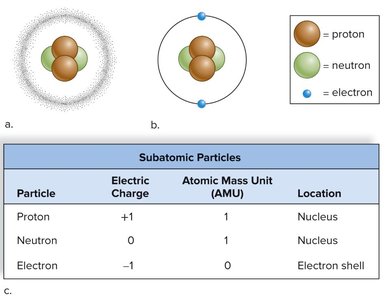
Subatomic Particles: Protons (+1 charge), neutrons (0 charge), electrons (-1 charge).
Atomic Number: Number of protons in the nucleus; defines the element.
Mass Number: Sum of protons and neutrons.

Electron Shells and Stability
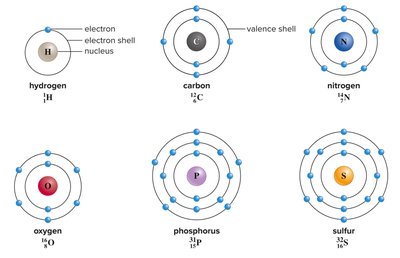
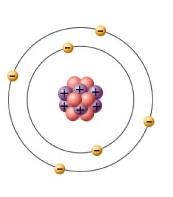
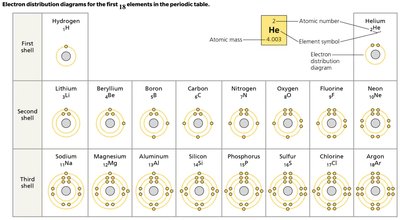
Electrons occupy energy levels called shells. The chemical reactivity of an atom is determined by the electrons in its outermost (valence) shell.
Inner shell holds up to 2 electrons; second shell holds up to 8 electrons.
Atoms are most stable when their valence shell is full (octet rule).
Periodic Table and Elements in Biology
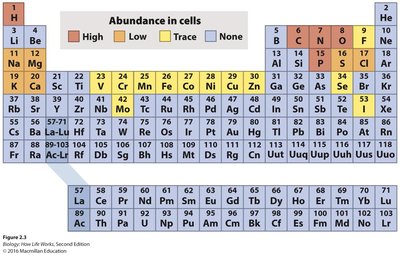
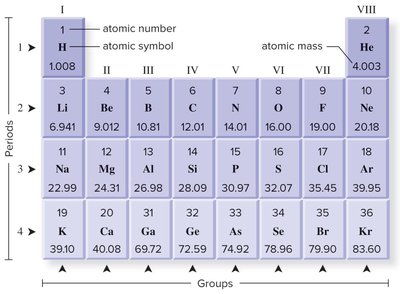
The periodic table organizes elements by atomic number and properties. Certain elements are especially abundant in living organisms.
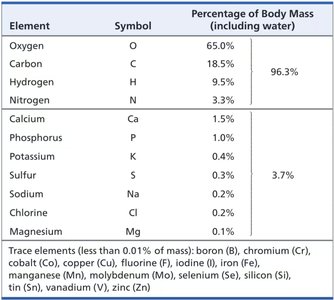
Major elements: Oxygen, carbon, hydrogen, nitrogen.
Minor elements: Calcium, phosphorus, potassium, sulfur, sodium, chlorine, magnesium.
Water
Structure of Water Molecule
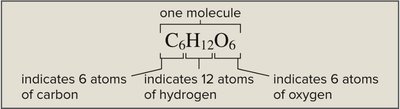
Water is a vital molecule for life, composed of two hydrogen atoms and one oxygen atom. Its structure allows for unique properties such as cohesion, adhesion, and solvent abilities.
Chemical formula:
Polar molecule: Unequal sharing of electrons creates partial charges.
Biomolecules
Major Biomolecules
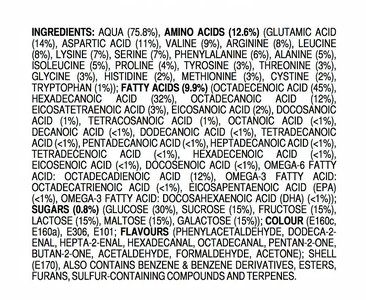
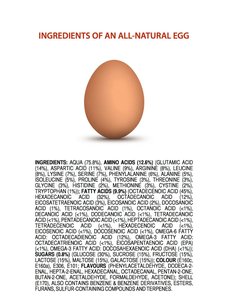
Biomolecules are organic compounds essential for life, including proteins, lipids, carbohydrates, and nucleic acids.
Proteins: Made of amino acids; perform structural, enzymatic, and regulatory functions.
Lipids: Include fats, oils, and phospholipids; important for energy storage and membrane structure.
Carbohydrates: Sugars and starches; provide energy and structural support.
Nucleic acids: DNA and RNA; store and transmit genetic information.
Cell Components
Structure of Eukaryotic Cells
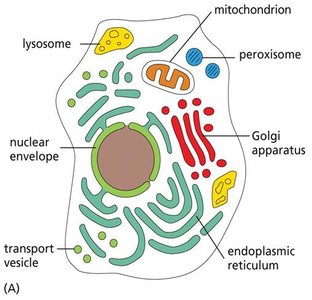
Eukaryotic cells contain membrane-bound organelles, each with specialized functions. Understanding these components is crucial for cell biology.
Nucleus: Contains DNA; controls cell activities.
Mitochondria: Site of cellular respiration; produces ATP.
Endoplasmic Reticulum (ER): Synthesizes proteins and lipids.
Golgi Apparatus: Modifies, sorts, and packages proteins and lipids.
Lysosomes: Digest cellular waste.
Peroxisomes: Break down fatty acids and detoxify.
Transport Vesicles: Move materials within the cell.
Chemical Bonds
Types of Chemical Bonds
Atoms interact to achieve stability by forming chemical bonds. The main types are ionic, covalent, and hydrogen bonds.
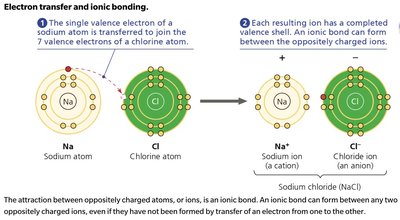
Ionic Bonds: Formed by transfer of electrons between atoms, resulting in charged ions.
Covalent Bonds: Formed by sharing electrons between atoms; can be polar or nonpolar.
Hydrogen Bonds: Weak interactions between molecules with polar covalent bonds.
Electronegativity and Bond Polarity
Electronegativity is the ability of an atom to attract shared electrons. Differences in electronegativity determine bond polarity.
Non-polar covalent bonds: Equal sharing of electrons.
Polar covalent bonds: Unequal sharing, resulting in partial charges (δ+ and δ-).
Ionic bonds: Large difference in electronegativity; electrons are transferred.
Summary Table: Elements in the Human Body
Element | Symbol | Percentage of Body Mass |
|---|---|---|
Oxygen | O | 65.0% |
Carbon | C | 18.5% |
Hydrogen | H | 9.5% |
Nitrogen | N | 3.3% |
Calcium | Ca | 1.5% |
Phosphorus | P | 1.0% |
Potassium | K | 0.4% |
Sulfur | S | 0.3% |
Sodium | Na | 0.2% |
Chlorine | Cl | 0.2% |
Magnesium | Mg | 0.1% |
Additional info:
Biomolecules are composed of elements that follow the rules of chemical bonding and polarity, which are fundamental to their biological function.
Cellular structure and function are directly related to the chemical properties of the molecules that compose them.
