 뒤로
뒤로General Biology Exam Review Guidance: Water, Membranes, Macromolecules, and Cellular Transport
스터디 가이드 - 스마트 노트
 자료에 맞춘 맞춤형 노트, 핵심 정의, 예시, 맥락을 확장해 제공합니다.
Q1. Which of the following is a hydrophobic material?
Background
Topic: Properties of Water and Hydrophobic/Hydrophilic Substances
This question tests your understanding of hydrophobic (water-repelling) versus hydrophilic (water-attracting) materials.
Key Terms:
Hydrophobic: Substances that do not mix with water; typically nonpolar.
Hydrophilic: Substances that mix well with water; typically polar or ionic.
Step-by-Step Guidance
Recall that hydrophobic materials are nonpolar and do not dissolve in water.
Consider the nature of each option: paper, oil, table salt, sugar.
Identify which material is nonpolar and does not interact with water.
Try solving on your own before revealing the answer!
Final Answer: B) oil
Oil is hydrophobic because it is nonpolar and does not mix with water.
Q2. What type of bonds are hydrophilic?
Background
Topic: Chemical Bonding and Water Interaction
This question tests your knowledge of which types of chemical bonds allow substances to interact with water.
Key Terms:
Hydrophilic: Water-loving, usually polar or ionic.
Covalent polar bonds: Bonds where electrons are shared unequally, creating partial charges.
Ionic bonds: Bonds formed by the transfer of electrons, resulting in charged ions.
Step-by-Step Guidance
Recall that hydrophilic substances dissolve in water due to their polarity or charge.
Review the bond types: polar covalent and ionic bonds.
Determine which bond types result in molecules that interact well with water.
Try solving on your own before revealing the answer!
Final Answer: D) both A and B
Both polar covalent and ionic bonds create hydrophilic substances that interact with water.
Q3. Cohesion, adhesion, and surface tension of water molecules are due to _____:
Background
Topic: Water Properties and Hydrogen Bonding
This question tests your understanding of the molecular interactions responsible for water's unique properties.
Key Terms:
Cohesion: Attraction between water molecules.
Adhesion: Attraction between water and other substances.
Surface tension: The 'skin' on water's surface due to molecular interactions.
Hydrogen bonds: Weak bonds between the hydrogen of one water molecule and the oxygen of another.
Step-by-Step Guidance
Recall that water molecules are polar and form hydrogen bonds with each other.
Consider how these bonds contribute to cohesion, adhesion, and surface tension.
Identify which type of bond is responsible for these properties.
Try solving on your own before revealing the answer!
Final Answer: A) hydrogen bonds
Hydrogen bonds between water molecules are responsible for cohesion, adhesion, and surface tension.
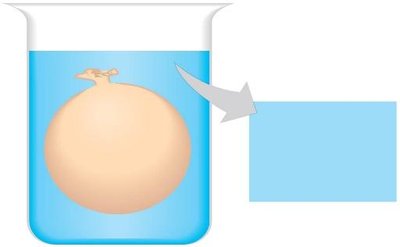
Q13. Draw solid arrows to indicate the net movement of water and glucose into/out of the cell. Is the cell in an isotonic, hypotonic, or hypertonic solution?
Background
Topic: Osmosis and Tonicity
This question tests your understanding of how water and solutes move across cell membranes based on concentration gradients.
Key Terms:
Osmosis: Movement of water across a membrane from high to low concentration.
Tonicity: The relative concentration of solutes inside and outside the cell (isotonic, hypotonic, hypertonic).
Isotonic: Equal solute concentration inside and outside.
Hypotonic: Lower solute concentration outside than inside.
Hypertonic: Higher solute concentration outside than inside.
Step-by-Step Guidance
Compare the concentrations of water and glucose inside and outside the cell.
Determine the direction of water movement (osmosis) based on concentration gradients.
Determine the direction of glucose movement based on its concentration gradient.
Assess whether the cell is in an isotonic, hypotonic, or hypertonic environment.
Try solving on your own before revealing the answer!
Final Answer:
Water will move out of the cell (from high to low concentration), and glucose will move into the cell (from high to low concentration). The cell is in a hypertonic solution because the environment has a higher solute (glucose) concentration than the cell.
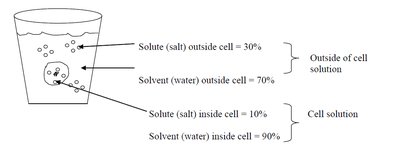
Q35. Where is the highest water concentration? Where is the lowest water concentration? Where is the lowest salt concentration? Where is the highest salt concentration? Which direction would the water move because of osmosis?
Background
Topic: Osmosis and Solute/Solvent Concentrations
This question tests your ability to interpret concentration gradients and predict the movement of water and solutes across a cell membrane.
Key Terms:
Solute: The substance dissolved (e.g., salt).
Solvent: The substance doing the dissolving (e.g., water).
Osmosis: Movement of water from high to low concentration.
Step-by-Step Guidance
Identify the water and salt concentrations inside and outside the cell.
Compare these concentrations to determine where each is highest and lowest.
Predict the direction of water movement based on osmosis (from high to low water concentration).
Set up your answer for each part: highest/lowest water, highest/lowest salt, direction of water movement.
Try solving on your own before revealing the answer!
Final Answer:
Highest water concentration: Inside the cell (90%)
Lowest water concentration: Outside the cell (70%)
Lowest salt concentration: Inside the cell (10%)
Highest salt concentration: Outside the cell (30%)
Direction of water movement: Out of the cell (from inside to outside)
Water moves from areas of higher concentration to lower concentration, so it leaves the cell in this scenario.
