 뒤로
뒤로General Biology Study Notes: Nutrition, Digestion, Gas Exchange, and Circulation
스터디 가이드 - 스마트 노트
 자료에 맞춘 맞춤형 노트, 핵심 정의, 예시, 맥락을 확장해 제공합니다.
Nutrition and Digestion
Introduction to Nutrition and Digestion
Understanding the structure and function of the digestive system is essential for evaluating dietary choices and maintaining health. Obesity and diet-related diseases are significant health concerns, making knowledge of nutrition and digestion crucial for informed decision-making.
Modes of Animal Nutrition
Herbivores: Eat mainly plants and algae (e.g., cattle, gorillas).
Carnivores: Eat other animals (e.g., lions, spiders).
Omnivores: Eat both plants and animals (e.g., humans, crows).
Animals have evolved four major feeding mechanisms:
Suspension feeders: Capture food particles from the surrounding medium.
Substrate feeders: Live in or on their food source and eat their way through it.
Fluid feeders: Suck nutrient-rich fluids from a living host.
Bulk feeders: Ingest large pieces of food.
Stages of Food Processing
Food processing in animals occurs in four main stages:
Ingestion: Taking in food.
Digestion: Breaking down food into absorbable molecules.
Absorption: Uptake of nutrients by body cells.
Elimination: Removal of undigested material.
Chemical digestion is necessary because animals cannot directly use the macromolecules in food.
Digestive Compartments
Sponges digest food in food vacuoles.
Cnidarians and flatworms have a gastrovascular cavity with a single opening.
Most animals have an alimentary canal (mouth to anus) with specialized regions.
The Human Digestive System
Food is ingested and chewed in the mouth, pushed into the pharynx, and moved by peristalsis through the alimentary canal.
Sphincters regulate movement into and out of the stomach.
Final digestion and absorption occur in the small intestine; undigested material is expelled via the large intestine and anus.
Oral Cavity and Swallowing
Mechanical and chemical digestion begin in the mouth.
The tongue shapes food into a bolus and moves it to the pharynx.
The swallowing reflex directs food into the esophagus, not the trachea.
Stomach Function
Secretes gastric juice (pepsinogen, mucus, HCl).
HCl activates pepsinogen to pepsin, which digests proteins.
Digestive Disorders
Acid reflux and GERD: Stomach acid enters the esophagus, causing heartburn.
Gastric ulcers: Open sores in the stomach lining, often caused by Helicobacter pylori infection.
Small Intestine
Major site of chemical digestion and nutrient absorption.
Enzymes from the pancreas and intestinal wall digest food; bile emulsifies fats.
Villi and microvilli increase surface area for absorption.
Liver and Large Intestine
The liver processes and detoxifies blood from the intestines.
The large intestine reclaims water, absorbs vitamins produced by bacteria, and compacts feces.
Diarrhea and constipation result from improper water reclamation.
Evolutionary Adaptations
Herbivores often have longer digestive tracts and compartments for cellulose-digesting microbes.
Nutrition: Dietary Requirements
Animals require energy (measured in kilocalories), raw materials, and essential nutrients.
Metabolic rate includes basal metabolic rate (BMR) and energy for activities.
Essential nutrients (fatty acids, amino acids, vitamins, minerals) must be obtained from the diet.
Vitamins and Minerals
Vitamins are organic molecules required in small amounts, often as coenzymes. Minerals are inorganic nutrients with diverse roles. A varied diet usually meets recommended dietary allowances (RDAs).
Dietary Deficiencies and Obesity
Malnutrition: Insufficient nutrients or calories; protein deficiency is most common worldwide.
Obesity: High body mass index (BMI); influenced by genetics, diet, and exercise. The hormone leptin suppresses appetite.
Diet and Disease
LDLs (low-density lipoproteins) increase risk of cardiovascular disease; HDLs (high-density lipoproteins) may decrease risk.
Diet influences the ratio of LDLs to HDLs and risk of cancer.
Dietary Guidelines for Reducing Cancer Risk |
|---|
Maintain a healthy weight throughout life. |
Eat five or more servings of fruits and vegetables daily. |
Choose whole grains over refined grains. |
Limit processed and red meats. |
Limit alcohol consumption. |
Gas Exchange
Overview of Gas Exchange
Gas exchange is the process by which organisms obtain oxygen (O2) and remove carbon dioxide (CO2). It is essential for cellular respiration and energy production.
Mechanisms of Gas Exchange
Occurs across thin, moist respiratory surfaces.
Some animals use skin; others use gills, tracheal systems, or lungs.
Human Respiratory System
Air enters through nostrils, passes through the pharynx, larynx, trachea, bronchi, and bronchioles to alveoli.
The diaphragm separates the thoracic and abdominal cavities and aids ventilation.
Surfactants prevent alveoli from sticking shut; mucus and cilia protect the lungs.
Breathing Mechanism
Ventilation occurs by negative pressure breathing: contraction of rib muscles and diaphragm expands the thoracic cavity, drawing air in.
Breathing is controlled by brain centers that monitor blood pH (CO2 levels).
Gas Transport in Blood
Oxygen-poor blood is pumped to the lungs, where it picks up O2 and releases CO2.
Oxygen-rich blood is delivered to body tissues.
Gases diffuse down their partial pressure gradients.
Hemoglobin Function
Hemoglobin (in vertebrates) binds O2, transports CO2, and buffers blood pH.
Other animals may use different respiratory pigments (e.g., copper-based in molluscs).
Circulation
Circulatory System Types
Gastrovascular cavities: Function in digestion and transport (e.g., cnidarians).
Open circulatory systems: Fluid bathes tissues directly (e.g., arthropods).
Closed circulatory systems: Blood is confined to vessels (e.g., vertebrates).
Vertebrate Cardiovascular Systems
Fish: Two-chambered heart, single circulation.
Amphibians/reptiles: Three-chambered heart, double circulation.
Birds/mammals: Four-chambered heart, double circulation (pulmonary and systemic circuits).
Human Cardiovascular System
Blood flows from the body to the right atrium, to the lungs, back to the left atrium, and out to the body via the aorta.
The SA node sets the heartbeat tempo; the AV node relays signals to the ventricles.
An electrocardiogram (ECG/EKG) detects heart electrical activity.
Cardiac Cycle
Diastole: Heart chambers fill with blood.
Systole: Atria and then ventricles contract, pumping blood.
Heart valves prevent backflow; cardiac output is the volume pumped per minute.
Cardiovascular Diseases
Heart attack: Damage to cardiac muscle, usually from blocked coronary arteries.
Stroke: Death of brain tissue due to blocked or ruptured arteries.
Atherosclerosis: Fatty plaques narrow arteries, increasing risk of heart attack and stroke.
Blood Vessels: Structure and Function
Arteries: Thick, elastic walls; carry blood away from the heart.
Veins: Thinner walls, lower pressure; one-way valves prevent backflow.
Capillaries: Thin walls for exchange of gases, nutrients, and wastes.
Blood Pressure and Flow
Blood pressure is highest in arteries, lowest in veins.
Blood velocity is slowest in capillaries, allowing exchange.
Skeletal muscle contractions and valves help move blood through veins.
Blood Pressure Measurement
Measured as systolic (during ventricular contraction) and diastolic (during relaxation) pressures.
Hypertension (high blood pressure) is a major risk factor for cardiovascular disease.
Regulation of Blood Flow
Smooth muscle in arterioles and precapillary sphincters regulate blood distribution to tissues.
Capillary Exchange
Blood pressure forces fluid out at the arterial end; osmotic pressure draws fluid in at the venous end.
Excess fluid returns via lymph vessels.
Blood Composition and Function
Plasma: Contains ions, proteins, nutrients, wastes, gases, and hormones.
Red blood cells (erythrocytes): Transport O2 via hemoglobin.
White blood cells (leukocytes): Defend against infection; some are phagocytes.
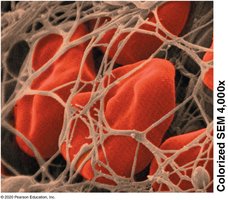
Platelets: Cell fragments involved in blood clotting.
Blood Disorders
Anemia: Low hemoglobin or red blood cell count; causes fatigue.
Erythropoietin (EPO): Hormone that stimulates red blood cell production.
Blood Clotting
Platelets adhere to damaged vessels and help convert fibrinogen to fibrin, forming a clot.
Stem Cells and Blood Cell Diseases
Adult stem cells in red bone marrow differentiate into all blood cell types.
Leukemia: Cancer of white blood cells; stem cell transplants can treat blood cell diseases.
