 뒤로
뒤로Human Tissue Types and Organization in Multicellular Organisms
스터디 가이드 - 스마트 노트
 자료에 맞춘 맞춤형 노트, 핵심 정의, 예시, 맥락을 확장해 제공합니다.
Organization in Multicellular Organisms
Levels of Biological Organization
Multicellular organisms are structured in a hierarchy of increasing complexity, allowing specialized cells to work together efficiently. This organization is essential for the integration and coordination of life functions.
Cell: Basic unit of life, capable of performing all necessary functions.
Tissue: Groups of similar cells performing a common function.
Organ: Structures composed of multiple tissue types working together.
Organ System: Groups of organs that coordinate to perform major body functions.
Organism: Complete living entity.
Population: Group of organisms of the same species.
Community: Multiple populations interacting.
Ecosystem: Community plus its physical environment.
Biosphere: All ecosystems on Earth.
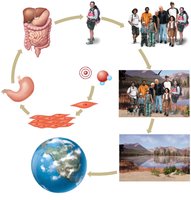
Additional info: This hierarchical structure is fundamental to understanding how multicellular life is organized and how specialized functions are distributed.
Major Tissue Types
Overview of Tissue Types
Tissues are groups of specialized cells that share similar structure and perform common functions. The four major tissue types in the human body are:
Epithelial Tissue
Connective Tissue
Muscle Tissue
Nervous Tissue
Epithelial Tissues
Structure and Function
Epithelial tissues consist of sheets of cells that cover or line surfaces and body cavities. They serve as protective barriers, reduce friction, absorb nutrients and water, and secrete waste products.
Examples: Skin, lining of mouth, digestive tract, lungs, bladder, blood vessels, kidney tubules.
Specialization: Glandular epithelia produce and secrete products via exocrine or endocrine glands.
Classification of Epithelial Tissues
Epithelial tissues are classified by cell shape and number of layers:
Shape:
Squamous: Flattened, plate-like cells.
Cuboidal: Cube-shaped cells.
Columnar: Tall, column-shaped cells (often with goblet cells).
Layers:
Simple: Single layer.
Stratified: Multiple layers.
Basement Membrane and Junctions
Basement Membrane: Non-cellular layer beneath epithelial cells, provides support and anchors to connective tissue.
Junctions: Hold epithelial cells together; three main types depending on tissue function.
Connective Tissues
General Functions
Connective tissues support organs, connect body parts, store fat, and produce blood cells. They contain few living cells and are divided into fibrous and specialized types.
Fibrous Connective Tissue
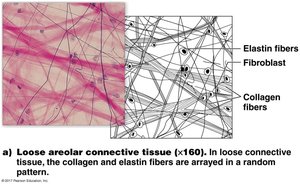
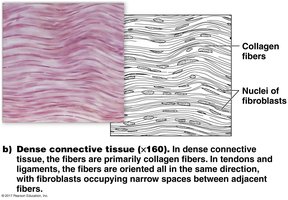
Fibrous connective tissue connects body parts, providing support, strength, and flexibility. Fibers are embedded in a ground substance made of water, polysaccharides, and proteins. Fibroblasts produce the proteins for fibers.
Collagen fibers: Provide strength and slight flexibility.
Elastic fibers: Made of elastin, stretch and recoil easily.
Reticular fibers: Thin collagen fibers, form structural frameworks for soft organs.
Sub-classifications of Fibrous Connective Tissue
Loose (Areolar) Connective Tissue
Loose connective tissue contains few collagen and elastic fibers in a random arrangement, making it flexible and moderately strong. It surrounds internal organs, blood vessels, and muscles.
Dense Connective Tissue
Dense connective tissue has more collagen fibers arranged in one direction, making it very strong. It is found in tendons, ligaments, and lower layers of skin. It contains few living cells and has a low nutrient supply, resulting in slow healing.
Elastic Connective Tissue
Contains a large proportion of elastic fibers, allowing it to stretch and recoil. Found in organs that change shape/size, such as the bladder, stomach, and vocal cords.
Reticular Connective Tissue
Made of thin, branched reticular fibers, providing a flexible internal framework for soft organs of the lymphatic system (liver, spleen, tonsils, lymph nodes).
Specialized Connective Tissues
Cartilage: Similar to dense connective tissue, but with more water and produced by chondrocytes. Functions as transitional tissue, maintains shape, and cushions joints.
Bone: Contains few living cells, supplied by blood vessels, and has a matrix of hard mineral deposits (Ca2+, PO43-).
Blood: Formed from stem cells in bone marrow, contains multiple cell types suspended in plasma. Red blood cells transport O2 and CO2, white blood cells defend, platelets clot blood.
Adipose: Loose connective tissue specialized for fat storage in adipocytes. Located under skin and around organs for insulation and protection.
Muscle Tissues
Types and Functions
Muscle tissues are specialized for contraction and movement. Proteins in the cytoplasm interact to cause contraction. There are three types:
Skeletal Muscle: Connects to tendons and bones, voluntary, long and thin fibers, multinucleated, activated by nerves.
Cardiac Muscle: Found in the heart, involuntary, short and blunt cells, gap junctions for coordinated contraction, one nucleus, activated by pacemaker cells.
Smooth Muscle: Found in blood vessels and hollow organs, involuntary, smaller tapered cells, one nucleus, gap junctions, maintains contraction.
Nervous Tissue
Structure and Function
Nervous tissue contains specialized cells for generating and transmitting electrical impulses. Located in the brain, spinal cord, and nerves. Two main cell types:
Neurons: Three types—sensory, interneurons, motor neurons.
Glial Cells: Provide physical support and protection, maintain chemical and nutrient concentrations, do not generate electrical impulses.
Parts of a Neuron
Cell body: Contains nucleus, DNA, mitochondria, and organelles.
Dendrites: Receive information from receptors or other neurons.
Axon: Conducts electrical impulses, branches into axon terminals ending with axon bulbs.
Types of Neurons
Sensory neurons: Receive stimulus, transmit information to CNS.
Interneurons: Integrate information within CNS.
Motor neurons: Transmit information from CNS to tissues/organs for response.
Glial Cells
Make up about 80% of nervous system cells.
Maintain healthy environment for neurons.
Additional info: Understanding tissue types is foundational for studying human biology, physiology, and medical sciences. Each tissue type plays a distinct role in maintaining the structure and function of the body.
