 뒤로
뒤로Introduction: Evolution and the Foundations of Biology
스터디 가이드 - 스마트 노트
 자료에 맞춘 맞춤형 노트, 핵심 정의, 예시, 맥락을 확장해 제공합니다.
Chapter 1: Introduction – Evolution and the Foundations of Biology
Overview of Biology’s Unifying Themes
Biology is the scientific study of life, encompassing a vast diversity of organisms and processes. Despite this diversity, several unifying themes connect all biological study. Understanding these themes provides a framework for exploring the complexity of life.
Evolution: The process by which populations of organisms change over generations, resulting in the diversity of life observed today.
Organization: Biological systems are structured in a hierarchical manner, from molecules to the biosphere.
Information: Life’s processes are directed by genetic information encoded in DNA.
Energy and Matter: All living organisms require energy and matter, which flow and cycle through ecosystems.
Interactions: Organisms interact with each other and their environments, forming complex systems.
Theme 1: Evolution – The Core Theme of Biology
Evolution is the central concept that explains both the unity and diversity of life. Through natural selection, populations adapt to their environments over time. For example, the Peromyscus polionotus (beach mouse) has evolved a light coat color that camouflages it against the white sand dunes, while inland populations are darker to blend with soil and vegetation. This adaptation provides protection from predators and illustrates how evolution shapes traits to fit specific habitats.
Natural Selection: The process by which individuals with advantageous traits survive and reproduce more successfully, leading to the accumulation of those traits in the population.
Unity and Diversity: All organisms share common features due to shared ancestry, but evolutionary processes generate the diversity of life forms.
Example: The beach mouse’s coat color matches its sandy habitat, an adaptation resulting from natural selection.
Theme 2: Organization – Structure Fits Function
Biological organization is hierarchical, with each level building on the previous one. Structure and function are closely related at all levels, from molecules to the biosphere. For example, the structure of a mouse’s heart enables it to pump blood efficiently, supporting the animal’s survival.
Levels of Organization: Molecule → Organelle → Cell → Tissue → Organ → Organism → Population → Community → Ecosystem → Biosphere
Structure-Function Relationship: The form of biological structures enables their specific functions (e.g., the shape of red blood cells allows efficient oxygen transport).
Theme 3: Information – The Role of DNA
Genetic information is stored in DNA, which directs the development and functioning of all living things. Genes encode instructions for building proteins, which determine an organism’s traits. For example, genes control the fur color of mice, influencing their adaptation to different environments.
Gene: A segment of DNA that contains instructions for making a specific protein.
Genotype and Phenotype: The genetic makeup (genotype) determines observable traits (phenotype).
Example: A gene for brown fur or white fur in mice determines their coat color.
Theme 4: Energy and Matter – Life’s Requirements
All living organisms require energy to carry out life processes. Energy flows one way through ecosystems, typically entering as sunlight and exiting as heat, while matter cycles between organisms and their environment. For example, plants capture solar energy, which is transferred to animals like mice when they eat the plants.
Energy Flow: Sun → Plants (producers) → Animals (consumers) → Decomposers
Matter Cycling: Elements such as carbon and nitrogen cycle between living and nonliving components of ecosystems.
Example: A mouse eating a plant and being preyed upon by a hawk demonstrates energy transfer and matter cycling.
Theme 5: Interactions – Systems and Their Components
Organisms interact with each other and their physical environment, forming complex systems. These interactions can be cooperative or competitive and are essential for ecosystem stability. For example, predator-prey relationships, such as a hawk hunting a mouse, illustrate biological interactions within a system.
Biological Systems: Groups of interacting components that function together (e.g., an ecosystem, an organ system).
Feedback Mechanisms: Processes that regulate biological systems, such as homeostasis.
Scientific Inquiry in Biology
Biology relies on scientific inquiry, which involves asking questions, forming hypotheses, and testing them through experiments and observations. Collaboration and diverse viewpoints enhance scientific progress.
Hypothesis: A testable explanation for an observation or phenomenon.
Scientific Method: Observation → Question → Hypothesis → Experiment → Analysis → Conclusion
Importance of Collaboration: Sharing data and perspectives leads to more robust scientific understanding.
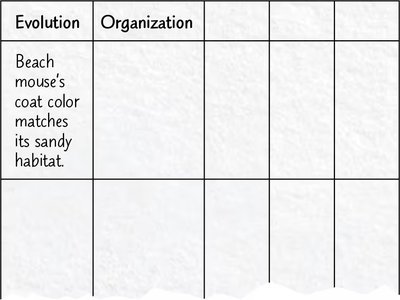
Sample Table: Unifying Themes of Biology
The following table helps organize examples of the five unifying themes of biology. (Additional info: Only the first cell is filled in; students are encouraged to complete the table as they study.)
Evolution | Organization | Information | Energy & Matter | Interactions |
|---|---|---|---|---|
Beach mouse’s coat color matches its sandy habitat. |
Learning Objectives
Use examples to illustrate each theme of biology.
Summarize how evolution accounts for the unity and diversity of life.
Describe the process of scientific inquiry and evaluate the importance of collaboration and diverse viewpoints to scientific progress.
Practice Questions
Which of the following statements is true regarding evolution?
Evolution is the process of change over time that has resulted in the array of organisms found on Earth.
Which of the following statements about biology is most accurate?
Asking questions about the living world and seeking answers through scientific inquiry are the central activities of biology.
