뒤로
뒤로Introduction to Biology & The Scientific Process: Levels of Organization, Emergent Properties, and Scientific Reasoning
스터디 가이드 - 스마트 노트
 자료에 맞춘 맞춤형 노트, 핵심 정의, 예시, 맥락을 확장해 제공합니다.
Introduction to Biology & The Scientific Process
Levels of Biological Organization
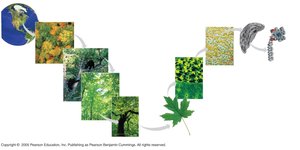
Biology examines life at multiple levels, from the smallest molecules to the entire biosphere. Understanding these levels helps scientists study complex biological systems by breaking them down into manageable parts.
Atoms: The basic units of matter.
Molecules: Groups of atoms bonded together.
Organelles: Specialized structures within cells.
Cells: The fundamental unit of life.
Tissues: Groups of similar cells performing a specific function.
Organs and Organ Systems: Structures composed of tissues that perform specific tasks; organ systems are groups of organs working together.
Organisms: Individual living entities.
Populations: Groups of organisms of the same species in a given area.
Communities: All the different populations in a specific area.
Ecosystems: Communities and their nonliving environment.
Biosphere: All ecosystems on Earth.
Reductionism and Systems Biology
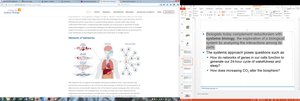
Reductionism is the approach of reducing complex systems to simpler components for study, often using model organisms. However, biologists also use systems biology to analyze interactions among parts at different levels, providing a holistic understanding of biological systems.
Model Organisms: Species that are easy to study and provide insight into biological processes.
Systems Biology: Focuses on the interactions and relationships between components of biological systems.
Emergent Properties
Emergent properties arise from the arrangement and interaction of parts within a system. These properties are not present in individual components but emerge when components interact at higher levels of organization.
Example: Flock of Birds – The coordinated movement of a flock is an emergent property not seen in individual birds.
Example: Ant Colony – The colony exhibits organization and stability beyond the lifespan of individual ants.
Structure and Function in Biology
At every level of the biological hierarchy, there is a close relationship between structure and function. The form of a biological structure often determines its function.
Mitochondria: The inner membrane's many infoldings (cristae) increase surface area for energy production.
Seeds Dispersed by Wind: Lightweight structure aids dispersal.
Streamlined Fish Bodies: Adapted for rapid swimming.
Large Roots in Desert Plants: Adapted for water absorption.
Intestinal Cells: Projections increase surface area for nutrient absorption.

The Scientific Process
Steps of the Scientific Process
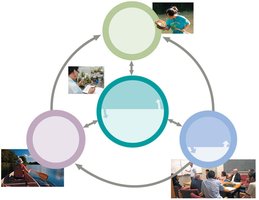
The scientific process is a systematic method for investigating natural phenomena. It involves making observations, forming logical hypotheses, and testing them through experiments and data analysis.
Observation: Gathering information about phenomena.
Hypothesis Formation: Proposing explanations based on observations.
Experimentation: Testing hypotheses through controlled experiments.
Data Collection: Recording observations and measurements.
Analysis and Feedback: Interpreting results and refining hypotheses.
Societal Benefits: Applying scientific knowledge for societal advancement.
Case Study: Natural Selection in Humans
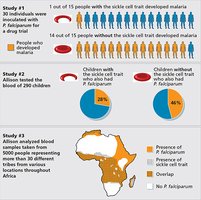
Scientists use the scientific process to study natural selection, such as the relationship between sickle cell trait and malaria resistance in humans. This involves collecting both qualitative and quantitative data, forming hypotheses, and testing them through observation and experimentation.
Qualitative Data: Descriptive observations (e.g., symptoms, behaviors).
Quantitative Data: Numerical measurements (e.g., number of cases, frequency of traits).
Types of Data in Biology
Data collected in biological research can be categorized as:
Quantitative Data: Numerical measurements, such as length, mass, or frequency.
Qualitative Data: Descriptive information, such as color, texture, or behavior.

Inductive vs. Deductive Reasoning
Biologists use both inductive and deductive reasoning to develop and test hypotheses:
Inductive Reasoning: Drawing general conclusions from many specific observations. For example, observing that all swans seen are white and concluding that all swans are white.
Deductive Reasoning: Making predictions based on general principles or rules, then testing these predictions. For example, if all organisms are made of cells, and humans are organisms, then humans are made of cells.