 뒤로
뒤로Introduction to Biology: Characteristics and Classification of Life
스터디 가이드 - 스마트 노트
 자료에 맞춘 맞춤형 노트, 핵심 정의, 예시, 맥락을 확장해 제공합니다.
Introduction to Biology
Characteristics of Life
Biologists use several criteria to distinguish living organisms from non-living things. These characteristics must all be present for an entity to be classified as "living."
Molecular Composition: Living things have a unique molecular makeup, often including complex biomolecules such as proteins, nucleic acids, lipids, and carbohydrates.
Energy and Raw Materials: All living organisms require energy (usually from food or sunlight) and raw materials to sustain their functions and growth.
Cellular Structure: Living things are composed of one or more cells, which are the basic units of life.
Homeostasis: The ability to maintain a stable internal environment despite external changes.
Response to Environment: Living organisms can detect and respond to stimuli in their surroundings.
Growth and Reproduction: Living things grow and reproduce, passing genetic information to their offspring.
Evolution: Populations of living organisms evolve over time through genetic changes and natural selection.
Classification of Living Things
Living organisms are classified based on shared characteristics in a hierarchical system. This system helps scientists organize and understand the diversity of life.
Domain
Kingdom
Phylum
Class
Order
Family
Genus
Species
Mnemonic: "Does King Phillip Come Over For Good Spaghetti?" helps remember the order of classification.
Human Classification Example
Humans are classified as follows:
Domain: Eukarya
Kingdom: Animalia
Phylum: Chordata (possess a neural cord)
Class: Mammalia (have mammary glands)
Order: Primates (includes lemurs, monkeys, apes)
Family: Hominidae (ancient and modern humans)
Genus: Homo
Species: sapiens
Formatting Note: Genus and species names are always italicized, with the genus capitalized and the species lowercase (e.g., Homo sapiens).
Defining Features of Humans
Humans possess several unique characteristics that distinguish them from other living organisms:
Bipedalism: Ability to walk upright on two legs.
Opposable Thumbs: Enables grasping and manipulating objects.
Larger Brain: Supports advanced cognitive functions.
Complex Language: Capacity for sophisticated communication.
These features have contributed to human survival and adaptation, but do not necessarily make humans "better" than other species—just different.
Biological Organization of Humans
Levels of Biological Organization
Biologists study living organisms at various levels of organization, from the molecular to the global scale. Understanding these levels helps explain how complex life forms are structured and function.
Level | Description |
|---|---|
Atom | Smallest unit of an element; consists of protons, neutrons, and electrons. |
Molecule | Two or more atoms bonded together; e.g., water (H2O). |
Cell | Fundamental unit of structure and function in living organisms. |
Tissue | A group of similar cells working together to perform a specific function. |
Organ | A structure composed of two or more tissue types working together; e.g., stomach. |
Organ System | A group of organs that work together to perform major functions; e.g., digestive system. |
Organism | An individual living being composed of multiple organ systems. |
Population | A group of individuals of the same species living in a specific area. |
Community | All living organisms in a particular area. |
Ecosystem | All living organisms plus the non-living environment in a given area. |
Biosphere | The sum total of all ecosystems on Earth. |
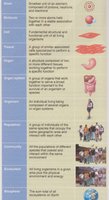
Example: The human digestive system is an organ system composed of organs such as the stomach, intestines, and liver, which are made up of tissues and cells.
Summary
Living things share seven key characteristics.
Classification of life follows a hierarchical system.
Humans are distinguished by bipedalism, opposable thumbs, larger brains, and complex language.
Biological organization ranges from atoms to the biosphere.
Additional info: The study of biology at different levels—from molecules to tissues—provides insight into both the structure and function of living organisms, especially humans.
