뒤로
뒤로Introduction to Biology: Themes, Organization, and Scientific Inquiry
스터디 가이드 - 스마트 노트
 자료에 맞춘 맞춤형 노트, 핵심 정의, 예시, 맥락을 확장해 제공합니다.
Introduction to Biology
The Science of Life
Biology is the scientific study of life, encompassing a vast scope that unifies much of natural science. Living systems are the most complex chemical systems on Earth, and their study is constrained by the properties of chemistry and physics. Modern biology is increasingly interdisciplinary, combining multiple scientific fields to understand life.
Unifying Themes in Biology
Major Themes
The study of life reveals several unifying themes that help organize biological knowledge:
Organization
Information
Energy and Matter
Interactions
Evolution
Characteristics of Living Organisms
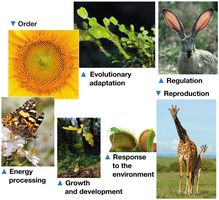
All living organisms share several fundamental characteristics:
Composed of cells
Complex and ordered
Respond to their environment
Can grow, develop, and reproduce
Obtain and use energy
Maintain internal balance (homeostasis)
Allow for evolutionary adaptation
Biological Organization
Hierarchical Organization of Living Systems
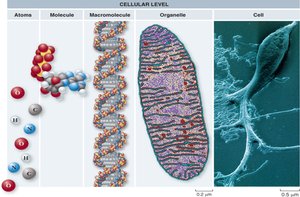
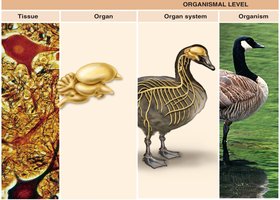
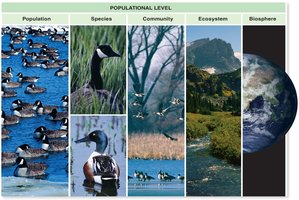
Living systems exhibit hierarchical organization, with each level building upon the previous one. This hierarchy includes:
Cellular Level: Atoms, molecules, macromolecules, organelles, cells
Organismal Level: Tissues, organs, organ systems, organisms
Populational Level: Populations, species, communities, ecosystems, biosphere
Emergent Properties
Each level of organization exhibits emergent properties—characteristics that arise from the arrangement and interaction of parts as complexity increases. These properties cannot be deduced by examining the parts alone. For example, "life" itself is an emergent property of complex molecular interactions.
Structure and Function
There is a strong correlation between structure and function at every level of the biological hierarchy. Analyzing a biological structure provides clues about its function, and understanding a function can reveal insights into structure and organization.
Example: The receptor for insulin on human cells can be compared to similar molecules in other organisms, such as worms, to infer similar functions.
Cell Theory
Principles of Cell Theory
The cell theory is a foundational concept in biology:
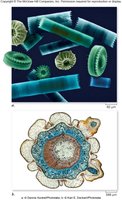
The cell is the smallest unit of organization that can perform all activities required for life.
All organisms are composed of cells.
All cells come from preexisting cells.
Genetic Information and Inheritance
Expression and Transmission of Genetic Information
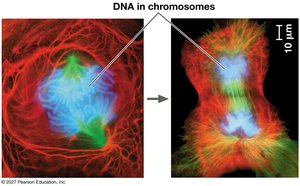
Within cells, structures called chromosomes contain genetic material in the form of DNA (deoxyribonucleic acid). The continuity of life depends on the faithful copying of DNA into daughter cells during cell division.
DNA: The Genetic Material
DNA is composed of four types of nucleotides (bases) that encode cellular information.
Gene: A discrete unit of information and inheritance.
Genome: The entire set of DNA instructions in an organism.
Each chromosome contains one long DNA molecule with hundreds or thousands of genes, which encode information for building cellular molecules.
The genetic information in DNA directs the development and functioning of organisms.
Evolution: The Core Theme of Biology
Diversity and Unity of Life
The diversity of life arises through evolution, while the underlying unity of biochemistry and genetics suggests a common origin for all life forms. Evolutionary change over time has produced the vast diversity of organisms observed today.
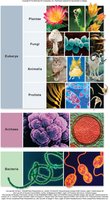
Bacteria: Single-celled prokaryotes
Archaea: Single-celled prokaryotes
Eukarya: Single-celled or multicellular eukaryotes (including plants, fungi, animals, and protists)
Evolutionary Conservation
All organisms today descended from a simple ancestral organism more than 4 billion years ago. Some characteristics, such as the use of DNA, are highly conserved, reflecting their fundamental roles in life. Cells are information-processing systems, using DNA to direct the synthesis of cellular components and to process environmental information.
The Nature of Science
Scientific Inquiry
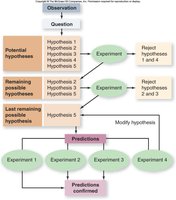
Science is a systematic approach to understanding the natural world. It involves making observations, forming hypotheses, making predictions, conducting experiments, and drawing conclusions.
Deductive reasoning: Uses general principles to make specific predictions.
Inductive reasoning: Uses specific observations to develop general conclusions.

The Scientific Method
The scientific method is an iterative process that includes:
Observation
Hypothesis formation
Prediction
Experimentation
Conclusion

Hypotheses and Experiments
A hypothesis is a possible explanation for an observation. It must be testable and is often tested in multiple ways.
Experiments are designed to test hypotheses, typically by manipulating one variable at a time and using control experiments for comparison.
Predictions derived from hypotheses provide a way to test their validity. If experimental results are inconsistent with predictions, the hypothesis must be rejected or revised.
Philosophical Approaches in Science
Reductionism: Breaking complex processes into simpler parts for study.
Systems biology: Focusing on emergent properties that arise from the interactions of simpler parts.
Models: Conceptual frameworks that organize knowledge and suggest experiments.
Scientific Theory
A scientific theory is a body of interconnected concepts supported by extensive experimental evidence and reasoning. It expresses ideas of which scientists are most certain, in contrast to the general use of "theory" as a guess or assumption.
Unity and Diversity of Life: Evolution as the Core Theme
Evolution Explains Unity and Diversity
Evolution provides the scientific explanation for both the unity and diversity of organisms. Living organisms are modified descendants of common ancestors, and abundant evidence supports the occurrence of evolution.
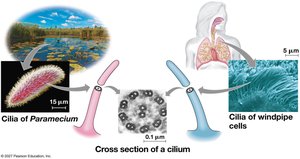
Example: The architecture of cilia in eukaryotes demonstrates unity underlying diversity, as similar structures are found in different organisms performing similar functions.