 뒤로
뒤로Introduction to Human Anatomy and Physiology: Organization, Terminology, and Homeostasis
스터디 가이드 - 스마트 노트
 자료에 맞춘 맞춤형 노트, 핵심 정의, 예시, 맥락을 확장해 제공합니다.
Introduction to Biology and Human Anatomy
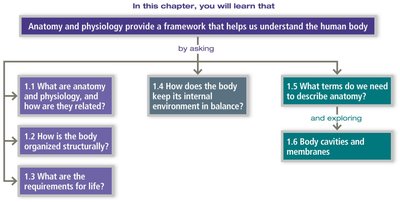
Overview of Anatomy and Physiology
Anatomy is the study of the structure of body parts and their relationships to one another, while physiology is the study of the function of the body’s structural machinery. Together, these disciplines provide a framework for understanding the human body and its complex systems.
Anatomy: Focuses on the form and organization of body structures.
Physiology: Explores how those structures function and interact.
Principle of Complementarity: Structure determines function, and function can influence structure.
Structural Organization of the Human Body
Levels of Organization
The human body exhibits a hierarchical organization, from the simplest chemical level to the complex organismal level. Each level builds upon the previous one, demonstrating the principle of emergent properties.
Chemical Level: Atoms combine to form molecules.
Cellular Level: Cells are made up of molecules and are the basic units of life.
Tissue Level: Groups of similar cells form tissues (epithelial, connective, muscle, nervous).
Organ Level: Organs are made up of different types of tissues.
Organ System Level: Organ systems consist of different organs that work together closely.
Organismal Level: The human organism is made up of many organ systems.
Major Organ Systems
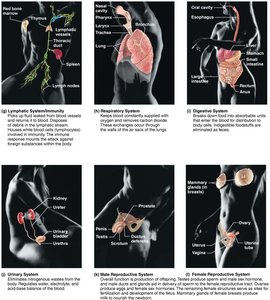
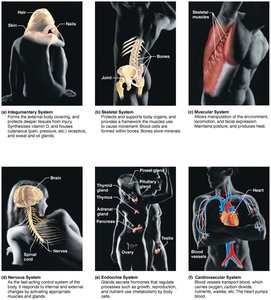
The human body contains eleven major organ systems, each with specific functions essential for survival and homeostasis.
Integumentary System: Protection, temperature regulation, sensation.
Skeletal System: Support, movement, protection, blood cell production.
Muscular System: Movement, posture, heat production.
Nervous System: Fast-acting control system, responds to stimuli.
Endocrine System: Hormonal regulation of body processes.
Cardiovascular System: Transport of nutrients, gases, wastes.
Lymphatic System: Immunity, fluid balance.
Respiratory System: Gas exchange (O2 and CO2).
Digestive System: Breakdown and absorption of nutrients.
Urinary System: Elimination of wastes, water balance.
Reproductive System: Production of offspring.
Directional Terms, Body Planes, and Regions
Directional Terms
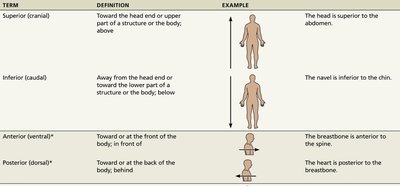
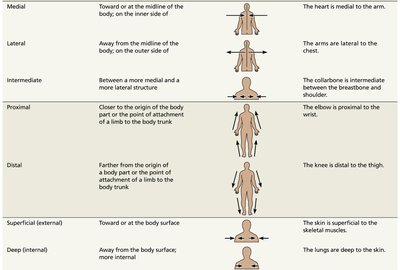
Directional terms are used to describe the locations of structures relative to other structures or locations in the body. These terms are essential for clear communication in anatomy.
Term | Definition | Example |
|---|---|---|
Superior (cranial) | Toward the head end or upper part of a structure | The head is superior to the abdomen. |
Inferior (caudal) | Away from the head end or toward the lower part | The navel is inferior to the chin. |
Anterior (ventral) | Toward or at the front of the body | The breastbone is anterior to the spine. |
Posterior (dorsal) | Toward or at the back of the body | The heart is posterior to the breastbone. |
Medial | Toward the midline of the body | The heart is medial to the arm. |
Lateral | Away from the midline of the body | The arms are lateral to the chest. |
Proximal | Closer to the origin of a body part | The elbow is proximal to the wrist. |
Distal | Farther from the origin of a body part | The knee is distal to the thigh. |
Superficial (external) | Toward or at the body surface | The skin is superficial to the skeletal muscles. |
Deep (internal) | Away from the body surface | The lungs are deep to the skin. |
Body Planes and Sections
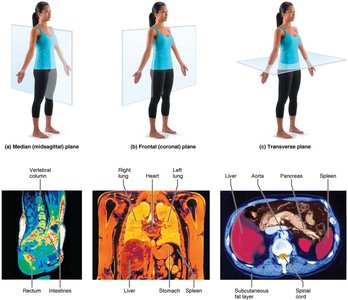
Body planes are imaginary lines used to divide the body into sections for anatomical study and medical imaging.
Median (Midsagittal) Plane: Divides the body into equal right and left halves.
Frontal (Coronal) Plane: Divides the body into anterior and posterior parts.
Transverse (Horizontal) Plane: Divides the body into superior and inferior parts.
Body Cavities and Membranes
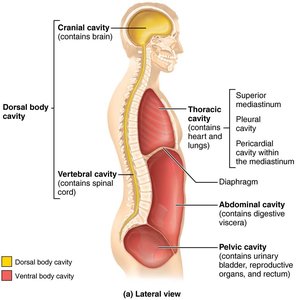
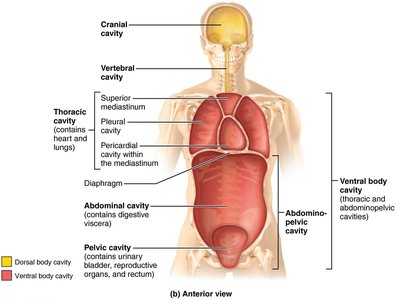
The body contains several cavities that house and protect vital organs. These cavities are lined by membranes that provide lubrication and reduce friction.
Dorsal Body Cavity: Contains the cranial cavity (brain) and vertebral cavity (spinal cord).
Ventral Body Cavity: Contains the thoracic cavity (heart and lungs) and abdominopelvic cavity (digestive, urinary, and reproductive organs).
Serous Membranes: Double-layered membranes that cover organs and line cavities (e.g., pericardium, pleura, peritoneum).
Abdominopelvic Quadrants and Regions
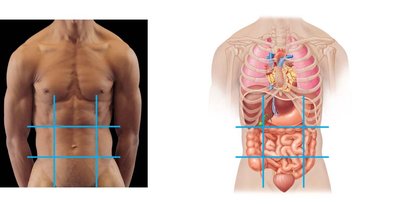
The abdominopelvic cavity is divided into quadrants and regions for clinical and anatomical reference.
Quadrants: Right Upper (RUQ), Left Upper (LUQ), Right Lower (RLQ), Left Lower (LLQ).
Nine Regions: Right/Left hypochondriac, epigastric, right/left lumbar, umbilical, right/left iliac (inguinal), hypogastric (pubic).
Characteristics of Life
Essential Properties of Living Systems
All living organisms share several fundamental characteristics that distinguish them from non-living matter.
Organization: Highly ordered structure from molecules to organisms.
Energy Use and Metabolism: Ability to acquire and use energy to maintain order and support life processes.
Homeostasis: Maintenance of a stable internal environment despite external changes.
Irritability/Responsiveness: Ability to sense and respond to stimuli.
Growth and Development: Increase in size and complexity over time.
Reproduction: Ability to produce new individuals and transmit genetic information.
Evolution: Capacity for populations to change over generations through genetic variation and natural selection.
Homeostasis and Feedback Mechanisms
Homeostasis
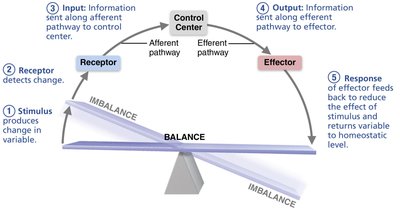
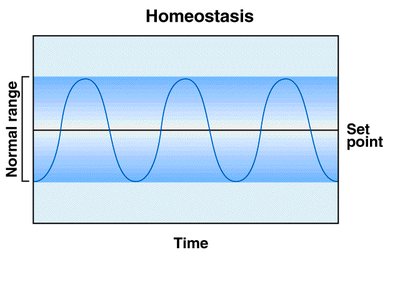
Homeostasis is the process by which living organisms maintain a relatively stable internal environment. This is essential for the proper functioning of cells and organ systems.
Negative Feedback: The most common mechanism; reduces or negates deviations from a set point (e.g., body temperature regulation).
Positive Feedback: Enhances or amplifies changes; usually not homeostatic (e.g., blood clotting, childbirth).
Example: Body Temperature Regulation
When body temperature rises above or falls below the set point, receptors detect the change, the control center processes the information, and effectors (such as sweat glands or muscles) restore balance.
Example: Positive Feedback in Blood Clotting
During blood clotting, platelets release chemicals that attract more platelets, amplifying the response until the clot is formed.
Survival Needs
Basic Requirements for Life
To survive, humans require several essential factors:
Nutrients: For energy and cell building.
Oxygen: Required for cellular respiration.
Water: Most abundant chemical in the body; necessary for metabolic reactions.
Normal Body Temperature: Needed for proper metabolic function.
Appropriate Atmospheric Pressure: Required for breathing and gas exchange.
Additional Academic Context
Emergent Properties: New properties arise at each level of organization that are not present at the preceding level.
Genetic Information Flow: DNA (genes) → RNA → Protein (central dogma of molecular biology).
Evolution: Genetic variation and mutation drive diversity and adaptation in populations over time.
