 뒤로
뒤로Membrane Structure and Function: Study Guide for General Biology
스터디 가이드 - 스마트 노트
 자료에 맞춘 맞춤형 노트, 핵심 정의, 예시, 맥락을 확장해 제공합니다.
Membrane Structure and Function
Fluid Mosaic Model of Cellular Membranes
The fluid mosaic model describes the structure of the plasma membrane as a dynamic combination of lipids and proteins. The membrane is primarily composed of a phospholipid bilayer with embedded proteins, carbohydrates, and cholesterol, allowing for flexibility and diverse functions.
Phospholipids: Amphipathic molecules with hydrophilic heads and hydrophobic tails, forming the bilayer.
Membrane fluidity: Maintained by unsaturated hydrocarbon tails (increase fluidity), cholesterol (stabilizes fluidity), and temperature.
Integral proteins: Span or are embedded in the membrane, involved in transport and signaling.
Peripheral proteins: Attached to the membrane surface, involved in support and communication.
Membrane carbohydrates: Glycolipids and glycoproteins, important for cell-cell recognition.
Cholesterol: Modulates membrane fluidity and stability.
ECM fibers and cytoskeleton microfilaments: Provide structural support inside and outside the cell.
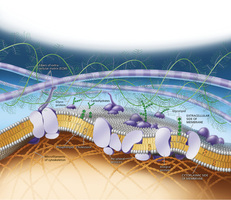
Example: Glycoproteins and glycolipids are used for cell recognition, such as sorting cells in embryonic development and immune response.
Selective Permeability of Membranes
Cell membranes are selectively permeable, allowing only certain substances to cross. This property is due to the structure of the phospholipid bilayer and the presence of specific transport proteins.
Channel proteins: Provide hydrophilic tunnels for molecules/ions to pass.
Carrier proteins: Bind and change shape to shuttle substances across.
Transport proteins: Highly specific, e.g., aquaporins for water.
Vesicle fusion (exocytosis): Adds membrane components and releases contents outside the cell.
Example: Glucose is transported by carrier proteins, while oxygen diffuses directly through the membrane.
Passive Transport: Diffusion, Osmosis, and Facilitated Diffusion
Passive transport involves movement of substances across the membrane without energy input. It includes diffusion, osmosis, and facilitated diffusion.
Diffusion: Movement of particles from high to low concentration.
Osmosis: Diffusion of water across a selectively permeable membrane.
Facilitated diffusion: Passive movement of polar molecules/ions via transport proteins.
Concentration gradient: Drives passive transport.
Isotonic: No net water movement.
Hypertonic: Cell loses water.
Hypotonic: Cell gains water.
Turgid: Firm plant cell in hypotonic solution.
Flaccid: Limp plant cell in isotonic solution.
Plasmolysis: Plant cell shrivels in hypertonic solution.
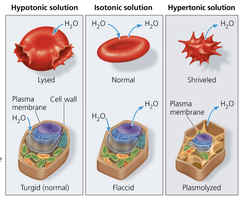
Example: Red blood cells burst in hypotonic solutions due to lack of cell wall, while plant cells become turgid.
Facilitated diffusion uses channel and carrier proteins, but does not require energy.
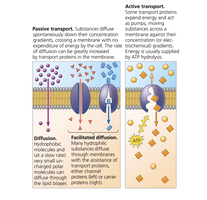
Active Transport: Moving Solutes Against Gradients
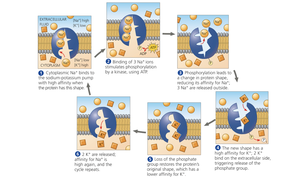
Active transport requires energy (usually ATP) to move substances from low to high concentration, against their gradient. Carrier proteins are essential for this process.
Sodium–Potassium Pump: Moves Na+ out and K+ into the cell, maintaining membrane potential.
Membrane potential: Voltage across the membrane; extracellular side is positive.
Electrochemical gradient: Combination of chemical and electrical forces driving ion diffusion.
Cotransport: Coupled transport of substances, e.g., sodium-glucose cotransport in intestinal cells.
Equation: ATP hydrolysis provides energy for active transport:
Bulk Transport: Exocytosis and Endocytosis
Cells transport large molecules in bulk via exocytosis and endocytosis, processes that require energy.
Exocytosis: Secretion of molecules by fusion of vesicles with the plasma membrane.
Endocytosis: Uptake of molecules by forming vesicles from the membrane.
Phagocytosis: Cell engulfs particles into a food vacuole.
Pinocytosis: Cell "gulps" extracellular fluid into vesicles.
Receptor-mediated endocytosis: Specific uptake of substances via receptor proteins.
Example: Cholesterol uptake by cells occurs via receptor-mediated endocytosis.
Application: Osmosis and Cell Behavior in Solutions
Understanding osmosis is crucial for predicting cell behavior in different environments.
In a hypotonic environment, water enters the cell, causing swelling.
In a hypertonic environment, water leaves the cell, causing shrinkage.
In an isotonic environment, there is no net water movement.
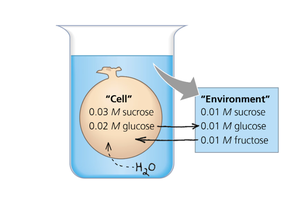
Example: Water moves from areas of low solute concentration to high solute concentration, leading to isotonic conditions over time.
Summary Table: Types of Membrane Transport
Type of Transport | Energy Required? | Transport Proteins? | Example |
|---|---|---|---|
Simple Diffusion | No | No | O2, CO2 |
Facilitated Diffusion | No | Yes (channel/carrier) | Glucose, H2O (aquaporins) |
Active Transport | Yes (ATP) | Yes (carrier) | Na+/K+ pump |
Bulk Transport | Yes | No | Exocytosis, Endocytosis |
Additional info: Cotransport is used in medical treatments, such as oral rehydration therapy for diarrhea, by promoting sodium and glucose absorption, which increases water uptake.
