 뒤로
뒤로Mendelian Genetics and Extensions: Patterns of Inheritance
스터디 가이드 - 스마트 노트
 자료에 맞춘 맞춤형 노트, 핵심 정의, 예시, 맥락을 확장해 제공합니다.
Chapter 14: Mendel and the Gene Idea
Concept 14.1: Mendel’s Laws of Inheritance
Gregor Mendel’s experiments with garden peas led to the foundation of modern genetics. He proposed that parents pass discrete units, called genes, to their offspring, which retain their identity across generations. Mendel’s work established two fundamental laws of inheritance.
Law of Segregation: Each individual has two alleles for each gene, which segregate during gamete formation so that each gamete carries only one allele for each gene. This explains the 3:1 phenotypic ratio observed in monohybrid crosses.
Law of Independent Assortment: Alleles of different genes assort independently during gamete formation. In dihybrid crosses, this results in a 9:3:3:1 phenotypic ratio among offspring.
Dominant and Recessive Alleles: In heterozygotes, the dominant allele masks the effect of the recessive allele. Homozygotes have two identical alleles and are true-breeding.

Example: When Mendel crossed true-breeding purple-flowered and white-flowered pea plants, the F1 generation was all purple (dominant), but the white trait reappeared in the F2 generation, demonstrating segregation of alleles.
Concept 14.2: Probability Laws in Mendelian Inheritance
Genetic inheritance follows the rules of probability, which can be used to predict the outcomes of genetic crosses.
Multiplication Rule: The probability of two independent events both occurring is the product of their individual probabilities.
Addition Rule: The probability of an event that can occur in multiple mutually exclusive ways is the sum of the individual probabilities.
Complex crosses (e.g., dihybrid) can be broken down into multiple monohybrid crosses, and probabilities multiplied to find overall outcomes.
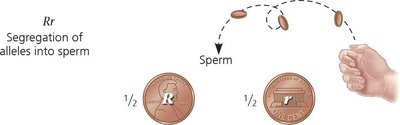
Example: In a dihybrid cross, the probability of inheriting a particular combination of alleles can be calculated by considering each gene separately and multiplying the probabilities.
Concept 14.3: Extensions of Mendelian Genetics
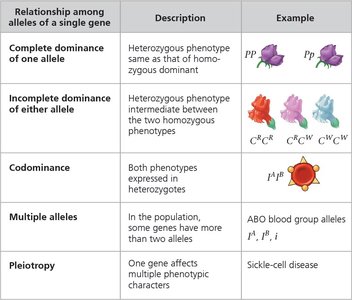
Inheritance patterns can be more complex than Mendel’s simple dominant-recessive relationships. These extensions include:
Complete Dominance: Heterozygote phenotype is identical to homozygous dominant.
Incomplete Dominance: Heterozygote phenotype is intermediate between the two homozygotes.
Codominance: Both alleles are fully expressed in heterozygotes.
Multiple Alleles: More than two alleles exist for some genes (e.g., ABO blood group).
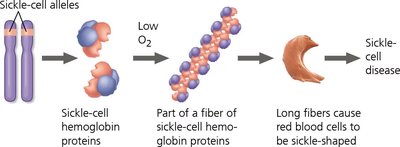
Pleiotropy: One gene affects multiple phenotypic traits (e.g., sickle-cell disease).
Extensions involving two or more genes:
Epistasis: The expression of one gene affects the expression of another gene.
Polygenic Inheritance: Multiple genes independently affect a single trait, often resulting in continuous variation (e.g., skin color).
Multifactorial Characters: Traits influenced by both genetic and environmental factors.
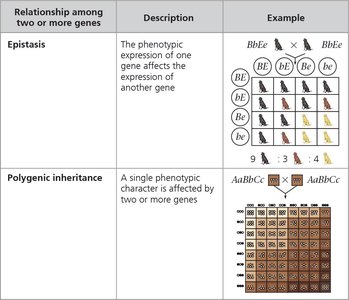
Example: The ABO blood group system demonstrates both multiple alleles and codominance. Sickle-cell disease is an example of pleiotropy, where one gene influences multiple traits.
Concept 14.4: Human Genetics and Pedigree Analysis
Many human traits follow Mendelian inheritance patterns. Family pedigrees are used to analyze inheritance and predict the probability of genetic disorders in offspring.
Pedigree Analysis: Used to deduce genotypes and predict inheritance patterns in families.
Recessive Disorders: Most affected individuals are homozygous recessive, often born to carrier parents.
Sickle-Cell Disease: The sickle-cell allele persists due to heterozygote advantage against malaria.
Dominant Disorders: Lethal dominant alleles are rare because affected individuals often die before reproducing. Nonlethal dominant alleles can be inherited in a Mendelian fashion.
Multifactorial Diseases: Many diseases are influenced by both genetic and environmental factors and do not follow simple Mendelian patterns.
Genetic Counseling: Helps families assess risks of inherited disorders using family history and genetic testing.
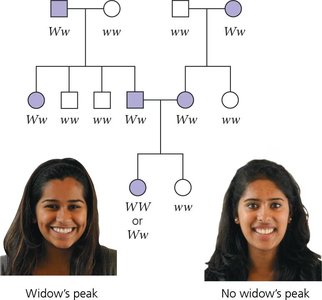
Example: If both parents are carriers for cystic fibrosis, each child has a 25% chance of having the disease, regardless of the health of previous children. Pedigree analysis and genetic testing can help clarify risks.
Tips for Solving Genetics Problems
Assign symbols for alleles (uppercase for dominant, lowercase for recessive).
Determine possible genotypes based on phenotypes.
Set up crosses using genotypes and Punnett squares.
Use probability rules for complex crosses.
Interpret phenotypic ratios to deduce parental genotypes.
Analyze pedigrees to determine inheritance patterns and likely genotypes.
Additional info: For large numbers of genes, probability calculations are more efficient than Punnett squares. Multifactorial traits require consideration of both genetic and environmental influences.
