 뒤로
뒤로Motor Mechanisms and Animal Behavior – Study Guide
스터디 가이드 - 스마트 노트
 자료에 맞춘 맞춤형 노트, 핵심 정의, 예시, 맥락을 확장해 제공합니다.
Motor Mechanisms and Behavior
Muscle Structure and Function
Muscles are specialized tissues responsible for producing movement and maintaining posture in animals. The basic unit of muscle tissue is the muscle fiber, which contains the machinery necessary for contraction.
Muscle: A tissue composed of muscle fibers that contracts to produce movement or maintain posture.
Muscle fiber: A single, elongated contractile cell (often multinucleated) containing myofibrils and activated by motor neurons.
Myofibrils: Long organelles within a muscle fiber, made up of repeating units called sarcomeres.
Sarcomere: The basic contractile unit of muscle, responsible for contraction and giving the muscle its striated appearance.
Thick filaments: Composed of myosin, these filaments pull on thin filaments during contraction.
Thin filaments: Composed of actin, these filaments interact with thick filaments to produce movement.
The Sliding-Filament Model of Muscle Contraction
The sliding-filament model explains how muscles contract by the interaction of actin (thin) and myosin (thick) filaments within the sarcomere. During contraction, these filaments slide past each other, shortening the sarcomere and thus the muscle fiber.
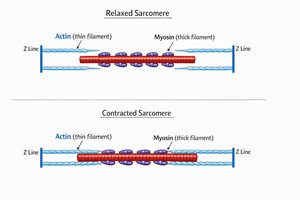
Relaxed Sarcomere: Actin and myosin filaments overlap partially.
Contracted Sarcomere: Actin filaments slide inward, increasing overlap with myosin, shortening the sarcomere.
Myosin and Muscle Contraction
Myosin is a molecular motor protein that converts chemical energy from ATP into mechanical work, enabling muscle contraction. It has a unique structure with a converter region and a lever-shaped arm that amplifies motion and generates force.
ATP: Adenosine triphosphate binds to myosin, providing the energy required for contraction.
Role of Calcium and the Sarcoplasmic Reticulum
The sarcoplasmic reticulum (SR) is a specialized endoplasmic reticulum in muscle fibers that stores calcium ions (Ca2+). The release of Ca2+ from the SR is triggered by nerve impulses, leading to muscle contraction.
Calcium Release: Ca2+ is released from the SR when channels open in response to depolarization of the muscle cell membrane.
Sequence of Muscle Contraction Events
Muscle contraction involves a series of steps initiated by a nerve impulse:
Nerve impulse arrives at the neuromuscular junction.
Acetylcholine is released from synaptic vesicles.
Acetylcholine binds to receptors on muscle fibers, allowing Na+ ions to enter and cause depolarization.
Depolarization spreads across the sarcolemma and down the transverse tubules.
Ca2+ is released from the SR.
Calcium ions bind to troponin on thin filaments.
The troponin-tropomyosin complex shifts, exposing myosin-binding sites on actin.
Myosin heads, activated by ATP hydrolysis, bind to actin and form cross-bridges.
Myosin heads pull actin filaments toward the center of the sarcomere.
Motor Units and Muscle Types
Motor unit: A motor neuron and all the skeletal muscle fibers it innervates; the basic functional unit of muscle contraction.
Skeletal muscle: Striated, voluntary, contains both fast-twitch and slow-twitch fibers.
Cardiac muscle: Striated, involuntary, found in the heart, contains intercalated disks.
Smooth muscle: Non-striated, involuntary, found in walls of internal organs.
Skeletal Systems
Types of Skeletons
Hydrostatic skeleton: Utilizes fluid pressure in body cavities to support the body and enable movement; common in invertebrates such as Porifera, Cnidaria, and Platyhelminthes.
Exoskeleton: A hard external covering made of chitin, characteristic of phylum Arthropoda.
Endoskeleton: An internal skeleton found in chordates, composed mainly of minerals such as calcium and phosphorus.
Animal Behavior
Definition and Study of Behavior
Behavior: Any action, reaction, or response of an organism to its environment, including both observable actions and internal processes.
Behavioral ecology: The study of the evolutionary basis of animal behavior in response to ecological pressures.
Innate Behaviors and Fixed Action Patterns
Fixed Action Pattern (FAP): An instinctive behavioral sequence that is triggered by a specific stimulus and runs to completion. Example: Egg-rolling behavior in Graylag Geese.
Sign stimulus: A specific environmental trigger that initiates a fixed action pattern, such as a predator's shadow causing a bird to flee.
Migration and Biological Rhythms
Migration: Long-distance movement of individuals to a new location, often for breeding or resource availability.
Circadian clock: An internal mechanism that regulates physiological and behavioral rhythms on a roughly 24-hour cycle.
Circadian rhythms: Daily cycles of behavior or physiology, such as the human sleep-wake cycle or leaf movements in Mimosa pudica.
Navigation in Animals
Sun compass orientation: Birds use the position of the sun and an internal clock to navigate during migration.
Stellar navigation: Birds use the stars, particularly the pattern around Polaris, for orientation during nighttime migration.
Animal Communication
Fireflies: Use species-specific light patterns for mating communication.
Red-Capped Manakin: Performs elaborate dances to attract mates.
Honeybees: Use the waggle dance to communicate the location of food sources.
Honeybee Dances
Round dance: Indicates nearby food; does not convey direction.
Waggle dance: Communicates both direction and distance to food sources; intensity reflects food quality.
Pheromones
Pheromones: Chemical signals released by organisms to affect the behavior or physiology of others of the same species.
Types of information transmitted: sexual status, social hierarchy, alarm signals.
Learning and Cognition
Innate vs. Learned Behavior
Innate behavior: Genetically programmed and performed without prior experience (e.g., reflexes).
Learned behavior: Acquired through experience or observation (e.g., language acquisition, riding a bicycle).
Imprinting and Sensitive Periods
Imprinting: Rapid, irreversible learning occurring during a critical period early in life, leading to strong attachments (e.g., goslings following the first moving object they see).
Sensitive/critical period: A specific developmental window when certain types of learning are most effective.
Classic Study: Konrad Lorenz and Imprinting
Lorenz demonstrated that graylag geese imprint on the first moving object they encounter after hatching, which can be a human if the biological mother is absent.
Challenges in Conservation: Whooping Cranes
Researchers must avoid imprinting hatchlings on humans by wearing crane costumes, ensuring the birds identify with their species and can be successfully reintroduced into the wild.
Types of Learning
Spatial learning: Formation of mental maps to navigate and remember locations.
Associative learning: Learning to associate one stimulus with another; includes classical conditioning (Pavlov's dogs) and operant conditioning (behavior shaped by rewards or punishments).
Cognition: Higher mental processes such as perception, problem-solving, and decision-making. Examples: Honeybee waggle dance, chimpanzee tool use, bird migration using landmarks.
Critical Periods in Bird Song Learning
If a white-crowned sparrow does not hear its species' song during the critical period, it will not develop a normal song.
Foraging and Mating Behavior
Foraging Behavior
All actions involved in locating, assessing, acquiring, and consuming food to meet energy and nutrient needs.
Mating Systems
Promiscuity: Multiple mating partners for both sexes, no exclusive bonds.
Monogamy: One male and one female form a pair bond for at least one breeding season.
Polygamy: One individual mates with multiple partners; includes polygyny (one male, multiple females) and polyandry (one female, multiple males).
Sexual Selection
Intersexual selection: Mate choice, typically one sex (often females) selects mates based on certain traits.
Intrasexual selection: Competition within the same sex (usually males) for access to mates.
Agonistic Behavior
Social behaviors related to conflict or competition between members of the same species. Example: Lionesses signaling to avoid conflict over food.
Altruism
Altruism: Behavior that benefits another individual at a cost to oneself, without expectation of personal gain.
