 뒤로
뒤로NSW Stage 6 Biology Syllabus: Structure, Skills, and Core Concepts
스터디 가이드 - 스마트 노트
 자료에 맞춘 맞춤형 노트, 핵심 정의, 예시, 맥락을 확장해 제공합니다.
Overview of the NSW Stage 6 Biology Syllabus
The NSW Stage 6 Biology Syllabus provides a comprehensive framework for the study of biology at the senior secondary level. It is designed to develop students' understanding of biological concepts, investigative skills, and appreciation for the diversity of life. The syllabus is structured to prepare students for further academic study, vocational training, and active participation in society.
Structure of the Biology Curriculum
Progression in the K–12 Science Curriculum
The curriculum is organized into progressive stages, beginning with foundational learning and culminating in specialized elective studies in Stage 6 (Years 11–12). This structure ensures continuity and depth in scientific understanding.
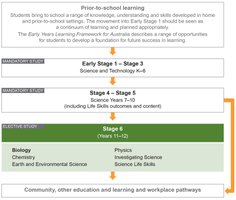
Early Stage 1 – Stage 3: Science and Technology K–6 (mandatory)
Stage 4 – Stage 5: Science Years 7–10 (mandatory, including Life Skills courses)
Stage 6 (Years 11–12): Elective study in Biology, Chemistry, Physics, Earth and Environmental Science, Investigating Science, or Science Life Skills
Post-school: Community, further education, and workplace pathways
Course Modules and Working Scientifically Skills
The syllabus is divided into eight modules, four for Year 11 and four for Year 12. Each module integrates the development of scientific skills, known as 'Working Scientifically,' which are central to the practice of science.
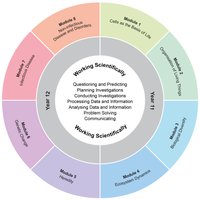
Year 11 Modules:
Module 1: Cells as the Basis of Life
Module 2: Organisation of Living Things
Module 3: Biological Diversity
Module 4: Ecosystem Dynamics
Year 12 Modules:
Module 5: Heredity
Module 6: Genetic Change
Module 7: Infectious Disease
Module 8: Non-infectious Disease and Disorders
Working Scientifically: Core Skills in Biology
Working Scientifically skills are dynamic and interdependent processes essential for scientific inquiry and investigation. These skills are developed throughout all modules and are fundamental to understanding and practicing science.
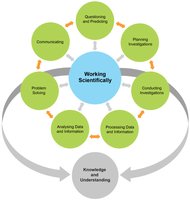
Questioning and Predicting: Developing and evaluating scientific questions and hypotheses.
Planning Investigations: Designing valid and reliable investigations, considering variables and controls.
Conducting Investigations: Collecting data safely and accurately using appropriate technologies.
Processing Data and Information: Organizing and representing qualitative and quantitative data using various media.
Analysing Data and Information: Identifying trends, patterns, and relationships; evaluating data quality.
Problem Solving: Using evidence and critical thinking to explain phenomena and solve scientific problems.
Communicating: Presenting scientific understanding using appropriate language, notations, and formats for specific audiences.
Depth Studies
Depth studies are extended investigations or activities that allow students to explore concepts in greater detail, develop investigative skills, and pursue individual interests in biology. These studies may include practical investigations, secondary-sourced research, creative projects, fieldwork, or data analysis.
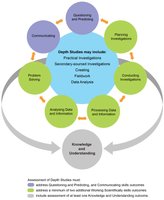
At least 15 hours of depth studies are required in both Year 11 and Year 12.
Depth studies must address at least four Working Scientifically outcomes, including Questioning and Predicting, and Communicating.
Examples include designing experiments, conducting literature reviews, creating models, and analyzing data sets.
Outcome and Content Coding
Outcome Coding
Each syllabus outcome is coded to indicate the subject, year, and outcome number. For example:
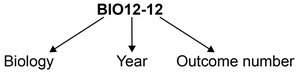
BIO12-12: Biology, Year 12, Outcome 12
Australian Curriculum Content Coding
Australian curriculum content descriptions are identified by a code, such as ACSBL003, where each part of the code specifies the curriculum, subject, and element.
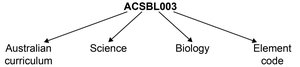
AC: Australian Curriculum
S: Science
BL: Biology
003: Element code
Summary Table: Year 11 and Year 12 Biology Modules
Year | Module | Main Focus |
|---|---|---|
Year 11 | Module 1: Cells as the Basis of Life | Cell structure, function, and biochemical processes |
Year 11 | Module 2: Organisation of Living Things | Multicellular organization, transport systems, and nutrient/gas exchange |
Year 11 | Module 3: Biological Diversity | Biodiversity, adaptations, and evolution by natural selection |
Year 11 | Module 4: Ecosystem Dynamics | Population dynamics, ecosystem interactions, and human impact |
Year 12 | Module 5: Heredity | Inheritance, DNA structure, and reproduction |
Year 12 | Module 6: Genetic Change | Mutation, biotechnology, and genetic technologies |
Year 12 | Module 7: Infectious Disease | Pathogens, immune response, and disease control |
Year 12 | Module 8: Non-infectious Disease and Disorders | Non-infectious diseases, epidemiology, and medical technologies |
Key Definitions
Abiotic: Non-living components of the environment.
Allele: A variant form of a gene.
Biotic: All living organisms in a specific region.
Gene Pool: The stock of different genes in an interbreeding population.
Hypothesis: A tentative explanation for an observed phenomenon, testable by investigation.
Model: A representation that describes or explains the workings or relationships within a system.
Symbiosis: Interaction between two different organisms living in close association.
Variable: A factor that can be changed, maintained, or measured in an investigation.
Conclusion
The NSW Stage 6 Biology Syllabus is designed to foster scientific literacy, critical thinking, and investigative skills. It provides a solid foundation for further study and careers in biology and related fields, emphasizing both theoretical knowledge and practical application through depth studies and scientific inquiry.
