 뒤로
뒤로Nucleic Acids and the RNA World: Structure, Function, and Evolution
스터디 가이드 - 스마트 노트
 자료에 맞춘 맞춤형 노트, 핵심 정의, 예시, 맥락을 확장해 제공합니다.
Chapter 4: Nucleic Acids and the RNA World
Introduction to Nucleic Acids and the RNA World
Nucleic acids are fundamental biomolecules that store and transmit genetic information. The RNA world hypothesis suggests that early life forms may have relied on RNA both to store genetic information and to catalyze chemical reactions, preceding the evolution of DNA and proteins.
Chemical evolution led to the production of self-replicating molecules.
Deoxyribonucleic acid (DNA) stores genetic information and is replicated with the help of proteins.
RNA world hypothesis: Proposes a period in evolution where RNA served as both genetic material and catalyst.
Once self-replicating molecules evolved, biological evolution began.
4.1 What is a Nucleic Acid?
Structure of Nucleic Acids
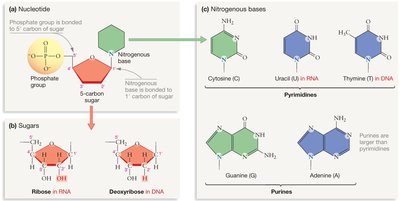
Nucleic acids are polymers made of nucleotide monomers. Each nucleotide consists of three components:
Phosphate group
Five-carbon sugar (either ribose in RNA or deoxyribose in DNA)
Nitrogenous base (a nitrogen-containing ring structure)
The phosphate group and nitrogenous base are both bonded to the sugar molecule.
Types of Nucleotides
Ribonucleotides (RNA): Contain ribose sugar, which has a hydroxyl (–OH) group on the 2' carbon.
Deoxyribonucleotides (DNA): Contain deoxyribose sugar, which has a hydrogen (–H) instead of a hydroxyl group at the 2' carbon.
Both sugars have a hydroxyl group at the 3' carbon.
Nitrogenous Bases
Pyrimidines (single ring, 6 atoms): Cytosine (C), Uracil (U, in RNA), Thymine (T, in DNA)
Purines (double ring, 9 atoms): Adenine (A), Guanine (G)
Mnemonic: "CUT the Py" (C, U, T are pyrimidines)
Polymerization of Nucleotides
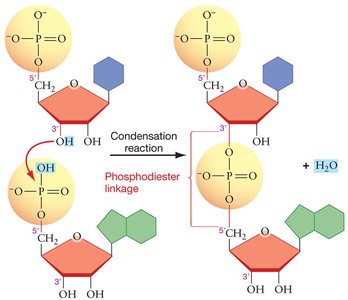
Nucleic acids are formed by condensation reactions that create phosphodiester linkages between the 5' phosphate group of one nucleotide and the 3' hydroxyl group of another.
This process produces a sugar–phosphate backbone.
Polymerization requires energy, often provided by nucleoside triphosphates (e.g., ATP).
Directionality of Nucleic Acid Strands
The sugar–phosphate backbone of nucleic acids is directional:
One end has an unlinked 5' phosphate group.
The other end has an unlinked 3' hydroxyl group.
The sequence of bases is written from 5' to 3'.

Energy for Polymerization
Polymerization of nucleic acids is energetically unfavorable and requires activation of nucleotides:
Nucleoside triphosphates (e.g., ATP) are "activated" nucleotides with high potential energy.
Hydrolysis of the extra phosphates releases energy, making the reaction spontaneous.

4.2 DNA Structure and Function
Primary and Secondary Structure of DNA
DNA's structure is essential for its function as the genetic material.
DNA is a polymer of deoxyribonucleotides linked by phosphodiester bonds.
Early evidence (Chargaff's rules) showed that the number of purines equals the number of pyrimidines (A = T, C = G).
X-ray crystallography revealed a helical structure.
Double Helix and Antiparallel Strands
Watson and Crick determined that DNA consists of two antiparallel strands forming a double helix:
Strands are held together by hydrogen bonds between complementary bases (A–T, C–G).
The sugar–phosphate backbone faces outward, while bases face inward.
Antiparallel orientation means one strand runs 5' to 3', the other 3' to 5'.


Tertiary Structure of DNA
DNA can form more compact three-dimensional structures in cells:
DNA supercoiling occurs when the molecule is overwound or underwound.
In eukaryotes, DNA wraps around histone proteins to form nucleosomes, aiding compaction.
The total length of DNA in a human cell is about 2 meters (6 feet).
DNA as an Information-Containing Molecule
DNA stores genetic information in the sequence of its bases:
The order of the four bases (A, T, C, G) encodes instructions for growth, development, and reproduction.
DNA replication is semiconservative: each strand serves as a template for a new complementary strand.

Stability of the DNA Double Helix
The double helix is stabilized by phosphodiester linkages, hydrogen bonds, and hydrophobic interactions between stacked bases.
DNA's stability makes it an effective long-term information storage molecule.
However, DNA alone is unlikely to have been the first self-replicating molecule in early life.
4.3 RNA Structure and Function
Primary and Secondary Structure of RNA
RNA differs from DNA in several key ways:
RNA contains ribose sugar (with a 2' –OH group), making it more reactive and less stable than DNA.
RNA uses uracil (U) instead of thymine (T).
RNA is usually single-stranded but can form complex secondary structures through intramolecular base pairing (e.g., hairpins).

Tertiary Structure and Versatility of RNA
RNA molecules can fold into diverse three-dimensional shapes, allowing them to perform a variety of functions:
RNA's flexibility enables it to act as a catalyst (ribozyme), transmit information (mRNA), and regulate gene expression.
RNA's tertiary structure forms when secondary structures fold into more complex shapes.

Comparison of DNA and RNA Structure
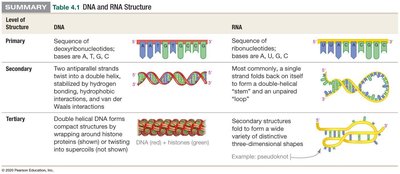
The following table summarizes the similarities and differences between DNA and RNA at the primary, secondary, and tertiary levels:
Level of Structure | DNA | RNA |
|---|---|---|
Primary | Sequence of deoxyribonucleotides; bases are A, T, C, G | Sequence of ribonucleotides; bases are A, U, C, G |
Secondary | Two antiparallel strands twist into a double helix, stabilized by hydrogen bonding, hydrophobic interactions, and van der Waals interactions | Most commonly, a single strand folds back on itself to form a double-helical stem and unpaired "loop" (hairpin) |
Tertiary | Double helical DNA forms compact structures by wrapping around histone proteins or twisting into supercoils | Secondary structures fold into a wide variety of distinctive three-dimensional shapes |
RNA as a Catalytic Molecule
Some RNA molecules, called ribozymes, can catalyze chemical reactions:
Ribozymes have active sites similar to those of protein enzymes.
They can catalyze the formation of phosphodiester bonds, suggesting that RNA could have replicated itself in early life forms.
4.4 The Origin of Life and the RNA World
Search for the First Life-Form
The theory of chemical evolution proposes that life began as a naked self-replicator—a molecule capable of both storing information and catalyzing its own replication, likely RNA.
The first living molecule had to provide a template for copying and catalyze the polymerization of monomers.
RNA is capable of both functions, supporting the RNA world hypothesis.
Experimental Evidence for the RNA World
Laboratory studies have produced ribozymes capable of catalyzing RNA replication and nucleotide addition.
These experiments mimic natural selection and demonstrate the plausibility of an RNA-based origin of life.
Transition from the RNA World to Modern Biology
Most modern ribozymes are involved in protein synthesis (e.g., ribosomal RNA).
The evolution of protein enzymes likely marked the end of the RNA world.
Three essential characteristics of life were established: information processing, replication, and evolution by random changes in nucleic acids.
