 뒤로
뒤로Nucleic Acids: Structure, Function, and Biological Importance
스터디 가이드 - 스마트 노트
 자료에 맞춘 맞춤형 노트, 핵심 정의, 예시, 맥락을 확장해 제공합니다.
5.5 Nucleic Acids Store, Transmit, and Help Express Hereditary Information
Introduction to Nucleic Acids
Nucleic acids are essential macromolecules responsible for the storage, transmission, and expression of genetic information in all living organisms. The two main types are deoxyribonucleic acid (DNA) and ribonucleic acid (RNA). These molecules are polymers made up of nucleotide monomers and play a central role in heredity and protein synthesis.
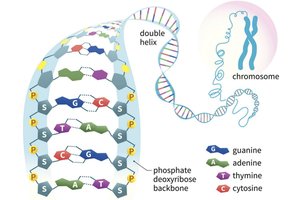
DNA is primarily located in the cell nucleus and forms chromosomes, which carry genetic instructions.
RNA is involved in protein synthesis and can be found in the nucleus and cytoplasm.
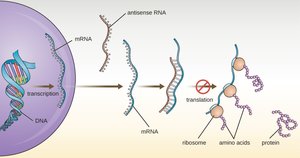
Protein synthesis involves the flow of genetic information from DNA to RNA to protein, a process known as the central dogma of molecular biology.
The Components of Nucleic Acids
Nucleotides and Their Structure
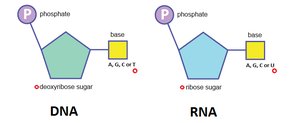
Nucleic acids are polymers called polynucleotides, which are composed of repeating units called nucleotides. Each nucleotide consists of three components:
Pentose sugar: Deoxyribose in DNA, ribose in RNA.
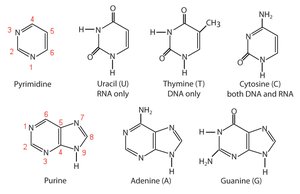
Nitrogenous base: Divided into two groups—pyrimidines (cytosine, thymine, uracil) and purines (adenine, guanine).
Phosphate group: Links the nucleotides together in the polymer.
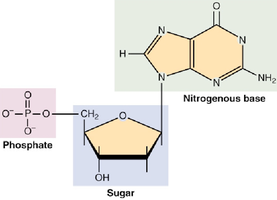
Pyrimidines vs. Purines
Pyrimidines: Single-ring structures; include cytosine (C), thymine (T, only in DNA), and uracil (U, only in RNA).
Purines: Double-ring structures; include adenine (A) and guanine (G).
Nucleotide Polymers
Formation and Structure of Polynucleotides
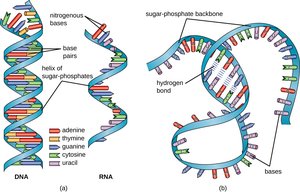
Nucleotides are joined together by phosphodiester linkages through a dehydration reaction, forming a sugar-phosphate backbone. The backbone is directional, with a 5' end (phosphate group) and a 3' end (hydroxyl group).
Phosphodiester linkage: Covalent bond between the phosphate group of one nucleotide and the 3' carbon of the next sugar.
Sugar-phosphate backbone: Provides structural support; nitrogenous bases project from the backbone.
Directionality: Polynucleotides are synthesized and read from the 5' to 3' direction.
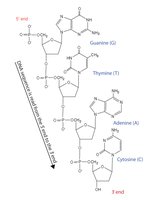
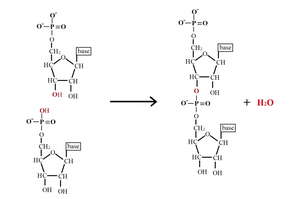
The Structures of DNA and RNA Molecules
DNA Structure
DNA consists of two polynucleotide strands that form a double helix. The strands are antiparallel and held together by hydrogen bonds between complementary nitrogenous bases:
Adenine (A) pairs with Thymine (T) via two hydrogen bonds.
Guanine (G) pairs with Cytosine (C) via three hydrogen bonds.
The double helix structure allows for the accurate replication and storage of genetic information.
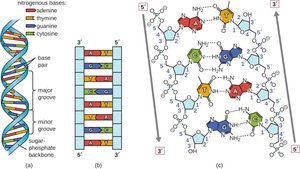
RNA Structure
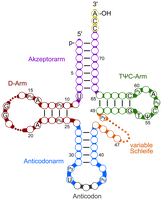
RNA is typically single-stranded but can form complex secondary structures through complementary base pairing within the same strand (e.g., tRNA). In RNA, uracil (U) replaces thymine (T) and pairs with adenine (A).
Single-stranded but may fold into functional shapes (e.g., tRNA, rRNA).
Base pairing: A-U and G-C in RNA.
Summary Table: DNA vs. RNA
Feature | DNA | RNA |
|---|---|---|
Sugar | Deoxyribose | Ribose |
Strands | Double-stranded (helix) | Single-stranded |
Nitrogenous Bases | A, T, G, C | A, U, G, C |
Location | Nucleus (mainly) | Nucleus & Cytoplasm |
Main Function | Genetic information storage | Protein synthesis, gene expression |
Key Processes: From DNA to Protein
Central Dogma of Molecular Biology
The flow of genetic information follows the sequence: DNA → RNA → Protein. This involves two main processes:
Transcription: DNA is transcribed into messenger RNA (mRNA) in the nucleus.
Translation: mRNA is translated into a polypeptide (protein) at the ribosome in the cytoplasm.
Example: The gene for hemoglobin is transcribed into mRNA, which is then translated into the hemoglobin protein in red blood cells.
