 뒤로
뒤로Overview of Cell Structure and Cell Theory
스터디 가이드 - 스마트 노트
 자료에 맞춘 맞춤형 노트, 핵심 정의, 예시, 맥락을 확장해 제공합니다.
Células (Cells)
Teoria Celular (Cell Theory)
The Cell Theory is a fundamental concept in biology that explains the properties and functions of cells. It consists of three main principles:
All living beings are formed by cells. This principle establishes that cells are the basic unit of life.
Cells are the smallest morphofunctional units. Cells carry out essential functions and are the smallest units capable of life.
Cells originate from other cells. New cells are produced by the division of pre-existing cells.
Exception: Viruses are considered acellular because they lack cellular structure and do not perform all functions of living cells.
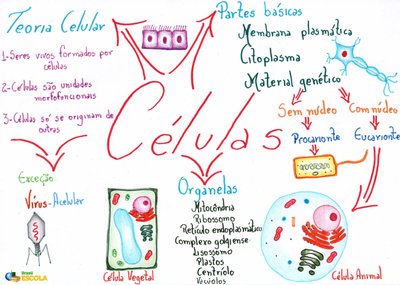
Partes Básicas da Célula (Basic Parts of the Cell)
All cells share certain basic components that are essential for their structure and function:
Membrana plasmática (Plasma membrane): The boundary that separates the cell from its environment and regulates the movement of substances in and out.
Citoplasma (Cytoplasm): The internal fluid of the cell where organelles are suspended and metabolic reactions occur.
Material genético (Genetic material): DNA or RNA that carries the instructions for cell function and reproduction.
Tipos de Células (Types of Cells)
Cells are classified based on the presence or absence of a nucleus:
Sem núcleo (Without nucleus): Procarionte (Prokaryotic) cells, such as bacteria, lack a defined nucleus. Their genetic material is found in the cytoplasm.
Com núcleo (With nucleus): Eucarionte (Eukaryotic) cells, such as plant and animal cells, have a membrane-bound nucleus containing their genetic material.
Organelas (Organelles)
Organelles are specialized structures within cells that perform distinct functions. Common organelles include:
Mitocôndria (Mitochondria): Responsible for energy production through cellular respiration.
Ribossomo (Ribosome): Site of protein synthesis.
Retículo endoplasmático (Endoplasmic reticulum): Involved in protein and lipid synthesis.
Complexo golgiense (Golgi complex): Modifies, sorts, and packages proteins and lipids.
Lisossomo (Lysosome): Contains digestive enzymes for breaking down waste.
Centriolo (Centriole): Important for cell division in animal cells.
Vacuolo (Vacuole): Stores substances; large central vacuole is characteristic of plant cells.
Comparação entre Célula Vegetal e Célula Animal (Comparison between Plant and Animal Cells)
Plant and animal cells share many organelles but also have distinct features:
Feature | Plant Cell | Animal Cell |
|---|---|---|
Cell Wall | Present | Absent |
Chloroplasts | Present | Absent |
Central Vacuole | Large | Small or absent |
Centrioles | Absent | Present |
Example: Plant cells contain chloroplasts for photosynthesis, while animal cells do not.
Additional info: The diagram visually reinforces the concepts of cell theory, basic cell parts, types of cells, and organelle functions, making it directly relevant for introductory cell biology study.
