 뒤로
뒤로Patterns of Inheritance – General Biology Final Exam Review Guidance
스터디 가이드 - 스마트 노트
 자료에 맞춘 맞춤형 노트, 핵심 정의, 예시, 맥락을 확장해 제공합니다.
Q1. The best definition of a purebred plant is one that ________.
Background
Topic: Mendelian Genetics – Purebred vs. Hybrid
This question tests your understanding of what it means for an organism to be purebred, especially in the context of Mendel's experiments with pea plants.
Key Terms:
Purebred: An organism that consistently passes down the same traits to its offspring.
Hybrid: An organism produced by crossing two different purebred varieties.
Trait: A characteristic determined by genes.
Step-by-Step Guidance
Recall that purebred plants are used in Mendel's experiments to ensure consistent traits across generations.
Think about what happens when a purebred plant self-fertilizes or is cross-fertilized with another purebred plant of the same trait.
Consider the definition: Does a purebred plant produce offspring with identical traits to itself?
Review the answer choices and eliminate those that do not fit the definition of purebred.
Try solving on your own before revealing the answer!
Final Answer: B) passes on to the next generation only those traits identical to the parent
A purebred plant consistently produces offspring with the same traits as itself, which is why Mendel used them in his experiments.
Q2. A mating between a purebred purple-flowered pea plant and a purebred white-flowered pea plant would produce a(n) ________.
Background
Topic: Mendelian Genetics – Hybridization
This question is about the terminology used in Mendel's experiments when crossing two purebred plants with different traits.
Key Terms:
Hybrid: Offspring resulting from the cross of two purebred parents with different traits.
P generation: Parental generation (purebred parents).
F1 generation: First filial generation (offspring of P generation).
Step-by-Step Guidance
Identify the parents: purebred purple-flowered and purebred white-flowered pea plants.
Recall Mendel's terminology for the offspring of two purebred parents with different traits.
Consider what the offspring are called and whether they are purebred or hybrid.
Review the answer choices and match the correct term to the offspring.
Try solving on your own before revealing the answer!
Final Answer: B) hybrid
The offspring of two purebred parents with different traits are called hybrids, specifically the F1 generation in Mendel's experiments.
Q3. Alleles are described as ________.
Background
Topic: Genetics – Alleles and Genes
This question tests your understanding of what alleles are and how they relate to genes and traits.
Key Terms:
Allele: Alternate version of a gene.
Gene: Segment of DNA that codes for a trait.
Phenotype: Observable trait.
Step-by-Step Guidance
Recall that genes can have different forms, which are called alleles.
Think about how alleles contribute to genetic variation in traits.
Review the answer choices and select the one that best defines alleles.
Try solving on your own before revealing the answer!
Final Answer: C) alternate versions of a gene
Alleles are different forms of the same gene, responsible for variations in traits.
Q4. A purebred plant that produces yellow seeds is crossed with a purebred plant that produces green seeds. The seeds of all of the offspring are yellow. Why?
Background
Topic: Dominance and Recessiveness in Genetics
This question tests your understanding of dominant and recessive alleles and how they affect the phenotype of offspring.
Key Terms:
Dominant allele: An allele that masks the effect of a recessive allele.
Recessive allele: An allele whose effect is masked by a dominant allele.
Phenotype: Observable trait (seed color).
Step-by-Step Guidance
Identify the genotypes: purebred yellow (YY) and purebred green (yy).
Recall that crossing these produces offspring with genotype Yy.
Consider which allele is dominant based on the offspring's phenotype.
Review the answer choices and select the one that explains why all offspring are yellow.
Try solving on your own before revealing the answer!
Final Answer: C) The yellow allele is dominant to the green allele.
All offspring are yellow because the yellow allele is dominant and masks the green allele in the heterozygous condition.
Q5. A purebred plant that produces yellow seeds is crossed with a purebred plant that produces green seeds. The F1 plants have yellow seeds. What is the expected phenotypic ratio of seed color of the offspring of an F1 × F1 cross?
Background
Topic: Mendelian Genetics – Monohybrid Cross
This question tests your ability to predict the phenotypic ratio of offspring from a monohybrid cross between two heterozygous individuals.
Key Terms and Formula:
Phenotypic ratio: The ratio of observable traits in offspring.
Monohybrid cross: A cross between two individuals heterozygous for a single trait.
Punnett square: Tool used to predict genotypes and phenotypes.
Step-by-Step Guidance
Identify the genotypes of the F1 plants (Yy).
Set up a Punnett square for Yy × Yy.
Determine the possible genotypes and their frequencies.
Translate the genotypes into phenotypes (yellow or green seeds).
Try solving on your own before revealing the answer!
Final Answer: C) 3:1
The expected phenotypic ratio is 3 yellow : 1 green, as predicted by Mendel's laws for a monohybrid cross.
Q6. Mendel's law of segregation indicates that ________.
Background
Topic: Mendelian Genetics – Law of Segregation
This question tests your understanding of Mendel's law of segregation and how alleles are distributed during gamete formation.
Key Terms:
Law of segregation: Each individual has two alleles for each gene, and these alleles separate during gamete formation.
Gamete: Reproductive cell (sperm or egg).
Step-by-Step Guidance
Recall that Mendel's law of segregation explains how alleles are separated during meiosis.
Consider how many alleles each gamete receives for each gene.
Review the answer choices and select the one that matches Mendel's law.
Try solving on your own before revealing the answer!
Final Answer: C) gametes have one allele copy for each gene.
Each gamete receives only one allele for each gene, as described by Mendel's law of segregation.
Q9. Attached earlobes are recessive to free earlobes. What is the probability of having a child with attached earlobes when an individual with attached earlobes mates with an individual heterozygous for free earlobes?
Background
Topic: Probability in Genetics – Punnett Square Analysis
This question tests your ability to use a Punnett square to determine the probability of a recessive trait appearing in offspring.
Key Terms and Formula:
Attached earlobes: Recessive trait (ee).
Free earlobes: Dominant trait (E).
Punnett square: Tool for predicting offspring genotypes.
Step-by-Step Guidance
Identify the genotypes: attached earlobes (ee) and heterozygous free earlobes (Ee).
Set up a Punnett square for ee × Ee.
Determine the possible genotypes of the offspring.
Calculate the probability of offspring with attached earlobes (ee genotype).
Try solving on your own before revealing the answer!
Final Answer: C) 50%
There is a 50% probability that the child will have attached earlobes, based on the Punnett square analysis.
Q14. Round seeds (R) are dominant to wrinkled seeds (r), and yellow seeds (Y) are dominant to green seeds (y). What is the expected phenotypic ratio of a cross between an RrYy and an rryy individual?
Background
Topic: Dihybrid Cross – Mendelian Genetics
This question tests your ability to predict the phenotypic ratio from a dihybrid cross involving two traits.
Key Terms and Formula:
Dihybrid cross: A cross between individuals heterozygous for two traits.
Phenotypic ratio: Ratio of observable traits in offspring.
Punnett square: Tool for predicting genotypes and phenotypes.
Step-by-Step Guidance
Identify the genotypes: RrYy × rryy.
Determine the possible gametes produced by each parent.
Set up a Punnett square for the cross.
Calculate the expected phenotypic ratio for the offspring.
Try solving on your own before revealing the answer!
Final Answer: D) 1:1:1:1
The expected phenotypic ratio for this dihybrid cross is 1:1:1:1, representing equal proportions of each phenotype.
Q15. An individual with the genotype AaBb produces four different gametes in equal proportions. This is a demonstration of ________.
Background
Topic: Mendelian Genetics – Law of Independent Assortment
This question tests your understanding of how alleles for different genes assort independently during gamete formation.
Key Terms:
Law of independent assortment: Alleles for different genes are distributed to gametes independently.
Gamete: Reproductive cell.
Step-by-Step Guidance
Recall that AaBb can produce AB, Ab, aB, and ab gametes.
Think about how this demonstrates independent assortment.
Review the answer choices and select the one that matches this principle.
Try solving on your own before revealing the answer!
Final Answer: B) Mendel's law of independent assortment
Producing four different gametes in equal proportions demonstrates the law of independent assortment.
Q19. What would you examine to determine whether a trait is sex linked?
Background
Topic: Sex-linked Traits – Genetic Analysis
This question tests your understanding of how to identify sex-linked traits using genetic tools.
Key Terms:
Sex-linked trait: Trait associated with a gene located on a sex chromosome.
Pedigree: Chart showing inheritance patterns across generations.
Step-by-Step Guidance
Recall that sex-linked traits often show distinct inheritance patterns in pedigrees.
Consider which tool allows you to track inheritance across generations.
Review the answer choices and select the one that best helps identify sex-linked traits.
Try solving on your own before revealing the answer!
Final Answer: B) pedigree
Pedigree analysis is used to determine whether a trait is sex-linked by tracking inheritance patterns.
Q21. An individual who is heterozygous for cystic fibrosis ________.
Background
Topic: Carrier Status – Recessive Genetic Disorders
This question tests your understanding of what it means to be heterozygous for a recessive genetic disorder.
Key Terms:
Heterozygous: Having two different alleles for a gene.
Carrier: An individual who carries one recessive allele for a disorder but does not show symptoms.
Step-by-Step Guidance
Recall that cystic fibrosis is caused by a recessive allele.
Consider what happens when an individual has one normal and one disease allele.
Review the answer choices and select the one that describes a carrier.
Try solving on your own before revealing the answer!
Final Answer: B) is a carrier
A heterozygous individual for cystic fibrosis is a carrier and does not show symptoms.
Q23. Which technique is used to collect fetal cells during pregnancy for genetic testing?
Background
Topic: Genetic Testing – Prenatal Diagnosis
This question tests your knowledge of techniques used to collect fetal cells for genetic testing during pregnancy.
Key Terms:
Amniocentesis: Procedure to collect amniotic fluid containing fetal cells.
Chorionic villus sampling: Another method for collecting fetal cells.
Step-by-Step Guidance
Recall the main techniques used for prenatal genetic testing.
Consider which technique involves collecting amniotic fluid.
Review the answer choices and select the correct technique.
Try solving on your own before revealing the answer!
Final Answer: C) amniocentesis
Amniocentesis is a common technique used to collect fetal cells for genetic testing during pregnancy.
Q24. What is the key to the recognition of incomplete dominance?
Background
Topic: Non-Mendelian Genetics – Incomplete Dominance
This question tests your understanding of how incomplete dominance differs from complete dominance and codominance.
Key Terms:
Incomplete dominance: The phenotype of the heterozygote is intermediate between the phenotypes of the homozygotes.
Codominance: Both alleles are fully expressed in the heterozygote.
Step-by-Step Guidance
Recall the definition of incomplete dominance.
Compare the phenotypes of homozygotes and heterozygotes.
Review the answer choices and select the one that describes incomplete dominance.
Try solving on your own before revealing the answer!
Final Answer: A) The phenotype of the heterozygote falls between the phenotypes of the homozygotes.
Incomplete dominance is recognized when the heterozygote's phenotype is intermediate between those of the homozygotes.
Q28. An individual with the blood group genotype LMLN has the phenotype MN. What is the relationship between the LM and LN alleles?
Background
Topic: Codominance – Blood Group Genetics
This question tests your understanding of codominance, especially in the context of blood group genetics.
Key Terms:
Codominance: Both alleles are fully expressed in the heterozygote.
Blood group: Example of codominance (MN blood group).
Step-by-Step Guidance
Recall that the MN blood group is an example of codominance.
Consider what happens when both LM and LN alleles are present.
Review the answer choices and select the one that describes codominance.
Try solving on your own before revealing the answer!
Final Answer: A) codominance
Both LM and LN alleles are fully expressed, resulting in the MN phenotype.
Q30. Which outcome could help you identify a trait whose expression is determined by the effects of two or more genes (polygenic inheritance)?
Background
Topic: Polygenic Inheritance – Complex Traits
This question tests your understanding of polygenic inheritance and how it affects trait expression.
Key Terms:
Polygenic inheritance: Trait controlled by two or more genes.
Continuous distribution: Trait varies along a spectrum.
Step-by-Step Guidance
Recall that polygenic traits often show a range of phenotypes.
Consider which outcome indicates a continuous distribution of traits.
Review the answer choices and select the one that matches polygenic inheritance.
Try solving on your own before revealing the answer!
Final Answer: D) The trait varies along a continuum in the population.
Polygenic traits show a continuous range of phenotypes, rather than discrete categories.
Q31. Which trait is polygenic in humans?
Background
Topic: Polygenic Traits – Human Genetics
This question tests your knowledge of traits in humans that are controlled by multiple genes.
Key Terms:
Polygenic trait: Trait influenced by multiple genes.
Examples: Height, skin color, intelligence.
Step-by-Step Guidance
Recall which human traits are influenced by multiple genes.
Consider the answer choices and identify the polygenic trait.
Try solving on your own before revealing the answer!
Final Answer: B) height
Height is a polygenic trait, influenced by many genes.
Q33. Mendel's laws are based on the behavior of chromosomes during ________.
Background
Topic: Chromosomal Basis of Inheritance
This question tests your understanding of how Mendel's laws relate to chromosome behavior during meiosis.
Key Terms:
Meiosis: Cell division that produces gametes.
Metaphase I and anaphase I: Stages where chromosomes segregate.
Step-by-Step Guidance
Recall the stages of meiosis where chromosomes segregate and assort independently.
Consider which stages are most relevant to Mendel's laws.
Review the answer choices and select the correct stage(s).
Try solving on your own before revealing the answer!
Final Answer: D) metaphase I and anaphase I of meiosis
Mendel's laws are based on chromosome behavior during metaphase I and anaphase I of meiosis.
Q34. Genes that violate Mendel's principle of independent assortment are ________.
Background
Topic: Linked Genes – Exceptions to Mendel's Laws
This question tests your understanding of linked genes and how they can violate Mendel's principle of independent assortment.
Key Terms:
Linked genes: Genes located close together on the same chromosome.
Independent assortment: Genes assort independently if they are on different chromosomes.
Step-by-Step Guidance
Recall that linked genes are inherited together because they are close on the same chromosome.
Consider how this violates independent assortment.
Review the answer choices and select the one that describes linked genes.
Try solving on your own before revealing the answer!
Final Answer: B) linked
Linked genes are inherited together and do not assort independently.
Q36. A dihybrid cross produces 30 recombinant offspring out of a total of 1,000 offspring. What is the recombination frequency of the two gene pairs?
Background
Topic: Recombination Frequency – Linked Genes
This question tests your ability to calculate recombination frequency, which helps determine if genes are linked.
Key Formula:
Recombination frequency = (Number of recombinant offspring / Total offspring) × 100%
Step-by-Step Guidance
Identify the number of recombinant offspring (30) and total offspring (1,000).
Set up the formula for recombination frequency.
Plug the values into the formula, but do not calculate the final percentage yet.
Try solving on your own before revealing the answer!
Final Answer: A) 3%
Recombination frequency is calculated as (30/1000) × 100% = 3%.
Q37. Linked genes are usually ________.
Background
Topic: Linked Genes – Chromosomal Location
This question tests your understanding of where linked genes are found and why they are inherited together.
Key Terms:
Linked genes: Genes located close together on a chromosome.
Step-by-Step Guidance
Recall that linked genes are inherited together because of their proximity on a chromosome.
Consider which answer choice describes their location.
Try solving on your own before revealing the answer!
Final Answer: D) located close together on a chromosome
Linked genes are found close together on the same chromosome, which is why they are inherited together.
Q38. Assume that having three nostrils is inherited as a sex-linked trait on the Y chromosome. A man with three nostrils has a daughter who has a son with a man who has only two nostrils. What is the probability that the three-nostril man's grandson has three nostrils?
Background
Topic: Sex-linked Traits – Y Chromosome Inheritance
This question tests your understanding of Y-linked inheritance and how traits are passed from father to son.
Key Terms:
Y-linked trait: Trait carried on the Y chromosome, only passed from father to son.
Step-by-Step Guidance
Recall that only males inherit Y-linked traits from their fathers.
Consider the family tree and whether the grandson could inherit the trait from his maternal grandfather.
Review the answer choices and select the correct probability.
Try solving on your own before revealing the answer!
Final Answer: A) 0%
The grandson cannot inherit the Y-linked trait from his maternal grandfather, as the Y chromosome is passed only from father to son.
Q39. Red-green colorblindness is inherited as a sex-linked recessive trait. The gene is found on the X chromosome. Can a man with normal color vision father a daughter who is red-green colorblind?
Background
Topic: Sex-linked Traits – X Chromosome Inheritance
This question tests your understanding of X-linked recessive inheritance and how it affects the probability of a daughter being colorblind.
Key Terms:
X-linked recessive trait: Trait carried on the X chromosome, often affects males more than females.
Step-by-Step Guidance
Recall that daughters inherit one X chromosome from each parent.
Consider the genotypes of the parents and whether the daughter can be colorblind.
Review the answer choices and select the correct scenario.
Try solving on your own before revealing the answer!
Final Answer: A) Yes, if the woman with whom he mates is red-green colorblind.
A daughter can be colorblind only if she inherits the recessive allele from both parents.
Q40. Hypophosphatemia (vitamin D–resistant rickets) is inherited as a sex-linked dominant trait. The relevant gene is found on the X chromosome. What is the expected outcome of a cross between a homozygous recessive woman and a man with hypophosphatemia?
Background
Topic: Sex-linked Dominant Traits – X Chromosome Inheritance
This question tests your understanding of X-linked dominant inheritance and how it affects offspring.
Key Terms:
X-linked dominant trait: Trait carried on the X chromosome, expressed in both males and females.
Step-by-Step Guidance
Recall the genotypes: homozygous recessive woman (xx) and man with hypophosphatemia (X*Y).
Consider how the trait is passed to daughters and sons.
Review the answer choices and select the expected outcome.
Try solving on your own before revealing the answer!
Final Answer: A) All of their daughters and none of their sons exhibit hypophosphatemia.
Daughters inherit the X* from their father, sons inherit the Y and do not express the trait.
Q1 (Art). In the accompanying art, you see a table with the actual number of offspring that resulted from a dihybrid cross. The numbers do not show the 9:3:3:1 ratio predicted. One phenotype occurred more than predicted; another occurred less. The reason could be because ________.
Background
Topic: Dihybrid Cross – Linked Genes
This question tests your understanding of why observed ratios in a dihybrid cross may differ from the expected 9:3:3:1 ratio.
Key Terms:
Linked genes: Genes located close together on a chromosome, inherited together.
Recombination: Exchange of genetic material between homologous chromosomes.
Step-by-Step Guidance
Examine the observed and predicted numbers in the table.
Recall that the 9:3:3:1 ratio is expected for unlinked genes.
Consider what could cause deviations from this ratio, such as gene linkage.
Review the answer choices and select the one that explains the deviation.
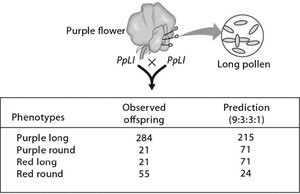
Try solving on your own before revealing the answer!
Final Answer: B) some of the alleles were linked
Linked genes do not assort independently, causing deviations from the expected 9:3:3:1 ratio.
Q2 (Art). Recombinant offspring were produced by the mating shown in the accompanying art. What is the recombination frequency of purple-round and red-long offspring?
Background
Topic: Recombination Frequency – Linked Genes
This question tests your ability to calculate recombination frequency using observed numbers of recombinant offspring.
Key Formula:
Recombination frequency = (Number of recombinant offspring / Total offspring) × 100%
Step-by-Step Guidance
Identify the number of recombinant offspring (purple-round and red-long).
Add the numbers for these phenotypes to get the total recombinant offspring.
Find the total number of offspring from the table.
Set up the formula for recombination frequency, but do not calculate the final percentage yet.
Try solving on your own before revealing the answer!
Final Answer: A) 21%
Recombination frequency is calculated as (21 + 21) / (total offspring) × 100% = 21%.
Q3 (Art). This hypothetical pedigree for a disease in humans illustrates inheritance that is ________.
Background
Topic: Pedigree Analysis – Modes of Inheritance
This question tests your ability to interpret a pedigree and determine the mode of inheritance for a disease.
Key Terms:
Autosomal recessive: Trait appears only when both alleles are recessive.
Autosomal dominant: Trait appears when at least one allele is dominant.
Sex-linked: Trait associated with a sex chromosome.
Step-by-Step Guidance
Examine the pedigree and note which individuals are affected.
Consider whether the trait appears in both males and females and skips generations.
Review the answer choices and select the mode of inheritance that fits the pattern.
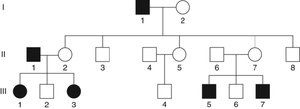
Try solving on your own before revealing the answer!
Final Answer: A) autosomal recessive
The pedigree shows a pattern consistent with autosomal recessive inheritance, where the trait can skip generations and affect both sexes.
Q1 (Scenario). Mary has the genotype ________.
Background
Topic: Pedigree Analysis – Dominant Trait Inheritance
This question tests your ability to interpret a pedigree and determine the genotype of an individual for a dominant trait.
Key Terms:
Dominant allele: Expressed when present.
Pedigree: Chart showing inheritance patterns.
Step-by-Step Guidance
Examine the pedigree and note Mary's phenotype (widow's peak).
Recall that widow's peak is caused by a dominant allele (W).
Consider Mary's offspring and their phenotypes to deduce her genotype.
Review the answer choices and select the genotype that fits the pattern.
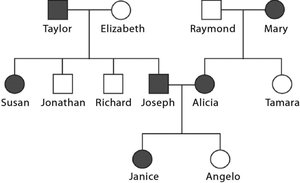
Try solving on your own before revealing the answer!
Final Answer: C) Ww
Mary must be heterozygous (Ww) because she has offspring with and without the widow's peak.
Q2 (Scenario). Janice's genotype is ________.
Background
Topic: Pedigree Analysis – Dominant Trait Inheritance
This question tests your ability to interpret a pedigree and determine the genotype of an individual for a dominant trait.
Key Terms:
Dominant allele: Expressed when present.
Pedigree: Chart showing inheritance patterns.
Step-by-Step Guidance
Examine the pedigree and note Janice's phenotype (widow's peak).
Consider the genotypes of Janice's parents and siblings.
Review the answer choices and select the genotype that fits the pattern.
Try solving on your own before revealing the answer!
Final Answer: A) Ww
Janice is heterozygous (Ww) for the widow's peak trait, based on the pedigree analysis.
Q3 (Scenario). This pedigree supports the fact that widow's peak is due to a dominant allele, because if it were due to a recessive allele and both parents show the recessive phenotype, then ________.
Background
Topic: Pedigree Analysis – Dominant vs. Recessive Traits
This question tests your understanding of how pedigrees can distinguish between dominant and recessive inheritance.
Key Terms:
Dominant allele: Expressed when present.
Recessive allele: Expressed only when both alleles are recessive.
Step-by-Step Guidance
Recall that two parents with the recessive phenotype cannot have offspring with the dominant phenotype.
Consider the implications for the offspring's phenotypes.
Review the answer choices and select the one that fits the pattern.
Try solving on your own before revealing the answer!
Final Answer: C) none of the daughters would have a widow's peak
If both parents have the recessive phenotype, none of their offspring would have the dominant trait.
