 뒤로
뒤로Phylogeny and the Tree of Life: Organizing Biological Diversity
스터디 가이드 - 스마트 노트
 자료에 맞춘 맞춤형 노트, 핵심 정의, 예시, 맥락을 확장해 제공합니다.
Phylogeny and the Tree of Life
Introduction to Biological Diversity
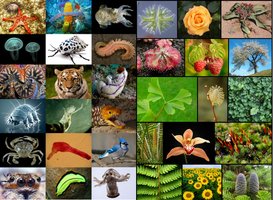
The diversity of life on Earth is immense, with approximately 1.8 million species named and estimates of total species ranging from 10 million to over 100 million. Despite this diversity, there is a fundamental unity among all living organisms, reflected in shared cellular structures and the universal genetic language of DNA. Understanding and organizing this diversity is a central goal of biology.
Systematics and Taxonomy
Systematics is the scientific discipline focused on classifying organisms and determining their evolutionary relationships. Taxonomy is the ordered division and naming of organisms, providing a universal language for scientists. Phylogeny refers to the evolutionary history of a species or group of related species, while cladistics is a method within systematics that groups organisms by common descent.
Systematics: Organizes biological diversity into an "organized whole" based on evolutionary relationships.
Taxonomy: Provides a hierarchical framework for naming and classifying organisms.
Phylogeny: Traces the lineage and evolutionary history of species.
Cladistics: Groups organisms based on shared derived characteristics and ancestry.
Classification Systems
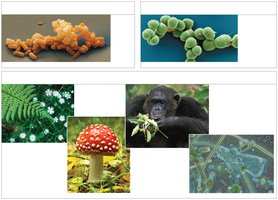
Classification is essential for organizing the vast diversity of species in a logical manner. Early systems divided life into two kingdoms (plants and animals), later expanding to five kingdoms. The current system recognizes three domains: Bacteria, Archaea, and Eukarya. Domains Bacteria and Archaea include prokaryotes, while Eukarya encompasses all eukaryotic organisms.
Hierarchical Classification
The taxonomic hierarchy organizes life from broad to specific categories:
Domain
Kingdom
Phylum
Class
Order
Family
Genus
Species
Each level is called a taxon. For example, the scientific name Homo sapiens refers to the human species, with Homo as the genus and sapiens as the specific epithet.
Binomial Nomenclature
Binomial nomenclature is the two-part scientific naming system for species, developed by Carolus Linnaeus. The first part is the genus (capitalized), and the second is the specific epithet (lowercase). For example: Homo sapiens, Felis catus, Panthera leo.
Phylogenetic Trees
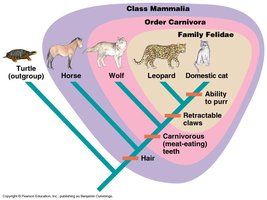
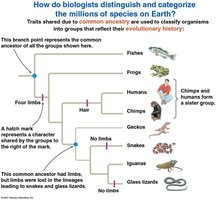
Phylogenetic trees are branching diagrams that depict evolutionary relationships among species. They show patterns of descent and help identify genetic similarities, which indicate closer evolutionary relationships. The "tree of life" model suggests that eukaryotes and archaea are more closely related to each other than to bacteria.
Homology vs. Analogy
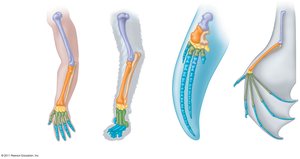
Homology refers to similarity due to shared ancestry, while analogy is similarity due to convergent evolution (independent adaptation to similar environments). Homologous structures are more likely when similarities are complex and supported by fossil evidence.
Homology: Example – The forelimbs of humans, cats, whales, and bats share a common skeletal structure due to shared ancestry.
Analogy: Example – The wings of bats and insects serve similar functions but evolved independently.
Convergent and Divergent Evolution
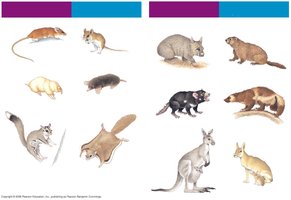
Convergent evolution occurs when unrelated organisms independently evolve similar traits due to similar environmental pressures. Divergent evolution is the accumulation of differences between closely related populations, potentially leading to speciation.
Cladistics and Clades
Cladistics groups organisms by common descent, identifying clades—groups that include an ancestral species and all its descendants. Clades are monophyletic. Other groupings include:
Monophyletic group (clade): Includes ancestor and all descendants.
Paraphyletic group: Includes ancestor and some, but not all, descendants.
Polyphyletic group: Includes species from different ancestors.
Using Phylogenetic Trees as Hypotheses
Phylogenetic trees are hypotheses that best fit available data, including morphological, molecular, and fossil evidence. As new data emerge, these trees may be revised to reflect improved understanding of evolutionary relationships.
Summary Table: Taxonomic Hierarchy Example
Taxonomic Rank | Example (Panthera pardus) |
|---|---|
Domain | Eukarya |
Kingdom | Animalia |
Phylum | Chordata |
Class | Mammalia |
Order | Carnivora |
Family | Felidae |
Genus | Panthera |
Species | Panthera pardus |
Key Terms and Concepts
Systematics: Study of biological diversity and evolutionary relationships.
Taxonomy: Science of naming and classifying organisms.
Phylogeny: Evolutionary history of a species or group.
Cladistics: Method of classification based on common ancestry.
Homology: Similarity due to shared ancestry.
Analogy: Similarity due to convergent evolution.
Clade: Monophyletic group including ancestor and all descendants.
Additional info:
Modern systematics increasingly relies on molecular data (DNA, RNA, proteins) to resolve evolutionary relationships.
Phylogenetic trees are dynamic and subject to change as new evidence is discovered.
