뒤로
뒤로Phylogeny and the Tree of Life: Study Notes
스터디 가이드 - 스마트 노트
 자료에 맞춘 맞춤형 노트, 핵심 정의, 예시, 맥락을 확장해 제공합니다.
Chapter 26: Phylogeny and the Tree of Life
Concept 26.1: Phylogenies Show Evolutionary Relationships
Understanding the evolutionary history of organisms is essential for classifying life and studying biodiversity. Phylogeny refers to the evolutionary history of a species or group of related species, while systematics is the discipline focused on classifying organisms and determining their evolutionary relationships.
Phylogenetic tree: A branching diagram representing the evolutionary history of a group of organisms.
Branch point (node): Represents the divergence of two evolutionary lineages from a common ancestor.
Sister taxa: Groups that share an immediate common ancestor.
Basal taxon: A lineage that diverges early in the history of a group and lies on a branch that originates near the common ancestor.
Binomial Nomenclature and Hierarchical Classification
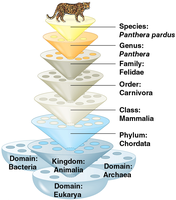
Modern taxonomy, established by Carolus Linnaeus, uses a two-part naming system and organizes species into a hierarchy of increasingly broad categories.
Binomial nomenclature: Each species is assigned a two-part Latin name: the genus (capitalized) and the specific epithet (lowercase), both italicized (e.g., Panthera pardus).
Hierarchical classification: Species are grouped into broader taxa: domain, kingdom, phylum, class, order, family, genus, and species.
Taxon: Any named group at any level of the hierarchy.
Linking Classification and Phylogeny
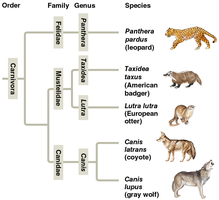
Traditional classification does not always reflect evolutionary relationships. Modern systematics aims to classify organisms based on common ancestry, using phylogenetic trees to represent hypotheses about evolutionary relationships.
DNA and molecular evidence can lead to reclassification of species to better reflect evolutionary history.
Only groups that include a common ancestor and all its descendants (monophyletic groups) should be named.
What We Can and Cannot Learn from Phylogenetic Trees
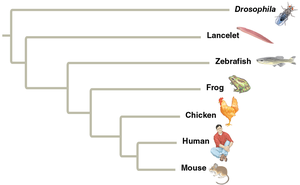
Phylogenetic trees are hypotheses about evolutionary relationships, not direct evidence of phenotypic similarity or the timing of evolutionary events.
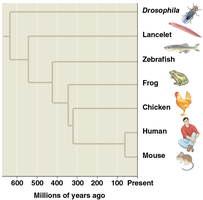
Branching patterns indicate the order of lineage divergence, not the amount of change or exact timing.
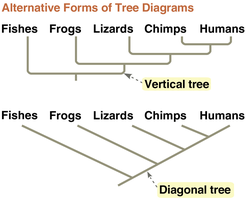
Tree diagrams can be drawn in various orientations without changing their meaning.
Applying Phylogenies
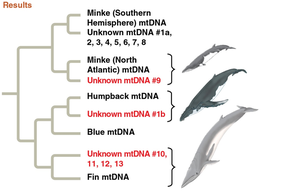
Phylogenetic analysis has practical applications, such as identifying the source of biological samples or tracking the spread of diseases.
Example: Determining the species origin of whale meat using mitochondrial DNA phylogeny.
Concept 26.2: Phylogenies Are Inferred from Morphological and Molecular Data
Systematists use morphological, genetic, and biochemical data to infer evolutionary relationships. Only features resulting from common ancestry (homologies) are useful for constructing phylogenies.
Homology: Similarity due to shared ancestry.
Analogy: Similarity due to convergent evolution, not common ancestry.
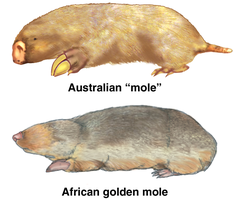
Evaluating Molecular Homologies
DNA sequence alignment is used to identify homologous genes. Insertions and deletions (indels) must be accounted for to avoid missing true homologies.
Statistical tools help distinguish true homologies from coincidental matches.

Concept 26.3: Shared Characters Are Used to Construct Phylogenetic Trees
Cladistics groups organisms by common ancestry. A clade includes an ancestral species and all its descendants. Clades can be nested within larger clades.
Monophyletic group: Ancestor and all descendants (a true clade).
Paraphyletic group: Ancestor and some, but not all, descendants.
Polyphyletic group: Distantly related species but not their most recent common ancestor.
Group Type | Definition |
|---|---|
Monophyletic | Ancestor and all descendants |
Paraphyletic | Ancestor and some descendants |
Polyphyletic | Distantly related species, not including common ancestor |
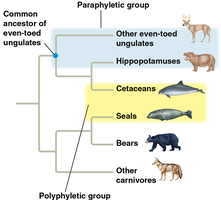
Shared Ancestral and Shared Derived Characters
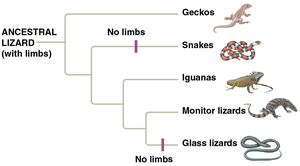
Characters can be ancestral (originated in an ancestor) or derived (evolutionary novelty unique to a clade). The distinction is relative to the group being studied.
Lost features can also be shared derived characters (e.g., loss of limbs in snakes).
Inferring Phylogenies Using Derived Characters
An outgroup is used to differentiate between shared ancestral and derived characters. Each ingroup species is compared with the outgroup to infer evolutionary relationships.
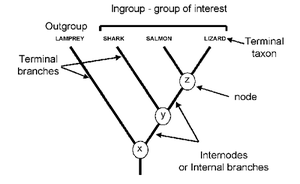
Maximum Parsimony and Maximum Likelihood
Systematists use principles such as maximum parsimony (fewest evolutionary events) and maximum likelihood (most probable sequence of events) to select the best phylogenetic tree.
Computer programs are used to analyze large data sets and identify the most parsimonious and likely trees.
Phylogenetic Trees as Hypotheses
Phylogenetic trees are hypotheses that can be tested. Phylogenetic bracketing predicts that features shared by two closely related groups are present in their common ancestor and all descendants.
Example: Nest building and brooding in dinosaurs inferred from their relationship to birds and crocodiles.
Concept 26.4: An Organism’s Evolutionary History Is Documented in Its Genome
Molecular comparisons can reveal evolutionary relationships even among morphologically dissimilar organisms. Gene duplication increases genetic diversity and leads to gene families.
Orthologous genes: Homology due to speciation; found in different species.
Paralogous genes: Homology due to gene duplication; found within a species.
Gene Type | Definition | Example |
|---|---|---|
Orthologous | Result of speciation; between species | Cytochrome c in humans and dogs |
Paralogous | Result of duplication; within species | Olfactory receptor genes in humans |
Concept 26.5: Molecular Clocks Help Track Evolutionary Time
A molecular clock estimates the absolute time of evolutionary change based on the observation that some genes evolve at a constant rate. The clock is calibrated using fossil data and genetic differences.
Orthologous genes: Substitutions proportional to time since common ancestor.
Paralogous genes: Substitutions proportional to time since duplication.
Some genes evolve at different rates; not all mutations are neutral.
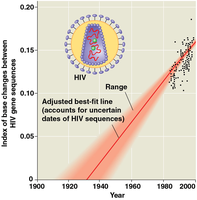
Concept 26.6: Our Understanding of the Tree of Life Continues to Change Based on New Data
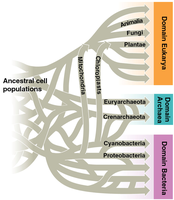
Advances in molecular systematics have led to the adoption of the three-domain system: Bacteria, Archaea, and Eukarya. Horizontal gene transfer complicates the reconstruction of evolutionary history.
Horizontal gene transfer: Movement of genes between genomes, common in early life history.
Some biologists propose representing early evolutionary history as a network rather than a simple tree.